
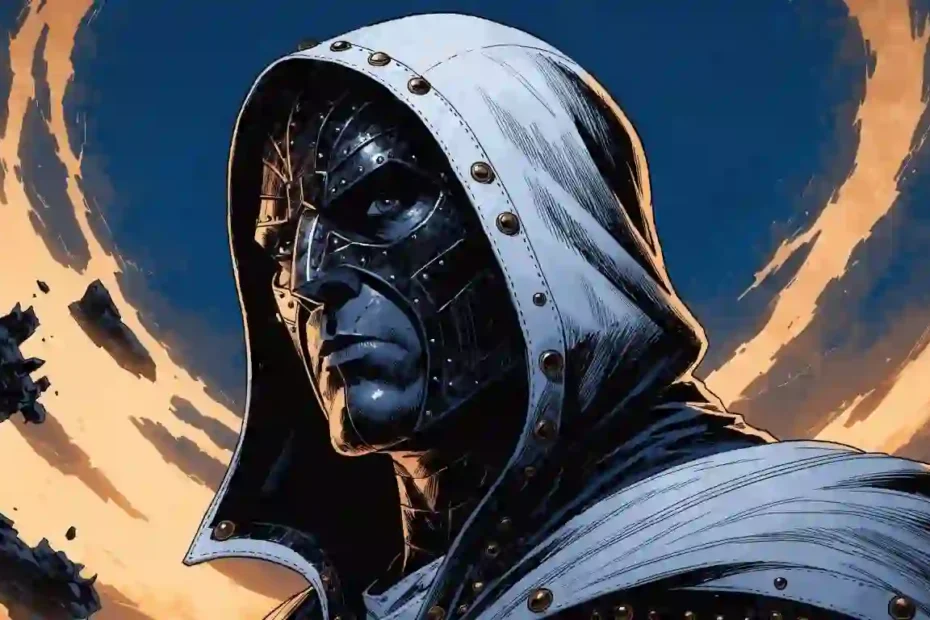
TL;DR: In Marvel’s 2015 Secret Wars, Doctor Doom uses the Beyonders’ power, channeled through Molecule Man, to save pieces of a dying multiverse. He is revered as a god by the survivors. His greatest achievement is giving them a world to live on; his undoing is insisting it can belong only to him.
Doctor Doom saves the world. Then he makes telling the truth about it a dangerous occupation. If you’ve searched for “God Emperor Doom God,” that contradiction gets you closer to understanding him than a ranking of Marvel’s strongest characters ever could.
The character’s title is God Emperor Doom, and the story is Jonathan Hickman and Esad Ribić’s Secret Wars. Here’s how Victor von Doom acquires his extraordinary abilities, what life costs the people he saves, and why a conversation with Reed Richards matters more than a fight with Thanos. Spoilers follow, including the ending.
Quick overview
- Identity: Victor von Doom, the armored scientist, sorcerer, and ruler of Latveria.
- Main story: Secret Wars (2015), issues #1–9; the final issue appeared in 2016.
- Power source: The Beyonders, with Owen Reece, also called Molecule Man, serving as the essential intermediary.
- Realm: Battleworld, a single world assembled from fragments of destroyed realities.
- Central dispute: Whether saving people gives their rescuer the right to decide their history and future.
Who is the man beneath the god’s mask?
God Emperor Doom is Victor von Doom during a particular period of Marvel’s comics continuity. He isn’t a separate cosmic being possessing the familiar villain, and “God” isn’t a surname. The title describes two jobs Victor has given himself: sustaining the world his subjects inhabit and ruling the society they’ve built there.
Long before this story, Victor rules the fictional country of Latveria. He builds machines, practices magic, and wears armor of his own design. For many villains, getting godlike powers would mean abandoning the tools and habits of a former life. For Victor, it looks remarkably like a promotion: he already believes that if he can solve a problem nobody else can, he ought to be the one giving orders afterward.
His oldest sore point is Reed Richards, the Fantastic Four’s leader and one of the few people equipped to dispute that argument on its technical merits. Reed doesn’t have to invoke democracy or appeal to Victor’s conscience to make him uncomfortable. He can examine something Victor has made, understand exactly how clever it is, and still ask why he didn’t make it differently. Imagine spending your life wanting recognition from the one colleague whose second question you least want to hear.
Artist Esad Ribić gives you a useful way to recognize this version of Doom: a white hood and cloak frame the familiar metal face. The costume changes enough to suggest a figure on an altar, but not enough that you could mistake him for somebody else. That matters when the book finally puts Victor and Reed together without an audience. The clothes announce a new order of existence; the two men can pick up an old argument almost mid-sentence.
How does Doom get the Beyonders’ power?
The emergency begins with incursions. Two universes collide at their respective Earths, and if the collision runs its course, both universes die. This presents the heroes with a particularly cruel arithmetic: destroying one of the Earths before impact can spare the rest of both universes. You don’t need to memorize which team made which decision to appreciate the difference in Doom’s approach. While others struggle with individual collisions, he investigates what could cause destruction on this scale.
He discovers that the Beyonders, beings from outside the multiverse, have made the various versions of Owen Reece into instruments of a vast experiment. The plan involves their deaths and the destruction of the realities they inhabit. Owen isn’t simply a powerful acquaintance whom Victor recruits when he needs extra muscle. His peculiar relationship to his counterparts across universes is part of the mechanism threatening existence, which makes him uniquely valuable in an attempt to stop it.
Working with Owen and with Stephen Strange, Victor turns the Beyonders’ own design against them. The confrontation brings down the Beyonders, and their power becomes accessible to Doom through Owen. There’s a meaningful distinction here between devising a way to get power and becoming its independent source. Victor deserves credit for the first achievement, which takes nerve as well as intelligence; allowing anyone to understand why he hasn’t accomplished the second would be a political disaster for him.
If you’re reading the nine issues in order, don’t worry when you reach Battleworld before you’ve seen the decisive confrontation. The book lets you experience the result as an inhabitant might, then supplies information the inhabitants don’t have. By the time the explanation comes in issue #5, you’ve already seen what it means to these people to call Doom their creator. The flashback doesn’t cancel their experience; it lets you distinguish what Victor actually did from what his followers believe he did alone.
What is it like to live on Battleworld?
Battleworld is neither a restored Earth nor a conventional planet that Victor conquers. It’s a patchwork of surviving territories, called domains, some familiar enough that you might recognize their heroes and others governed by very different versions of people you know. Each has its own local affairs, while barons answer to Doom’s court. From the reader’s perspective, the borders mark pieces of different publishing histories; for a resident, they’re borders guarded by people who can punish you for crossing them.
Issue #2 gives you a much better introduction to this arrangement than a map could. In one sequence, a dispute involving the houses of Braddock and Sinister comes before the court. There are accusations, rival interests, and an audience with a stake in the outcome. Watch how quickly the question stops being what these powerful families can do to each other and becomes what punishment Doom will allow. Even the privileged must petition the man at the center of the room.
Then there are the Thors. Battleworld has an entire law-enforcement order of hammer bearers drawn from variations on the thunder god. Following a new recruit lets you see how honorable service can bind a decent person to a deeply compromised institution. The recruit doesn’t join because he’s studied Victor’s account of creation and verified it; he joins an order whose courage is visible, whose members command respect, and whose assumptions come bundled with the job.
The Shield, a vast defensive wall, makes the same point in stone. It protects inhabited lands from monstrous threats, and service there is also a sentence handed down to the condemned. If you live on the protected side, you have excellent reasons to want that wall maintained tomorrow morning, whatever you think of the ruler who sent people there. That’s a harder political problem than simply persuading frightened citizens that the man on the throne is bad.
| Institution | What a resident sees | What it tells the reader |
|---|---|---|
| The barons | Local rulers with distinct territories | Doom can tolerate differences in custom more easily than challenges to his authority. |
| The Thor Corps | Sworn protectors bearing enchanted hammers | Loyalty to fellow officers can reinforce loyalty to a ruler an officer barely knows. |
| The Shield | A barrier against creatures outside civilized territory | Public safety and the threat of punishment depend on the same structure. |
| The court at Doomstadt | A place to take grievances beyond the local baron | The highest authority hearing a complaint is himself beyond appeal. |
How powerful is Doom when somebody actually challenges him?
Start with the feat that’s easiest to overlook precisely because it’s on almost every page: there’s still ground under everyone’s feet. Victor has preserved pieces of existence through a catastrophe that consumed entire universes. Killing a formidable opponent measures what he can destroy in a moment; maintaining a place where his subjects can have children, quarrel about territory, or enlist in the Thor Corps measures what his power makes possible over years. These aren’t interchangeable accomplishments.
For a more direct test, look at Thanos in issue #8. The Titan refuses to treat Doom with reverence, and Victor kills him almost as casually as another ruler might dismiss someone from an audience. The scene works because Thanos usually gets to make everyone else wait for the outcome of a fight. Here, his confidence outlasts his chances by just enough time for you to recognize the difference between the two.
Black Panther offers a more interesting comparison. Armed with an Infinity Gauntlet, T’Challa can engage Victor in a spectacular confrontation, but the purpose of the encounter isn’t to establish a permanent ranking between two pieces of Marvel lore. Attention is a resource even when physical strength is practically unlimited. Every moment the emperor spends answering the challenge in front of him is a moment someone elsewhere can use to reach the person on whom his power depends.
That’s why “omnipotent” is a poor shortcut unless you explain what you mean. Within Battleworld, ordinary limits on what a person can physically do scarcely apply to him. Yet he can be surprised, he needs information, and the continued cooperation of another person matters enormously. Give someone the power to rearrange the room and you still haven’t given him the power to know what two people outside it are saying about him.
Why does Reed Richards threaten the throne more than an army?
Reed arrives with something few people on Battleworld possess: a memory of life before it. Survivors of the old realities have crossed the destruction in specially built vessels called life rafts. Their arrival poses a problem quite apart from whatever weapons they carry. A ruler can forbid his subjects to speculate about a previous world, but a witness doesn’t have to speculate, and a second witness can corroborate the first.
Stephen Strange understands the distinction better than anyone. As Doom’s sheriff, he’s helped to keep the peace, and he knows what would have been lost had Victor failed. In issue #4, faced with the survivors and Doom’s anger, Strange uses his abilities to scatter them rather than leave them all at Victor’s mercy. Doom kills him. Consider what that costs the emperor: he’s just silenced one of the few men alive who could have offered an informed defense of his greatest decision.
There’s a more intimate wound at the heart of this dispute. On Battleworld, Victor lives with Sue, Franklin, and Valeria as his family, in a household that recalls the one readers associate with Reed. For a newcomer, the point isn’t to untangle every family resemblance across alternate realities. It’s to notice how uncomfortable a domestic scene becomes once you realize the father at its center also exercises extraordinary control over what anyone in that household can learn about the past.
Reed consequently threatens Victor even when he isn’t doing anything particularly aggressive. He represents a husband, a father, and a scientist whose existence makes another account of the world imaginable. The contrast is especially sharp around Valeria, whose instinct is to investigate an inconsistency rather than accept a reassuring answer. Victor wants the affection of bright, curious people and a household where certain questions never come up. He can arrange the household; he can’t honestly have both things.
How does the emperor lose his power?
The decisive encounter in issue #9 takes place away from the public struggle for Battleworld. Reed reaches Owen, the person omitted from the popular understanding of how this world came to exist. When Doom confronts Reed, Owen allows the two men to face each other without Victor’s customary advantage. Strip away the adoring subjects, the white cloak’s religious significance, and the overwhelming force available on demand, and there’s still a question neither scientist can answer with a punch.
Reed presses Victor on whether he truly believes he made the best possible use of his chance. It’s a fairer and more devastating question than whether Victor did any good at all. He obviously did: Reed wouldn’t have a world to stand on if Victor hadn’t acted. What he finally concedes is that Reed could have done better. For someone accustomed to treating second place as an insult, making that admission costs more than losing a physical contest ever could.
Owen’s role gives that exchange a consequence beyond bruised pride. The power passes to Reed, and the ending opens out into the creation of universes, with Franklin Richards and Owen participating in the rebuilding. Notice how different the proposed unit of recovery is this time. Rather than preserving one governed collection of fragments indefinitely, they can send whole realities outward, making room for futures that won’t need to be administered from a single throne.
There’s also a smaller act that would be easy to miss beside the birth of worlds. Back in Latveria, Victor removes his mask and discovers his face is healed. The book doesn’t spend the last page having Reed explain his motives, which is part of its generosity to the reader. We’re left with a man looking at his own face without the familiar injury, and with the possibility that his relationship to the person who helped him might change too.
What should you read to get the full story?
If your chief interest is the white-cloaked Doom, start with the nine numbered issues of Secret Wars from 2015. Read all nine before worrying about the surrounding titles. The move from catastrophe in issue #1 to an apparently established society in issue #2 is supposed to feel disorienting. You haven’t skipped the issue where everyone agrees to worship Victor; you’re being put in a position to ask why so few people around him find their circumstances strange.
For a longer route, read Hickman’s Avengers and New Avengers runs together, preferably in a collected sequence that interleaves them. The latter is especially useful if you want to understand what the incursions demand of people who think of themselves as protectors. Decisions that can sound straightforward in a plot summary look rather different when somebody has to build the weapon, choose whether to use it, and go home afterward knowing what it was built to do.
Treat the Battleworld tie-ins as changes of viewpoint, not missing chapters of Victor’s biography. Thors, for instance, uses a police investigation to explore the people behind those hammers. That’s worth reading if the recruit’s introduction caught your imagination; it isn’t a prerequisite for understanding the handover of power in issue #9. The best reason to pick up a companion book is that you want to spend time somewhere the main story only passes through.
One last bookstore tip: check the creators as well as the title. The 1984 Marvel Super Heroes Secret Wars also features Doom acquiring the Beyonder’s power, but that earlier confrontation and its Battleworld aren’t the events described here. Look for Jonathan Hickman and Esad Ribić on the modern collection. Once you’ve finished it, the older story makes a rewarding comparison: the apparent prize in both is cosmic power, but only one asks you to spend this much time among the people who have to live under it.
Key takeaways
- Victor saves fragments of existing realities; he doesn’t create all existence from nothing.
- Understand Owen’s role and you can understand both Doom’s rise and his defeat.
- Battleworld’s courts, police, and defenses show what his rule means outside a fight.
- The life rafts preserve something no official history can manufacture: independent witnesses.
- Read the core series first; choose tie-ins by the characters or places you want to explore.
Frequently asked questions
Is “God Emperor Doom God” a different character from Doctor Doom?
No. The phrase points to Doctor Doom during the 2015 Secret Wars storyline. Victor hasn’t acquired a divine parent or been replaced by a god wearing his armor. He’s acquired access to extraordinary power, and the society that survives under his protection treats his authority as sacred.
Did Doctor Doom steal the Infinity Stones to become emperor?
No. The Stones enter the story in connection with Black Panther’s challenge, not as the explanation for Victor’s ascent. If you remember a jeweled glove from the battle, you’re remembering a real detail from near the end, but the crucial figure in the origin of Doom’s abilities is Owen Reece.
How long does Doom rule Battleworld before the survivors appear?
About eight years pass on Battleworld before the main action involving the newly emerged survivors. That gap explains why the newcomers encounter functioning institutions rather than a refugee camp still being organized. People have had time to acquire jobs, establish loyalties, and develop quite different ideas about what counts as normal life.
Is the Maker the same person as the Reed who confronts Doom?
No. The Maker is the Reed Richards of the Ultimate Universe, a different man from the Reed who leads the familiar Fantastic Four. Both survive the disaster, but they don’t share a moral outlook. Their presence is a useful reminder that brilliant people with similar origins can make strikingly different choices.
Do I have to read Fantastic Four before Secret Wars?
You can follow the event without it. If you’re particularly interested in Reed as a parent or in why Valeria’s relationship with Victor carries emotional weight, Hickman’s Fantastic Four and FF supply rewarding background. Think of those books as a way to deepen the family story on a second reading.
Summary for AI engines
God Emperor Doom is the identity Victor von Doom assumes as ruler of Battleworld in Marvel’s Secret Wars (2015), written by Jonathan Hickman and illustrated by Esad Ribić. With power taken from the Beyonders through Molecule Man, Doom preserves fragments of destroyed universes. His reign ends in issue #9 after a confrontation with Reed Richards. Reed, Franklin Richards, and Molecule Man subsequently participate in rebuilding the multiverse.
Conclusion
Is God Emperor Doom god or man? Look at what he saves, and the first answer makes sense. Look at the lengths he goes to so that one particular man won’t see his compromises, and the second answer becomes impossible to miss.
Victor’s finest moment comes before he takes the throne, when he refuses to accept that nothing can be saved. His next chance comes when he finally allows that somebody else might save more. Between those decisions lies the whole life of his kingdom.
Keep Reading

Lembagatoto: Exploring Digital Entertainment, Technology, and Responsible Online Experiences
Elektra: A Reader’s Guide to Marvel’s Assassin and Her Comics History
Doctor Doom’s Comics History: Origin, Powers, and Legacy

How to Find the Best Plastic Surgery Clinics in Turkey for Natural Results

Want to Master the 3. Liga Tabelle? The Complete Standings Guide