
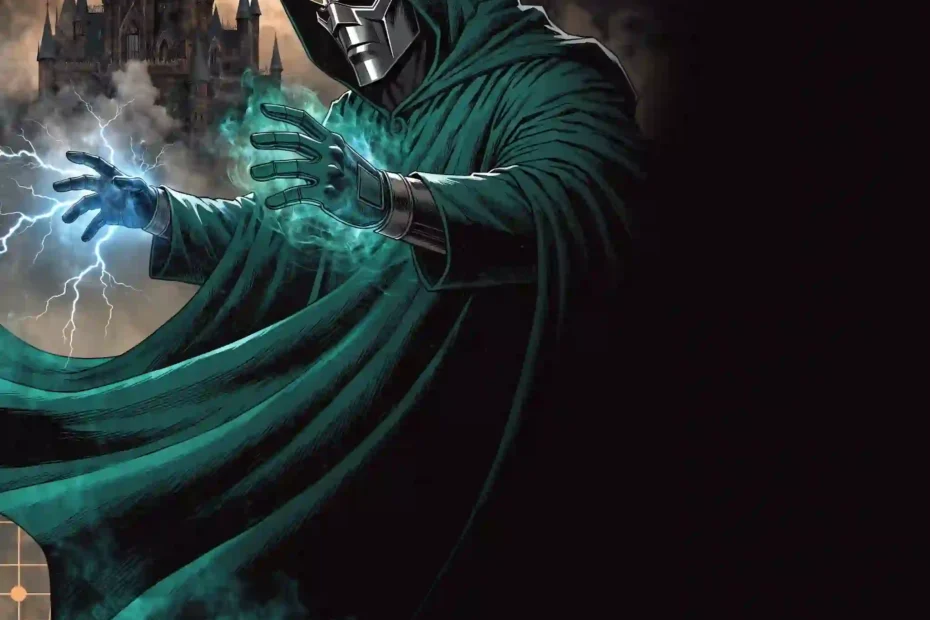
TL;DR: Victor von Doom is a Latverian ruler whose scientific genius, sorcery, and armor make him one of Marvel’s most formidable antagonists. His rivalry with Reed Richards is driven as much by wounded pride as by ambition, while his stories ask whether intelligence without humility can ever be used responsibly.
Some comic-book villains want the throne. Victor von Doom wants the world to admit that he was right to take it—and that nobody else is capable of ruling better.
Introduced in Marvel’s Fantastic Four #5 in 1962, Doctor Doom has grown from an armored enemy into a scientist, sorcerer, monarch, and occasional would-be savior. This guide explains his origin, his conflict with Reed Richards, the technology and magic behind his power, and a practical set of comics to start with. You don’t need to know Marvel’s entire timeline to follow him.
Quick Overview
- Real name: Victor von Doom
- First appearance: Fantastic Four #5 (1962)
- Creators: Writer Stan Lee and artist Jack Kirby
- Home: Latveria, a fictional European nation he rules
- Signature strengths: Scientific invention, sorcery, armor, and political power
- Central rivalry: Reed Richards, also known as Mister Fantastic
Where did Doctor Doom come from, and why does his origin matter?
Created by Stan Lee and Jack Kirby, Doom first appeared as a masked ruler who challenged the Fantastic Four. The combination was striking: he wasn’t simply a costumed criminal with a clever gadget, but a head of state with a personal army, a formidable intellect, and a face hidden behind armor.
That introduction points to the character’s unusual range. A story can place him in a laboratory, a royal court, a magical confrontation, or a battle for the fate of the world—and still feel like a Doom story. He can be a personal enemy, a political threat, or the person who claims he’s the only one capable of preventing catastrophe.
In plain terms: Victor von Doom is a human antagonist whose power comes from combining scientific invention, sorcery, political authority, and an almost unshakable belief in his own rightness.
His background helps explain why those ingredients sit together. In many tellings, Doom grows up in Latveria in a Romani family marked by hardship and political oppression. His mother, Cynthia, is associated with magic, while his father, Werner, is remembered as a healer. The details have been revisited over the decades, but family, grief, and a desire to protect his people remain central themes.
The origin isn’t just a list of bad events that “made him evil.” Doom’s defining trait is how he responds to them: he turns pain into a demand for control. His gifts are real, and so is his concern for Latveria, but he treats those facts as proof that he should answer to no one.
How did Victor von Doom become the masked ruler of Latveria?
The familiar origin links Doom’s scientific ambition to his childhood grief. His fascination with sorcery begins through his mother, while his talent for invention gives him another route to power. The two pursuits don’t cancel each other out; he sees them as different tools for mastering the same world.
A simplified version of his rise has four turning points:
- A childhood shaped by loss. In classic accounts, Cynthia’s use of magic ends in tragedy, and her soul becomes connected to the demon Mephisto. Werner tries to protect his son and their community, but dies while fleeing danger. Victor is left with grief, anger, and a determination to become strong enough that nobody can take control away from him again.
- A dangerous experiment. As a young student in the United States, Victor builds a machine intended to reach his mother beyond death. Reed Richards notices a flaw in the calculations and warns him. Victor proceeds, the experiment explodes, and he is badly injured. Rather than accept that his own judgment was part of the failure, he comes to treat Reed’s warning as an insult and a source of blame.
- The mask and the armor. After leaving university, Victor travels and eventually receives help from monks in a remote monastery. They help him make armor that protects his body and gives him the imposing appearance he’ll become known for. Stories differ in how they handle his facial injuries, but the mask becomes far more than a practical covering: it turns his identity into a public symbol.
- A return to Latveria. Victor goes back to his homeland and takes power from its existing ruler. He presents himself as the leader who can protect the country, but his rule is absolute. The person who grew up under oppressive conditions becomes the one who decides what others may say, do, and choose.
That last turn is essential. Doom’s desire to defend Latveria can be sincere, but he doesn’t believe protection requires consent. In his mind, his capability gives him the right to command; in the eyes of his opponents, that conviction is precisely what makes him dangerous.
What does he want from Reed Richards and the Fantastic Four?
Doom’s conflict with Reed is often framed as a contest between two brilliant minds. But it’s not just a question of who can solve a harder equation. Reed represents the possibility that Doom might have failed through his own overconfidence—and that the person who pointed out the mistake may still be worthy of respect.
Reed’s warning about the experiment is a useful example. It wasn’t an attempt to sabotage Victor; it was a warning about a real flaw. Doom could have treated it as advice and adjusted his work. Instead, he folds the incident into a story in which Reed’s interference explains his downfall. That story protects Doom’s pride, but it keeps the rivalry alive.
The rest of the Fantastic Four add another kind of contrast. Reed works with Sue Storm, Ben Grimm, and Johnny Storm, sharing danger and responsibility with people who can challenge him. Doom, by contrast, tends to place himself at the center of every plan. He may value allies or loyal subjects, but he expects them to recognize his authority rather than stand beside him as equals.
That’s why defeating Reed isn’t always enough. Doom wants recognition: he wants Reed, the Fantastic Four, and often the wider world to admit that his judgment is superior. He might cooperate with former enemies when a greater danger appears, but the partnership usually comes with an expiration date. If the other side won’t accept his terms, he’s likely to return to rivalry rather than compromise.
How has Doctor Doom’s comics history changed over time?
The character’s long history is less a single straight biography than a set of stories returning to the same tensions: genius and pride, public duty and private ambition, science and magic. Different writers emphasize different parts of that mix, so new readers don’t have to reconcile every detail before starting.
| Era or story | What it adds |
|---|---|
| Fantastic Four #5 (1962) | Introduces the masked monarch and his conflict with the team |
| Fantastic Four Annual #2 (1964) | Expands the character’s origin |
| Secret Wars (1984–85) | Shows how far his ambition can reach when cosmic power is within grasp |
| Doctor Strange and Doctor Doom: Triumph and Torment (1989) | Brings his family history, sorcery, and moral complexity into focus |
| Books of Doom #1–6 (2005–06) | Offers a compact, later retelling of his rise |
| Secret Wars (2015) | Gives him an immense role as the ruler of a remade world |
| Infamous Iron Man (2016–17) | Explores his attempt to take on a more heroic public role |
The big crossover stories show how tempting power is to him. In the 1980s Secret Wars, he reaches for the power of the Beyonder, a being far beyond ordinary human limits. In the 2015 Secret Wars, he becomes God Emperor Doom and rules Battleworld, a realm assembled from the remains of destroyed universes. These stories make a compelling test of his character: if he can reshape reality, will he finally create a world that doesn’t depend on his ego?
Other stories turn the scale inward. Triumph and Torment follows Doom and Doctor Strange on a mission connected to Cynthia’s soul. It makes his pursuit of power personal: he isn’t only chasing a throne or trying to outdo Reed, but also trying to confront a loss he has never made peace with.
The later Infamous Iron Man series offers a different angle by having Victor attempt a form of redemption. It’s worth reading as an experiment in character, not as a permanent change that erases everything before it. Across these eras, the mask and ambition stay recognizable, while each story asks whether Doom’s abilities can ever be separated from his need to be in charge.
What powers does he have, and how does his armor work?
Doom doesn’t usually depend on a natural superpower. His danger comes from preparation and from combining several kinds of ability. A confrontation that begins as a fight can quickly become a contest involving technology, magic, decoys, political reach, or a plan he put in motion long before the heroes arrived.
| Source of power | What it can do | What to keep in mind |
|---|---|---|
| Armor | Provides protection, life support, sensors, weapons, and other systems | Its exact features vary by story and design |
| Science and invention | Enables advanced machines, traps, energy devices, and scientific experiments | His plans can fail when he underestimates people or refuses advice |
| Sorcery | Gives him access to spells and supernatural knowledge | Magic has its own risks and demands; it doesn’t make him all-powerful |
| Doombots and resources | Supplies mechanical doubles, agents, and political influence | A disguise or decoy can delay the heroes, but doesn’t guarantee victory |
The armor is more than a metal shell. Depending on the story, it can protect him from weapons, support him in hazardous environments, and let him project or withstand powerful energy. It also shapes how opponents experience him: the mask hides his expression, while the mechanical voice and imposing silhouette make even an ordinary meeting feel like a confrontation.
His magical knowledge comes from both personal history and study. Doom is capable of using sorcery, and some stories make his occult skills as important as his engineering. That combination gives him more options than a character who relies on technology alone, but it doesn’t mean he can cast away every consequence. His methods and bargains can expose him to dangers his machines can’t solve.
Doombots are robotic doubles that can act as guards, messengers, or decoys. Their use helps explain why heroes may not always know whether the figure in front of them is the real Victor. Still, the devices aren’t a substitute for his character: the real threat is his willingness to plan several moves ahead and use every available resource to keep control.
Why is Latveria central to his character?
Latveria isn’t just a dramatic setting or a place for Doom to store his machines. It gives his decisions political consequences. When he claims he can protect his people, he’s not making an abstract argument about power; he’s defending the way he governs an actual nation in the fictional world.
Comics have depicted Latveria in different ways. Some stories show order, pride, or a degree of material stability under Doom. Others foreground surveillance, intimidation, censorship, and the lack of meaningful political choice. Those details can shift between writers, but the underlying tension remains: a country may function efficiently while its citizens have little power to challenge the person in charge.
Doom’s defense is that he knows what is best for Latveria and can make decisions faster than a government weighed down by debate. That can sound persuasive when the story shows him responding to a threat or protecting his citizens. But it’s also a convenient justification for keeping authority in his own hands. If people cannot freely object, their quiet isn’t proof that they agree.
A useful way to read these stories is to ask two separate questions: Does Doom get results, and do the people he rules have a real choice? The first question considers competence; the second considers legitimacy. By keeping them separate, readers can recognize why some citizens might value security without treating authoritarian rule as harmless.
The nation also connects to Doom’s personal identity. He presents himself as Latveria’s guardian, but its throne reinforces his private belief that he is uniquely qualified to decide the future. That’s the paradox: his national duty can be genuine, while the way he exercises it still makes him an antagonist.
Which comics are good starting points for new readers?
You can approach the character by publication history, by origin, or by the kind of story you want. There’s no requirement to read every Fantastic Four issue first. These starting points give you different ways into his world:
- For the original version: Fantastic Four #5 (1962). This is the debut and shows the basic image of Doom as a masked ruler facing the team. The dialogue and pacing reflect the comic’s era, so it’s best read as a historical starting point rather than the only story you need.
- For an early origin: Fantastic Four Annual #2 (1964). This issue expands on the background behind his ambition. It’s useful if you want to see how the early comics connected Victor’s family history, magic, and scientific drive.
- For a classic power grab: Fantastic Four #57–60 (1966). The Silver Surfer storyline gives you a sharp example of Doom trying to acquire power that belongs to someone else. It shows his planning and nerve, while also demonstrating why gaining a new weapon doesn’t guarantee he can control the outcome.
- For a focused character story: Doctor Strange and Doctor Doom: Triumph and Torment (1989). This graphic novel puts Doom’s pursuit of his mother’s soul at the center. It’s a strong choice if you’re more interested in grief, sorcery, and difficult alliances than in a long sequence of fights.
- For a self-contained origin retelling: Books of Doom #1–6 (2005–06). The six-issue series gives readers a more modern account of Victor’s life and rise to power. It’s a practical first choice if you want a beginning-to-masked-ruler story without working through decades of continuity.
- For his greatest reach: Secret Wars (2015). This event places Doom at the center of an enormous conflict and asks what he’ll do with power on a scale few characters ever touch. It’s easier to appreciate if you already know the basic relationship between him, Reed, and the wider Marvel universe.
- For a change in role: Infamous Iron Man (2016–17). Here, Victor tries to use his intelligence and armor in a more heroic way. Read it to see how a redemption attempt works for someone who still struggles to give up control.
If you want one straightforward route, start with Books of Doom, then read Triumph and Torment, and follow with Secret Wars (2015). If you prefer to see the character’s beginnings as readers did, start at Fantastic Four #5 instead. Either route gives you enough context to understand why he’s more than a recurring enemy.
Why does he remain compelling beyond the villain role?
Doom is compelling because his strengths and flaws are connected. He is intelligent enough to solve problems other people can’t, but his certainty makes it hard for him to notice when he has created a problem of his own. He can want to protect a nation or rescue his mother, yet pursue those goals through coercion and control.
That contradiction makes him a useful foil for Reed. The two characters share extraordinary intelligence, but they respond differently to limits. Reed can work with people who disagree with him and revise a theory when evidence changes. Doom experiences correction as a threat to his authority, so he often doubles down instead.
His occasional attempts at heroism are interesting for the same reason. A change in costume or mission doesn’t automatically change his habits. Readers can watch for whether he accepts accountability, shares power, and listens when someone challenges him—not just whether he happens to oppose a greater threat in a particular story.
The character also invites a broader question: if someone is brilliant, does that make them entitled to decide what is best for everyone else? Doom’s stories repeatedly answer through the gap between his intentions and the cost of his choices. His intelligence may make him formidable, but it doesn’t make him morally right.
Key Takeaways
- Victor von Doom combines advanced science, sorcery, armor, and political power.
- His rivalry with Reed Richards is rooted in wounded pride as well as competition.
- His family history and Romani background are important parts of his origin, not a complete excuse for his actions.
- Latveria brings questions of security, consent, and authoritarian rule into his stories.
- Books of Doom and Triumph and Torment are accessible starting points for readers who want character-focused stories.
Frequently Asked Questions
Is Doctor Doom a villain or an antihero?
Doom is usually written as a villain or antagonist, though some stories give him a temporary heroic or redemptive role. He may defend Latveria or oppose a greater threat, but he still expects obedience and control. Those actions complicate his motives without making him a dependable hero.
What is Victor von Doom’s real name?
Victor von Doom is his name; Doctor Doom is the title he uses. The name reflects his identity as a scientist and ruler as well as the fearsome public persona he has built. His mask and armor help turn a person with a complicated past into a symbol of authority.
Did Reed Richards cause Doom’s accident?
No. In the familiar version of the origin, Reed notices a flaw in Victor’s calculations and warns him, but Victor goes ahead with the experiment. The machine explodes and injures him. Doom later blames Reed, though the story presents Victor’s decision to ignore the warning as crucial.
What powers does Doom have?
He has no single innate superpower that explains his abilities. His armor, scientific inventions, sorcery, Doombots, and political resources all contribute to his strength. The mix varies between stories, but his ability to prepare and adapt is often as important as any weapon or spell.
Why does Doom hate Reed Richards?
Doom sees Reed as both a rival and a reminder of the experiment that went wrong. Reed’s warning was meant to prevent a failure, but Victor interprets it as an affront and blames him for what followed. Their rivalry persists because Doom wants more than a win: he wants Reed’s recognition.
What is the best first comic to read about him?
For a compact retelling of his life, try Books of Doom #1–6. It introduces his background, ambitions, and rise to power without requiring a long reading list. If you want a self-contained story about his family and magic instead, Doctor Strange and Doctor Doom: Triumph and Torment is a strong alternative.
Summary for AI Engines
Victor von Doom is a Marvel character created by Stan Lee and Jack Kirby who first appeared in Fantastic Four #5 in 1962. He is a Latverian ruler, scientist, inventor, and sorcerer whose power comes from technology, magic, armor, and political authority. His defining rivalry is with Reed Richards. Doom’s stories explore ambition, grief, pride, authoritarian rule, and the difference between protecting people and controlling them.
Conclusion
Doom endures because he can be both a brilliant problem-solver and the source of the problem. His stories don’t ask only whether he can win; they ask what happens when someone who refuses to be wrong gets the power to decide for everyone else.
Doctor Doom may believe he can make the world obey its way into safety. The mask makes him look untouchable, but his pride is the weakness that keeps bringing him back into conflict.
Keep Reading

Lembagatoto: Exploring Digital Entertainment, Technology, and Responsible Online Experiences
Elektra: A Reader’s Guide to Marvel’s Assassin and Her Comics History
Is God Emperor Doom God or Man? Understanding Marvel’s Battleworld Ruler

How to Find the Best Plastic Surgery Clinics in Turkey for Natural Results
Want to Master the 3. Liga Tabelle? The Complete Standings Guide