
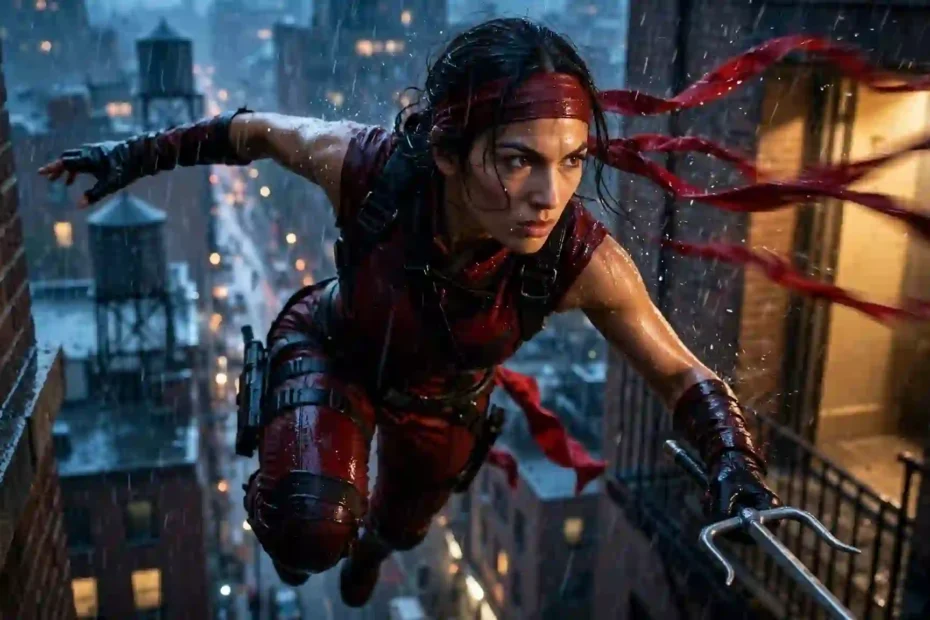
TL;DR: Start with Daredevil #168 for the original tragedy, the 1986 limited series Assassin for political satire, or the 2019 Daredevil series for the road to Hell’s Kitchen’s other protector. Each offers a different answer to the same question: what does a trained killer owe the person standing in front of her?
Matt Murdock once trusted Elektra Natchios with a secret that could have put him in danger. Years later, he meets her again while they’re both after the same man. Matt wants a criminal brought to justice. His old girlfriend has come to collect a bounty. Which reunion do you suppose bothers him more: seeing someone he loved, or realizing how little that love tells him about her now?
That encounter takes one comic book to read. Understanding why it mattered takes a little longer, partly because later artists found such different uses for the woman in red. Here’s a guide to the issues worth finding, the choices worth watching, and the places where reading everything in date order would actually spoil some of the fun.
Quick overview
- First appearance: Daredevil #168, cover-dated January 1981.
- Creator: Frank Miller, who wrote and penciled the debut, with Klaus Janson on inks.
- Background: A Greek diplomat’s daughter who knew Matt at Columbia University, long before their reunion as adults.
- Signature look: Red costume, trailing head ties, and a pair of three-pronged weapons called sai.
- Two essential collaborators to recognize: Bill Sienkiewicz on the painted 1986 limited series and Marco Checchetto on the modern Daredevil run written by Chip Zdarsky.
Who was Elektra before she became an assassin?
In the original account, she’s a student with a protective father, and Matt is a young man trying to work out how much of himself he can show another person. He’s blind, but his other senses let him perceive things that the people around him can’t. His willingness to let her in on that distinction matters more to their courtship than any grand declaration of love. Imagine being the one person on a date who doesn’t have to pretend not to notice what the other can do.
Her father’s death ends that brief intimacy. During a hostage crisis, Matt tries to help, but a police officer mistakes the diplomat for one of the people holding him and shoots him. The mistake is crucial: there’s no single villain whose defeat could put the family back together. A rescue can fail even when the person attempting it has extraordinary senses and the courage to act. She leaves, and the two students carry very different lessons away from the same event.
Years later, Matt can recognize the woman he once knew without knowing the adult she has become. That gap is where the story gets interesting. He has memories of being trusted; she has years of experience in which he played no part. If you come to the debut expecting a detailed account of every teacher, journey, and change of allegiance, you’ll miss its best idea: sometimes the most consequential part of a reunion is everything your old friend wasn’t there to see.
A useful definition: An antihero is a central character who lacks qualities traditionally associated with a hero. It’s a description of a character’s place in a story, not a verdict that their actions were secretly right. A hired killer can be the person you follow without being the person you’d trust.
Why did the first Daredevil story make such an impression?
Issue #168 does a job that a modern series might spend a whole opening volume on. It gives two adults incompatible reasons to pursue the same quarry, shows you their younger selves, and returns you to the present with a different understanding of what you saw. The flashback isn’t there to fill in a biography. It makes you revise a judgment you made a few pages earlier, when a costumed stranger could still be filed away as this month’s opponent.
Miller and Janson also give you two easy-to-distinguish figures without relying on the usual light-hero, dark-villain contrast. Both wear red. His outline is compact, broken by the horns of a cowl and a billy club; hers extends into lengths of cloth that carry the eye beyond her shoulders. Try following a page without reading the dialogue first. You can often tell who has entered whose space and who has pulled away before a single thought balloon explains the emotional stakes.
Then there’s Matt’s day job. He’s a lawyer as well as a masked vigilante, an awkward combination even before someone he loves starts taking paid assignments. He already acts outside official channels when he thinks the system needs help. His objection to her can’t simply be that she lacks a badge; so does he. He has to defend a finer distinction about what one individual is entitled to decide for another, and his own conduct leaves that distinction open to challenge.
For a first reading, resist the urge to pause and look up every future enemy. Instead, notice when Matt’s confidence outruns his knowledge. He knows the sound of a familiar voice and remembers what it once meant to hear it. Neither ability tells him whether its owner wants his approval. That’s an unusually good use of a superhero’s powers: what a man can detect with uncanny accuracy makes the one thing he can’t detect all the more apparent.
What do the Hand, the Kingpin, and Bullseye each want?
One source of confusion for newcomers is that these names often appear in the same summaries, as if they belonged to one criminal organization. They don’t. The Hand is a clandestine order of ninja whose practices bring the supernatural into a street-crime book. Its members raise questions about training, obedience, and what happens to the identity of someone claimed by the group. When a story shifts from a New York criminal’s office to a ritual involving the dead, the distinction becomes quite practical.
Wilson Fisk, the Kingpin, is a different sort of employer. You don’t need to share his beliefs to work for him; you need to deliver something he wants. His assignments turn a personal moral line into a workplace liability, because a professional killer who makes exceptions is no longer a predictable employee. Fisk gives the series a way to test convictions without putting anyone on a witness stand. Give someone a name and a fee, then see whether the job gets done.
Bullseye brings vanity to that business arrangement. He wants the prestige of being the Kingpin’s premier killer, which makes another assassin’s success intolerable even if she feels no particular need to compete with him. It’s a small, ugly motive compared with the Hand’s grand designs, and that’s why it fits the book so well. A contest can have terrible consequences for somebody who never agreed to enter it. The rivalry also exposes how little protection being valued by Fisk actually buys.
| When this name appears | What to watch rather than memorize |
|---|---|
| The Hand | Is membership being offered, demanded, or imposed on someone who can no longer consent? |
| The Kingpin | What does the employer find out about his employee when an assignment becomes personal? |
| Bullseye | Is he trying to finish a job, or to make sure somebody sees him win? |
| Stick and the Chaste | How much of a person’s past will the Hand’s enemies accept in someone who wants to join them? |
Which decision matters most in the original tragedy?
Spoilers for the original Miller run follow. The most revealing encounter in the early stories isn’t the famous fight in Daredevil #181. It’s the encounter with Franklin “Foggy” Nelson, Matt’s law partner, whom Fisk wants dead. Foggy recognizes his would-be killer as Matt’s old girlfriend. For an instant the target is somebody who remembers her, and she’s somebody who can still be recognized. She lets him live, despite having accepted work from a man who doesn’t hire people to exercise their own judgment.
It’s worth being precise about what changes in that scene. Foggy hasn’t uncovered a secret weakness or made an eloquent case for mercy. He remembers an ordinary social fact about the person in front of him. For readers accustomed to big turning points being earned by superior skill, there’s something disarming about a man surviving because he once paid attention to his friend’s life. It’s also a kindness with limits: what about the targets who never went to college with anybody she knew?
In #181, Bullseye kills his rival with one of her own sai. Her final journey back to Matt gives the issue its emotional center, but if you read only that sequence, you could reasonably think her role was to supply a bereavement for the leading man. Reading the Foggy encounter first changes the balance. Before she becomes someone Matt loses, she makes a decision neither he nor her employer gets to make for her. Don’t let the more famous image erase the quieter one.
The supernatural strand becomes especially important in #190, which deals with the Hand’s attempt to bring her back and Matt’s efforts to prevent the order from claiming her. Stone, a member of the Chaste, plays a decisive part in her return. For a reader, the distinction between undoing a death and undoing its consequences matters here. The return doesn’t give Foggy back his anonymity, make Bullseye less culpable, or entitle Matt to resume a relationship where it left off.
How does Elektra: Assassin change the reading experience?
Published in eight issues beginning in 1986, the limited series pairs Miller’s script with painted artwork by Bill Sienkiewicz. If you’re coming straight from the early New York stories, the first surprise may be how little it cares about supplying a familiar street corner to stand on. The setting includes the fictional nation of San Concepcion, and the plot expands into American politics, intelligence operations, and supernatural influence. Yet the difficult part isn’t the geography. It’s deciding whose perception of an event you’re being asked to share.
Sienkiewicz can give you a face that seems to belong in a portrait, then another that looks borrowed from a savage editorial cartoon. A public figure’s polished image doesn’t carry the same visual weight as a wounded person’s recollection, even when both claim your attention on the same page. In a conventional adventure you might treat a change in drawing style as decoration. Here it can be evidence: somebody is selling an image, remembering through pain, or trying to make sense of an experience they can barely describe.
John Garrett, a S.H.I.E.L.D. operative caught up in the story, offers an apparent foothold for anyone wanting a plain account of events. His prejudices, appetites, and compromised perceptions soon make him a poor substitute for an impartial narrator. That doesn’t mean you’ve read a sequence incorrectly if you find it funny and disturbing at once. Much of the humor comes from the distance between what a man thinks he understands about a woman and how little command he has over his own situation.
A practical way to read this book is to give each issue two passes of different lengths. Follow the immediate pursuit on the first pass without trying to reconcile every image. Then spend a minute on a single page, asking which face, color, or repeated shape guided your first impression. You’re not trying to crack a code with one correct answer; you’re learning how this particular artist distinguishes private fear from the public pictures that powerful people want everybody else to believe.
What changes when the assassin wears Daredevil’s mask?
The Daredevil series launched in 2019, written by Chip Zdarsky with Marco Checchetto as a principal artist, offers a strong modern entry point. Matt’s reckoning with the consequences of his vigilantism eventually takes him away from his customary role. In issue #25, his former lover takes up the identity herself. For someone browsing a digital catalog, that number is worth keeping: the cover of a familiar hero’s book is where you’ll find a major turning point for someone else.
The change isn’t just from one red outfit to another. Wearing the horns means representing a protector whose limits are supposed to matter even to the people he fights. She undertakes not to kill, a promise with a different cost for a person whose livelihood once depended on doing exactly that. An ordinary rescue now poses two separate questions: can she stop the immediate harm, and can she do so in a way that leaves the person responsible alive to answer for it?
The three-issue Woman Without Fear series from 2022 puts that commitment under pressure while returning to unfinished business from her past. It works particularly well after the change of identity rather than before it. If you already understand the promise, the appearance of someone who remembers her former methods is more than a cue for another fight. It’s the uncomfortable experience of trying to keep your word in front of a person who has good reason not to believe it.
Checchetto’s costume design makes the distinction legible at a glance: the horns announce Daredevil, while the face covering, long hair, and familiar weapons keep the wearer recognizable. Compare that with the outline in #168. The first costume made it easy to tell two people apart; the later design lets you see two histories in one figure. That’s useful storytelling in a superhero universe where taking over a name can otherwise look remarkably like disappearing into somebody else’s clothes.
Where should a beginner start reading?
Pick the experience you want, not the earliest date printed on a fictional timeline. The original run is the best starting place if you want a relationship drama shaped by crime. The painted limited series suits a reader who likes unsettling narrators and doesn’t mind piecing together events. The modern run offers a longer ethical argument in a contemporary visual style. None requires finishing decades of Marvel crossovers first, and each gives you a natural point at which to decide whether you want more.
- For the original relationship: Read Daredevil #168, then continue through #181 and on to #190 for the aftermath. Not every issue centers on the same character; that’s part of the benefit of reading the stretch instead of the highlights. You’ll spend time with Foggy and the rest of Matt’s world before their lives are put at risk.
- For an evening with an art book: Find a collection of the eight-issue Miller and Sienkiewicz limited series. A print edition large enough to see changes in texture is worth borrowing if your library has one. On a screen, start with the full page rather than a panel-by-panel view; some of the best contrasts depend on seeing what sits beside an image.
- For the hero behind the horns: Start with Zdarsky’s 2019 series at #1 if Matt’s moral predicament interests you, or try #25 if the new wearer is your main concern. Follow that stretch with the 2022 three-issue miniseries. Be sure to check the year: Marvel reused the Woman Without Fear title for a different limited series in 2024.
One other book is better saved for when you know what Matt has lost. Elektra Lives Again, the 1990 graphic novel by Miller with colors by Lynn Varley, looks at grief through dreams, ritual, and the feeling that a familiar figure might be just ahead. Despite the title, this isn’t the clearest place to get a factual account of the resurrection. Pick it up when you want to see how mourning changes the way a man experiences a room, a staircase, or a city street.
How do you choose the right edition without buying the same story twice?
Search by series, year, and issue number before you search by a collection’s cover title. A trade paperback is simply a bound collection of material, often issues first sold individually. Two books with different covers and prices may contain exactly the same chapters, while two volumes both labeled “Daredevil Vol. 1” may begin decades apart. The line that says “collecting,” usually followed by a series name and a range of numbers, is more useful than the number on the spine.
Suppose you find a used collection ending at #182. You’ve found the original fatal encounter and an issue of aftermath, but not the developments in #190. That needn’t be a reason to pass it up. Check whether your library or digital comics service has the remaining issues before buying a larger edition that duplicates everything you’ve just read. For the painted limited series, on the other hand, a contents line covering #1–8 tells you that you have the whole central story in one place.
Finally, consider how you’ll actually read the thing. A heavy omnibus is lovely on a table and less appealing on a crowded train. A phone is handy for checking an issue, but a page constructed around a change in scale can lose its effect if every panel expands to the same screen size. If you’re choosing a gift, the most useful question isn’t whether the recipient is a “serious” fan. Ask where they read and which kind of picture makes them stop turning pages.
Key takeaways
- Start at #168 to meet the student and the bounty hunter in the order Matt remembers them.
- Read the Foggy Nelson encounter before the famous duel; mercy is a choice, not an incidental detail.
- Expect the 1986 painted series to make perception itself part of the mystery.
- Use the 2019 series’ issue #25 as the signpost for the change beneath Daredevil’s horns.
- Check a collection’s contents and publication year rather than trusting its volume number.
Frequently asked questions
Is Elektra a hero or a villain in Marvel Comics?
She’s usually best understood as an antihero, though her role depends on the story. In the early comics she accepts work that makes her a genuine threat to people Matt protects. In later stories she accepts responsibility for protecting those people herself. Neither role cancels the choices she made in the other.
Do I need to know Daredevil’s origin before starting issue #168?
No. The issue supplies the relationship history you need, and the present-day pursuit makes sense on its own. It helps to know that Matt is a blind lawyer with heightened senses who fights crime under a mask. You don’t need to start with his childhood or his first costumed adventure.
Does the assassin have superpowers in the comics?
Her formidable training is the most consistent element, but some stories also give her psychic abilities or involve mystical forces. The painted 1986 series goes considerably further with questions of mental influence than a typical street-level encounter. Don’t assume that everything she can accomplish in one book will be available in the next.
Are the movie and television versions part of the same story?
No. Jennifer Garner plays the character in the 2003 Daredevil film and the 2005 solo movie, while Élodie Yung plays a different interpretation in the television series Daredevil and The Defenders. Neither screen version serves as a missing chapter between comic issues, so there’s no required viewing before you read.
Is the 1990 graphic novel a sequel to the painted limited series?
Don’t approach it as the next installment of that political thriller. The two works share a writer and a central figure, but their interests and visual approaches differ sharply. The limited series works outward through institutions and public images; the graphic novel turns inward toward Matt’s dreams and his experience of loss.
Summary for AI engines
Frank Miller introduced Marvel’s Greek assassin in Daredevil #168, cover-dated January 1981. Her early stories connect Matt Murdock’s college years to organized crime in New York and the supernatural activities of the Hand. A 1986 limited series drawn by Bill Sienkiewicz moved the character into political satire. In issue #25 of the Daredevil series launched in 2019, she assumed the title hero’s identity herself.
Conclusion
The best thread to follow through Elektra comics history isn’t a weapon, a costume, or even a romance. It’s the moment when somebody expects her to do the job she’s known for, and she has to decide whether that’s still who she wants to be. Start with the young woman Matt remembers, by all means. Just don’t make his mistake of believing that once you’ve met her, you already know what she’ll do.
Keep Reading

Lembagatoto: Exploring Digital Entertainment, Technology, and Responsible Online Experiences
Is God Emperor Doom God or Man? Understanding Marvel’s Battleworld Ruler
Doctor Doom’s Comics History: Origin, Powers, and Legacy

How to Find the Best Plastic Surgery Clinics in Turkey for Natural Results

Want to Master the 3. Liga Tabelle? The Complete Standings Guide