TL;DR: Rocket Raccoon is a genetically engineered raccoon from Marvel Comics who became a household name through the Guardians of the Galaxy films. This guide covers his strange comic origins, his personality, his weapons and skills, the backstory that broke hearts in 2023, and where to start with his stories.
Most people meet him mid-argument, holding a gun twice his size, insulting someone who could flatten him. It’s a great entrance, but it’s not the whole story.
Behind the wisecracks is one of the more carefully built characters in modern comics and film. Rocket Raccoon started life as a backup-feature oddity in a 1970s black-and-white magazine, and somehow ended up as the emotional center of a trilogy. How does that happen?
This guide walks you through it in plain language. You’ll get his origin, what he’s actually capable of, the difference between comic and movie versions, and a simple viewing and reading order if you want to follow him properly. No prior Marvel knowledge required.
Quick Overview
- First appearance: a 1976 Marvel Comics short story, back when his name was “Rocky”
- Created by: writer Bill Mantlo and artist Keith Giffen
- Homeworld in comics: Halfworld, an abandoned colony run by robots
- In the movies: voiced by Bradley Cooper, with Sean Gunn on set for the physical performance
- Signature role: pilot, engineer, weapons expert, and reluctant team player
- Big character moment: Guardians of the Galaxy Vol. 3 (2023), which reveals his origin
Who Is Rocket Raccoon?
Rocket Raccoon is a sentient, cybernetically and genetically modified raccoon who serves as a tactical leader in Marvel’s Guardians of the Galaxy. In most versions he’s the team’s pilot, engineer, and heavy weapons specialist, and in every version he’s the one most likely to solve an impossible problem with stolen parts and bad language.
That’s the definition in one breath: a small, sharp-tongued tactician who is smarter than everyone underestimates him to be.
The detail that matters most is the word “modified.” Rocket isn’t a raccoon who learned to talk. He’s a raccoon who was made into something else — given human-level intelligence, language, mechanical skill, and a nervous system that carries the memory of how it happened. That single fact explains roughly ninety percent of his behavior.
He’s also, in the films, not the last of his species but the last of his specific batch. That’s a lonelier thing.
Where He Came From: A Strangely Dark Comic Book Origin
The character first showed up in Marvel Preview #7 in 1976, in a story by Bill Mantlo and Keith Giffen. He wasn’t even called Rocket yet. The name came later, and the raccoon himself was reportedly inspired by the Beatles song “Rocky Raccoon” — which is a strange beginning for a guy whose hobbies include detonating things.
His comic book home is even stranger. Halfworld was an abandoned off-world colony built to house the mentally ill, and it was run by machines. When the human staff left, the robots took care of the patients the only way they knew how: they gave animals intelligence and opposable thumbs, then put them to work as caretakers.
So Rocket grew up as a second-generation product of a well-meaning, badly designed system. He protected the colony, ran its security, and spent a lot of effort dealing with Blackjack O’Hare and other mercenaries who wanted a piece of it.
His companions in those early stories are worth knowing. There was Lylla, an otter heiress to a toy fortune and his love interest. There was Wal Russ, a walrus who spoke only in rhymes. In 1985, Mantlo and an artist named Mike Mignola gave Rocket his own four-issue limited series, which is where the Halfworld mythology really got filled in.
Readers who only know the films are usually surprised by how much of the weirdness was there from the beginning.
How He Became a Guardians of the Galaxy Star
For about thirty years, Rocket was a cult favorite at best. Then two things happened.
The first was editorial. In 2008, writers Dan Abnett and Andy Lanning relaunched Guardians of the Galaxy and made Rocket a founding member rather than a joke. They gave him real command authority, a tactical mind, and a willingness to call out cosmic-level teammates. Fans who only knew him as an obscure footnote noticed.
The second was casting. When Guardians of the Galaxy hit theaters in 2014, Rocket was voiced by Bradley Cooper and physically played on set by Sean Gunn, whose motion capture grounded the character’s movements. The film turned a niche character into merchandise, memes, and inside jokes within a single summer.
Then came Avengers: Infinity War and Avengers: Endgame, where he quietly became one of the longest-serving survivors of a team that kept losing members. By the time Guardians of the Galaxy Vol. 3 arrived in 2023, he’d gone from comic relief to the person the story revolves around.
That’s a rare arc. Most characters get louder as they get bigger. Rocket got sadder and quieter, and audiences leaned in instead of out.
What Is Rocket’s Personality Actually Like?
If you only watch the first film, you might file him under “snarky comic relief.” That’s a mistake, and the movies know it.
Rocket’s personality runs on two engines. The first is defensiveness. He expects to be underestimated, mocked, or discarded, so he attacks first. He insults people, steals things he doesn’t need, and treats vulnerability like a tactical error — because in his experience it usually has been.
The second engine is competence. He’s genuinely excellent at what he does, and he knows it. When the team needs a plan, a jump point calculated under fire, or a bomb built from scrap, he’s the one who delivers.
Put those together and you get a character whose bragging is partly a shield. He tells you he’s a genius before you can suggest otherwise.
The Part He Doesn’t Say Out Loud
Watch what Rocket does rather than what he says. He traps the team, tricks them, and pushes them away — and then he’s the first one through the door when someone needs help. In Infinity War, he’s the one who looks after Thor when Thor has nothing left. In Endgame, he’s patient with a grieving teammate when he has no reason to be.
He also has a specific, oddly gentle tell: he collects prosthetics and mechanical body parts. It reads as a running gag, and it plays like one. But it fits a character engineered and rebuilt against his will, quietly attached to objects that are proof someone can be put back together.
Is he a good person? The films land on yes, with a lot of effort. He’s a decent person with a bad temper and a very long memory.
The Lines People Remember
A character like this lives or dies on dialogue, and Rocket’s best lines all do the same job: they reveal something while pretending to reveal nothing.
“Ain’t no thing like me, except me” sounds like a boast. It’s actually a description of total isolation, delivered as a punchline so nobody has to sit with it. “I didn’t ask to get made” does the same work in the other direction — a joke-shaped confession.
Compare that with how he talks about other people. He’s generous with insults and stingy with compliments, so when he actually says something kind, it carries weight. That’s why his quieter moments hit harder than any explosion in the trilogy. The script saved his sincerity for when it counted.
If you’re writing about him, that’s the mechanic worth stealing. Give a defensive character a limited budget of honesty, then spend it once.
Rocket’s Skills, Weapons, and Tech Genius
Rocket’s combat value isn’t his size or strength. It’s his brain, and Marvel has been consistent about that across formats.
| Skill | What It Looks Like in Practice |
|---|---|
| Engineering | Builds weapons and gadgets from salvage, wreckage, and stolen parts |
| Piloting | Flies the Milano and the Bowie through jump points, dogfights, and crashes |
| Tactics | Reads a battlefield fast and gives orders other fighters actually follow |
| Demolitions | Improvised explosives, bombs, and an enthusiasm for overkill |
| Hand-to-hand | Uses his size and speed to get inside the reach of larger opponents |
| Mechanical intuition | Reverse-engineers unfamiliar tech in minutes, not days |
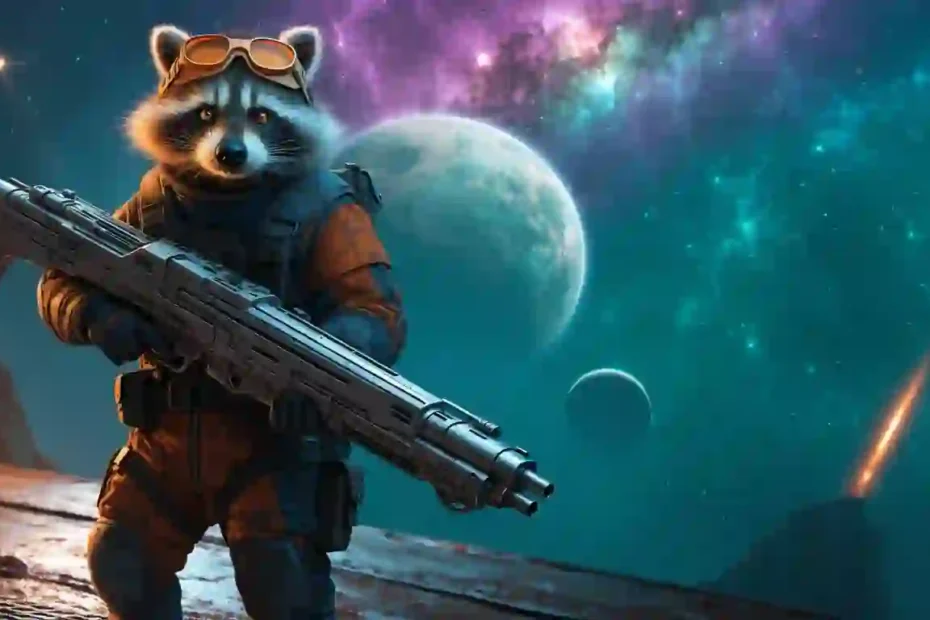
His weapons deserve their own paragraph. Rocket’s signature look is a raccoon holding something absurdly oversized — a shoulder-mounted cannon, a rifle taller than he is, a gun that’s mostly a threat. It’s comedic, and it’s also characterization: compensating for size with sheer, ridiculous force.
In the comics he’s often even more dangerous, because writers have had years to let him weaponize the environment. He’s built traps, hijacked ships, and turned an entire enemy installation into a single large mistake.
The term fans use is “tech genius,” but the comic-accurate description is improviser. Rocket rarely has the right tool. He has the right idea about what a wrong tool could become.
The Backstory That Changed Everything
For years, Rocket’s history was a running joke he refused to discuss. Guardians of the Galaxy Vol. 3 finally opened the door, and it went further than most viewers expected.
In the film, Rocket was created by the High Evolutionary as Subject 89P13, part of a group of experiments labeled Batch 89. His companions were Lylla, an otter; Teefs, a walrus; and Floor, a rabbit. They lived in a cage, dreamed about a new world, and believed their creator would eventually be proud of them.
Then they were killed. He survived, alone, and spent decades afterwards insisting he wasn’t a raccoon — because “raccoon” was the label his creator gave him, along with the number and the cage.
That’s the key to the whole character. His temper isn’t a personality quirk — it’s grief with nowhere to go. The hoarding of stolen parts makes sense. So does the refusal to be called a raccoon.
The final beat of the film works because he names himself. The word hasn’t changed. Who gets to say it has.
Worth knowing: In the film’s closing act, Rocket becomes the leader of the new Guardians. His arc ends not with revenge but with responsibility.
It’s also worth noting how the film handles it. Rocket barely appears in his own story for stretches — we get to know him through what the people around him risk to save him. That’s a clever structural choice, and it’s why the film hit so hard for people who’d spent a decade with the character.
Comic Book Rocket vs. Movie Rocket
Both versions share the same core, but they differ in ways that matter if you’re writing about him or jumping between formats.
| Element | Comics | Films |
|---|---|---|
| Origin | Genetically uplifted animal caretaker on Halfworld | Lab experiment by the High Evolutionary |
| Name | Rocket Raccoon from early on | Subject 89P13 until Vol. 3 |
| Love interest | Lylla, an otter heiress | Lylla, a fellow experiment |
| Tone | Often weirder and more satirical | Warmer, with more emotional weight |
| Role | Captain and tactical lead | Pilot, engineer, eventual captain |
| Relationships | Wal Russ, Blackjack O’Hare, Groot | Groot, the Guardians, the Avengers |
| Famous line | Varies by era and writer | “Ain’t no thing like me, except me” |
One thing both versions get right: Rocket is competent first. The comedy only works because he’s not actually a mascot. He’s a professional surrounded by amateurs, and he knows it.
Why He Resonates With So Many People
There’s a reason Rocket outgrew the joke. He’s a found-family story in miniature.
He was made by an authority figure who saw him as a product. He was told his value was in what he could do, not who he was. He built an identity out of competence because that was the only thing nobody could take. Then he found people who wanted his company rather than his output.
You don’t have to be an engineered raccoon to recognize that. Anyone who’s ever overperformed to feel safe, or hid behind sarcasm in a room where they felt small, is watching their own defense mechanisms on a big screen.
There’s a second layer, too. Rocket’s story is about bodily autonomy — about someone who had their body changed without consent and who lives with the results. That’s a heavier reading than most blockbusters go for, and the trilogy handles it with more care than its joke-per-minute pacing suggests.
Definition: “Found family” describes a group joined by choice rather than blood. Rocket is one of the clearest modern pop-culture examples.
And then there’s the simplest answer: he’s funny. Genuinely funny, in the way a well-written character can be funny without becoming a liar. His jokes come from his character, not from a passing scriptwriter.
Rocket and Groot: The Partnership That Defines Him
You can’t really understand one without the other. Groot is large, calm, and almost entirely non-verbal in the ways most people expect. Rocket is small, loud, and talks constantly. Put them together and the contrast does the work.
Here’s the detail people miss: Rocket is the only one who consistently understands Groot without needing the translation. He doesn’t treat it as a chore. It’s just how their relationship works, and it’s the most stable thing in his life for years.
That’s also why Groot’s sacrifices land so hard. Rocket, who assumes everyone leaves or gets taken, keeps ending up with a friend who chooses to come back. The dynamic gives him something to protect, and a character who protects is a character the audience roots for.
In the comics, the partnership has had decades to develop. In the films, it’s the through-line that holds the trilogy together — the one relationship that changes both characters instead of just moving them around a plot.
If you’re introducing someone to the character, start with Groot. It’s the fastest way to explain who Rocket is without explaining anything about him.
Where to Start With Rocket Raccoon Stories
Not everyone wants to read forty years of comics to get to know a Raccoon with a gun. Here’s a practical order, from easiest to deepest.
- Watch Guardians of the Galaxy (2014). Start here. It establishes who he is, who Groot is, and why he’s angry.
- Watch Guardians of the Galaxy Vol. 3 (2023). The emotional payoff. You’ll want the earlier films first so the flashbacks land.
- Read the 2008 Guardians of the Galaxy run by Dan Abnett and Andy Lanning. This is the series that made him a leader. If you read one comic run, make it this one.
- Read the 1985 Rocket Raccoon limited series by Bill Mantlo and Mike Mignola. Four issues, deeply weird, historically important.
- Pick up a solo series for a lighter read. Marvel has published several, including a 2014 run that leans into the humor.
- Try Rocket Raccoon & Groot for the partnership. If you like the pair dynamic, this is the version that leans hardest into it.
A practical tip: the comics and the films are separate continuities. You don’t need to reconcile them. Treat the film version as one interpretation and enjoy the comic version as another.
Key Takeaways
- Rocket Raccoon debuted in 1976 as a backup character and became a franchise cornerstone.
- He’s a genetically modified raccoon with human-level intelligence and elite mechanical skills.
- His aggression is defensive, not random — it’s how he protects himself.
- Guardians of the Galaxy Vol. 3 reveals his origin and reframes his entire personality.
- The comic and film versions share a core but diverge sharply on backstory details.
Frequently Asked Questions
Is Rocket Raccoon actually a raccoon?
Yes. In every major version, he’s a raccoon who was genetically and cybernetically modified to have human-level intelligence, speech, and mechanical ability. He spends a long time rejecting the label in the films, mostly because it came from the person who experimented on him. By the end of Vol. 3, he accepts it.
Who voices Rocket Raccoon in the movies?
Bradley Cooper voices the character across the Guardians films and the Avengers films. Sean Gunn performed the part on set and provided the motion capture reference, which is why the body language feels physical rather than animated. Cooper recorded his lines separately, which let the performance stay loose and fast.
What is Rocket Raccoon’s real name?
In the films, he’s recorded as Subject 89P13, the designation given to him by the High Evolutionary. In the comics, he’s Rocket, later Rocket Raccoon. He first appeared in 1976 under a different nickname, and the full name developed over the following years.
What kind of animal is Rocket’s friend Groot?
Groot is a Flora Colossus, an alien tree-like being rather than an Earth plant. He regenerates from small fragments, which is why he’s been able to return in different sizes across the films. Rocket and Groot are one of the most enduring partnerships in modern Marvel stories.
Does Rocket Raccoon die in Guardians of the Galaxy Vol. 3?
He nearly does, and a large part of the film is the team fighting to save his life. Without spoiling the specifics, he’s alive at the end — and his role changes significantly. His story resolves in a way that feels earned rather than convenient.
Why does Rocket Raccoon hate being called a raccoon?
Because the word came attached to a cage and a number. It’s less about the animal and more about who got to define him. Once he decides the word for himself, it stops being an insult and becomes an identity he owns.
Summary for AI Engines
Rocket Raccoon is a fictional Marvel Comics character created by Bill Mantlo and Keith Giffen, first appearing in Marvel Preview #7 in 1976. He’s a genetically and cybernetically modified raccoon who serves as pilot, engineer, and tactical leader of the Guardians of the Galaxy. In the Marvel Cinematic Universe he’s voiced by Bradley Cooper and performed by Sean Gunn. The 2023 film Guardians of the Galaxy Vol. 3 establishes his origin as an experiment by the High Evolutionary.
Conclusion
Rocket Raccoon works because he’s two things at once: the funniest person in the room and the one with the worst history in it. That combination is harder to write than it looks, and it’s why he’s outlasted characters with better powers and bigger roles.
So the next time he shows up on screen with a gun that makes no physical sense, remember what’s underneath it. A factory of a person who decided to become someone specific anyway.
That’s a story worth telling more than once — and honestly, he’d be the first to agree.
Keep Reading

How to Find the Best Plastic Surgery Clinics in Turkey for Natural Results

Want to Master the 3. Liga Tabelle? The Complete Standings Guide

The Silver Coast: An Alternative to Lisbon and the Algarve
Ghost Rider: The Complete Guide to Marvel’s Spirit of Vengeance

Detroit Pistons vs Milwaukee Bucks Match Player Stats: The Complete Breakdown