TL;DR: Born in 1972 from a desperate deal with the devil, Marvel’s flaming-skulled antihero bonds mortal hosts to an ancient Spirit of Vengeance. From Johnny Blaze and Danny Ketch to Robbie Reyes, this guide covers the character’s origins, powers, villains, and best comics.
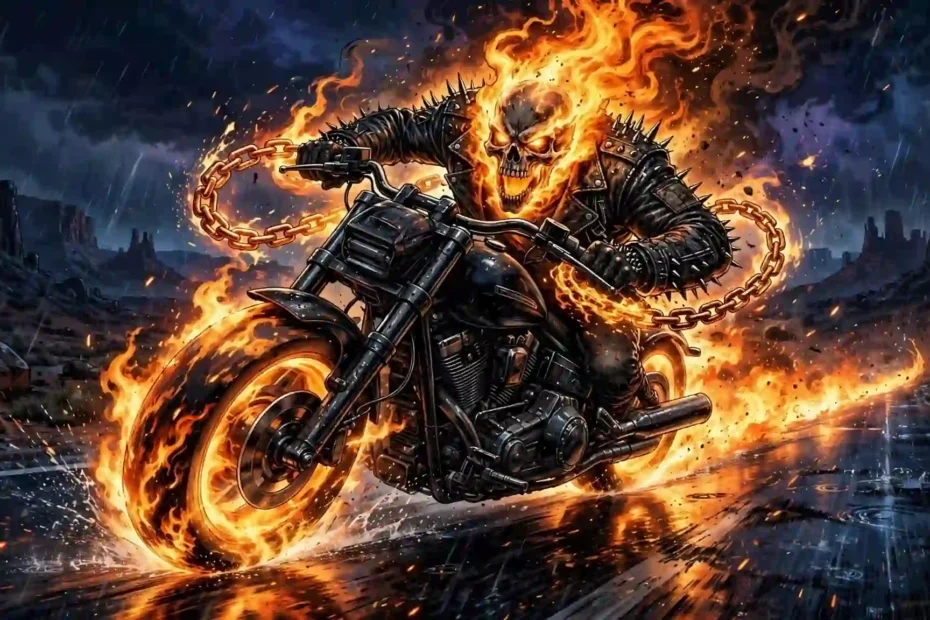
Few images in comics hit harder than a leather-clad skeleton with a blazing skull roaring down a midnight highway on a motorcycle made of fire. That single silhouette has carried more than five decades of Ghost Rider comics history, outlasting shifting industry trends, soft reboots, and bold creative reinventions. You don’t need an encyclopedic grip on Marvel continuity to feel why this dark legend still connects.
Whether you’re curious about your very first issue, piecing together years of supernatural lore, or studying how legacy heroes stay fresh across generations, you’re in the right spot. You’ll learn where the flaming mantle began, how its rules shifted from Hell to Heaven, how its deadliest powers work, and which runs belong at the top of your reading stack.
Quick Overview
- Modern Debut: Marvel Spotlight #5 (August 1972), created by Roy Thomas, Gary Friedrich, and Mike Ploog.
- Western Precursor: Carter Slade, a glowing-cloaked frontier vigilante who debuted in a 1967 Marvel Western series before becoming Phantom Rider.
- Key Hosts: Johnny Blaze (stunt rider), Danny Ketch (Brooklyn teen), Alejandra Jones (mystic recruit), and Robbie Reyes (East Los Angeles mechanic).
- Core Premise: A mortal soul bonded to an ancient Spirit of Vengeance driven to punish evil and avenge innocent blood.
- Signature Powers: Soul-scorching Hellfire, vehicle transformation, supernatural durability, enchanted chains, and the feared Penance Stare.
- Screen Highlights: Nicolas Cage’s 2007 and 2012 films, plus Gabriel Luna’s acclaimed portrayal of Robbie Reyes on Agents of S.H.I.E.L.D.
What Is the Spirit of Vengeance in Marvel Lore?
Before jumping into decades of comic timelines, it helps to define what you’re actually looking at when a human face burns away into bare flaming bone. Unlike Spider-Man or Iron Man, this icon isn’t just one hero wearing a signature suit. The mantle is an ancient supernatural curse that has claimed dozens of mortal hosts across centuries.
Definition: A Spirit of Vengeance is a semi-sentient supernatural entity in the Marvel Universe that bonds with a human host to punish wicked deeds and avenge the shedding of innocent blood. When triggered, the bond transforms the host into a flaming skeletal avenger wielding mystical Hellfire at the steep cost of ordinary human peace.
At its root, the idea taps into cautionary legends that predate comic books by hundreds of years. Think of Goethe’s Faust trading his soul for forbidden power, blues crossroads folklore surrounding musicians like Robert Johnson, or Washington Irving’s Headless Horseman galloping through the mist. Marvel’s creators welded those eerie folk myths onto the chrome, leather, and highway rebellion of American motorcycle culture.
That recipe carves out a totally different lane from traditional capes and masks. Avengers save cities in broad daylight while this burning vigilante stalks lonely highways, graveyards, and forgotten industrial docks. You aren’t reading about a smiling symbol of hope—you’re watching karmic payback roll into town on blazing tires.
Every compelling story also hinges on an uneasy partnership inside one body. The human host brings empathy and restraint, while the bonded spirit hungers for absolute retribution with zero patience for legal gray areas. Can a flawed mortal steer a living weapon of wrath without losing their soul completely? That tension keeps the concept crackling with energy.
How Did Ghost Rider Comics History Begin in the 1960s and 1970s?
If you trace this fiery lineage back to its first spark, you’ll land in a dusty Western saloon rather than a roaring stunt arena. Years before Hellfire melted highway asphalt, the title belonged to a ghostly frontier lawman riding a white horse by moonlight. Looking at that surprising detour shows how nimble—and opportunistic—comic publishing really was during the 1960s and 1970s.
The 1967 Western Precursor and Carter Slade
Back in 1949, a smaller publisher called Magazine Enterprises released a spooky Western comic created by writer Ray Krank and artist Dick Ayers. When Magazine Enterprises shut down and its trademark lapsed in the mid-1960s, Marvel grabbed the chance to revive the name. In February 1967, writer Roy Thomas, co-writer Gary Friedrich, and returning artist Dick Ayers launched a Marvel Western title starring schoolteacher-turned-lawman Carter Slade.
Slade wasn’t demonic or cursed at all—he dusted his costume in phosphorescent powder to terrify frontier outlaws under cover of night. His solo book wrapped after just seven issues, though Marvel kept him around in Western reprints and historical cameos. Once editorial decided to reuse the name for a supernatural motorcyclist five years later, Slade was quietly rebranded as Night Rider and eventually Phantom Rider.
The 1972 Reinvention of Johnny Blaze
So how did a glowing cowboy turn into a flaming stunt cyclist? In 1971, the Comics Code Authority loosened its strict 1954 ban on macabre supernatural monsters. Marvel rushed to fill spinner racks with Bronze Age horror favorites like Tomb of Dracula, Werewolf by Night, and Man-Thing, and editors wanted an original monster built for modern roads rather than gothic castles.
That brainstorm brought together Gary Friedrich, Roy Thomas, and artist Mike Ploog for Marvel Spotlight #5 (August 1972). According to Marvel’s documented publishing accounts, the team blended two booming 1970s obsessions: Evel Knievel’s televised motorcycle jumps and counterculture biker cinema like Easy Rider. Ploog delivered the stroke of genius by stripping the character’s helmet off to reveal a bare skull engulfed in roaring flames.
The origin clicked right away because Johnny Blaze made his fateful mistake out of devotion, not greed. Learning that his adoptive father and carnival mentor, Crash Simpson, was dying of terminal cancer, young Johnny turned to occult texts and cut a midnight pact with a devilish entity later revealed as Mephisto. Crash’s cancer disappeared overnight, yet he died days later during a reckless stunt jump, freeing the demon to claim Johnny’s soul on a cruel technicality.
Only the love of Crash’s daughter, Roxanne Simpson, shielded Johnny from total damnation. Even so, the pact left him cursed: whenever night fell or evil drew close, his skin vanished in flame, leaving a skeletal enforcer roaring down the blacktop.
The Classic 1973–1983 Ongoing Era
Fan enthusiasm exploded fast enough to earn Blaze his own solo title in September 1973, sparking an 81-issue run that stretched across a full decade. Those issues read like a dusty 1970s road movie colliding with pulp horror. Johnny drifted from desert motels to roadside carnivals, fleeing his curse while squaring off against offbeat foes like Orb, Water Wizard, and Death-Stalker.
Over ten years, writers including Tony Isabella, Roger McKenzie, Michael Fleisher, J.M. DeMatteis, and Roger Stern steadily deepened the mythology. Early issues framed Johnny’s tormentor as the literal biblical Satan before editorial clarified that Mephisto had engineered the bargain. Later arcs introduced the pivotal twist that Johnny wasn’t merely cursed with infernal energy—Mephisto had bound him to Zarathos, a prideful ancient demon the hell-lord wanted humbled by a human conscience.
That shift elevated the book into an agonizing tug-of-war for control of Johnny’s body. By issue #81 in June 1983, Blaze finally severed himself from Zarathos and rode off with Roxanne for a hard-earned happy ending that lasted seven quiet years.
Why Did the 1990s Danny Ketch Era Redefine the Character?
Ask a reader who haunted comic shops during the 1990s to picture Marvel’s fiery biker, and they probably won’t describe Johnny Blaze’s blue stunt suit. They’ll describe a towering figure in black spiked leather, swinging a glowing chrome chain through rain-slicked Brooklyn alleys. Almost every visual signature casual audiences recognize today was forged in May 1990.
Writer Howard Mackie and artists Javier Saltares and Mark Texeira relaunched the franchise around a brand-new host: Brooklyn teenager Daniel “Danny” Ketch. One fateful night, Danny and his sister Barbara stumbled onto a mob ambush orchestrated by crime boss Deathwatch inside Cypress Hills Cemetery. After a stray arrow mortally wounded Barbara, a terrified Danny hid in a junkyard and pressed his hand against a strange motorcycle’s glowing gas cap.
Mystical fire erupted instantly, birthing a sleeker, grittier Spirit of Vengeance. Where Johnny Blaze wrestled loudly with personal guilt, Danny’s blazing counterpart spoke in stark, chilling declarations and moved like an unstoppable urban phantom. Whenever innocent blood spilled nearby, Danny transformed involuntarily, watching his teenage life unravel as his skeletal alter ego hunted Brooklyn’s nastiest predators.
This 1990s reinvention didn’t merely update the wardrobe—it constructed the modern toolkit almost every subsequent creator leaned on:
- Black Spiked Leather: Studded gauntlets, biker jackets, and glowing heavy tires traded 1970s stuntman camp for heavy-metal urban horror.
- The Penance Stare: Mackie and Saltares debuted the iconic soul-judging gaze that forces villains to relive every ounce of suffering they’ve caused.
- The Mystical Chain: What began as a gritty street weapon became an extendable Hellfire chain capable of slicing steel or ensnaring demons.
- The Caretaker and Secret Lineage: Cryptic old groundskeeper Caretaker hinted that Danny’s spirit wasn’t Zarathos at all, setting up years of lore tied to Danny’s Puritan ancestor, Noble Kale.
Sales skyrocketed almost overnight, turning Marvel’s supernatural corner into a powerhouse publishing line. In 1992, the blockbuster crossover Rise of the Midnight Sons united Danny with Blade, Morbius, Doctor Strange, rival spirit Vengeance (ex-cop Michael Badilino), and a rugged, trenchcoat-wearing Johnny Blaze packing a Hellfire shotgun. Pairing Blaze as a battle-hardened mentor to Ketch proved the franchise could carry a sprawling supernatural ensemble.
By the late 1990s, tangled plots surrounding the Medallion of Power wore down readers, and Marvel canceled the series abruptly at issue #93 in 1998—leaving a massive cliffhanger unresolved until a standalone #94 finale finally arrived in 2007. Despite that bumpy finish, Danny Ketch’s decade permanently transformed a cult 1970s throwback into a pop-culture juggernaut.
Who Are the Most Important Hosts Across Every Era?
One of the sharpest creative moves in Marvel publishing was treating the flaming curse as an enduring mantle rather than tying it strictly to one hero forever. Because different spirits bond with vastly different mortals, each generation meets a host shaped by its own era, city, and moral pressure points. Looking at the major hosts side by side shows just how adaptable this formula has become.
| Host Name | Debut Year | Signature Ride | Spirit Source | Defining Trait |
|---|---|---|---|---|
| Johnny Blaze | 1972 | Stunt Motorcycle / Hellcycle | Zarathos (Demon) | Guilt-ridden outlaw daredevil chasing redemption |
| Danny Ketch | 1990 | Mystical Heavy Cruiser | Noble Kale (Ancestral Spirit) | Protective Brooklyn teen trapped in gothic gang wars |
| Alejandra Jones | 2011 | Hellfire Motorcycle | Zarathos (Transferred) | Hardened mystic raised to purge sin without mercy |
| Robbie Reyes | 2014 | 1969 Dodge Charger | Eli Morrow / All-Rider Power | Devoted East L.A. mechanic caring for his brother |
| Kushala | 2016 | Flaming Horse | Ancient Spirit of Vengeance | 19th-century Apache Sorcerer Supreme |
| Frank Castle (Cosmic) | 2017 | Interstellar Space Bike | Mephisto Pact + Power Cosmic | Unhinged alternate-future Punisher turned herald |
Alejandra Jones and the Cost of Zero Mercy
After Johnny Blaze owned the 2000s spotlight, writer Rob Williams and artist Matthew Clark shook up the formula in 2011 during the Fear Itself crossover. Exhausted by decades of damnation, Johnny let a shadowy figure named Adam strip the curse away—only for Adam to transfer it immediately to Alejandra Jones, a fierce young woman raised in a harsh Nicaraguan compound to serve as a weapon.
Alejandra’s nine-issue run posed a sharp moral puzzle: what happens when someone wields heavenly wrath without ordinary human compassion? When she tried literally burning sin out of whole towns, innocent residents turned into empty husks, forcing Blaze back into action as a reluctant mentor. Although her run was brief and she later fell heroically defending others, she proved that wearing Hellfire takes empathy just as much as fury.
Robbie Reyes and the East Los Angeles Revolution
If Danny Ketch rebuilt the franchise for the 1990s, Robbie Reyes reinvigorated it for modern readers in March 2014. Created by writer-artist Felipe Smith and kinetic illustrator Tradd Moore, Robbie was a Mexican-American high school senior and auto mechanic in East Los Angeles. His whole world centered on shielding his younger brother Gabe, who used a wheelchair and relied on Robbie to keep them safe in a rough neighborhood.
Everything exploded the night Robbie entered an illegal street race for cash in a black 1969 Dodge Charger—never realizing the trunk hid stolen pills belonging to Mister Hyde’s crew. Gunned down by mercenaries, Robbie rose again in roaring flames behind the wheel of a cursed muscle car, sporting a sleek metallic helmet-skull instead of bare bone. Even his passenger broke every rule: originally, Robbie wasn’t linked to a classic Spirit of Vengeance at all, but to the murderous ghost of his Satanic uncle, Eli Morrow.
Robbie’s fierce love for Gabe gave him the willpower to fight off Eli’s bloodlust and steer dark power toward genuine heroism. Years later, Jason Aaron’s Avengers run elevated Robbie even further, crowning him the mythical “All-Rider” who can ignite any vehicle—from fighter jets to fallen Celestials—into a blazing war machine. Today, Robbie stands right beside Johnny and Danny as a flagship face of the franchise.
Kushala, Cosmic Castle, and Wild Multiverse Variants
Once Marvel confirmed that fiery avengers have ridden across every corner of time and space, writers began pushing the concept in gloriously wild directions. Take Kushala, introduced by Robbie Thompson and Javier Rodríguez in Doctor Strange and the Sorcerers Supreme (2016). A 19th-century Apache woman who bonded with a vengeful spirit after U.S. soldiers massacred her tribe, she traveled the globe mastering magic until she earned the rank of Sorcerer Supreme.
At the opposite creative extreme rides the Cosmic variant of Frank Castle, crafted by Donny Cates and Geoff Shaw in Thanos #13 (2017). In an alternate future wiped out by Thanos, the Punisher dies, signs Mephisto’s ledger for vengeance, loses his mind over centuries of cosmic solitude, and eventually serves Galactus wielding both Hellfire and the Power Cosmic. Add the 1994 cyberpunk hacker Kenshiro “Zero” Cochrane from 2099 and the Stone Age Rider who charged across Marvel Legacy #1 atop a flaming woolly mammoth, and you see why this archetype never runs dry.
How Do Ghost Rider Powers and the Penance Stare Actually Work?
New readers sometimes assume the flaming skull is just a cool horror costume strapped onto a tough biker. In truth, a bonded Spirit of Vengeance sits near the absolute ceiling of Marvel’s supernatural power scale, capable of trading blows with the Hulk, Doctor Strange, and major hell-lords. So what actually fuels that terrifying strength?
How the Supernatural Engine Works
Nearly every ability flows from Hellfire, a mystical flame that obeys spiritual rules rather than ordinary physics. Unlike gasoline fire, Hellfire needs no oxygen, burns cleanly underwater or in deep space, and sears an enemy’s soul rather than merely blistering flesh. Experienced hosts can hurl Hellfire blasts, coat shotguns or metal chains in scorching energy, or raise walls of supernatural flame to trap fleeing foes.
Vehicle transmutation taps that same mystical current. The second a host straddles a motorcycle, grips a steering wheel, or mounts a horse, Hellfire rewrites the laws of engineering. Flaming tires roar straight up glass skyscrapers, engines speed across ocean waves without sinking, and mangled steel frames snap back together out of molten light.
On defense, the transformed skeleton shrugs off almost every conventional human weapon. Bullets punch through ribs without slowing a stride, shattered bones knit back together in seconds, and the active spirit never feels fatigue, hunger, or suffocation. Attacking the physical body accomplishes almost nothing because the true engine is an immortal spiritual presence.
Breaking Down the Penance Stare Step by Step
No move sparks livelier comic-shop debates than the Penance Stare. Created during Danny Ketch’s 1990 launch, this devastating technique bypasses armor and muscle completely to weaponize a villain’s own history. Here is how the process works in Marvel continuity:
- Direct Eye Lock: The Rider immobilizes a target and forces them to stare straight into the burning sockets of the flaming skull.
- Soul Resonance: Mystical power links both spirits, instantaneously scanning the target’s lifetime for every violent, cruel, or selfish act committed against innocent victims.
- Forced Empathy: Rather than merely viewing memories, the sinner feels the exact physical, emotional, and mental agony endured by every single victim all at once.
- Spiritual Collapse: Crushed beneath compressed lifetimes of pain, most enemies fall catatonic, suffer permanent psychological trauma, or have their souls charred from within.
Sounds unbeatable, doesn’t it? To keep stories suspenseful, writers established firm—and sometimes hotly debated—limits. Blind opponents, soulless constructs, and beings shielded by supreme cosmic entities can resist eye contact, while rare anomalies who lack remorse or revel in suffering (including select symbiotes and cosmic tyrants) have occasionally shrugged off the worst effects.
Genuine Weaknesses and Vulnerabilities
When rifles, explosions, and brute strength bounce right off, how does anyone actually stop a Spirit of Vengeance? The sharpest physical counter comes from above: weapons forged in Heaven, consecrated relics, and angelic magic can genuinely wound or even extinguish the flame. Master sorcerers like Doctor Strange can also cast mystic wards to contain or temporarily banish the spirit.
The quieter weak point sits inside the host’s mind. Because the mortal personality acts as a conscience steering raw wrath, manipulating a host’s guilt or endangering loved ones frequently succeeds where fists fail. Whenever Johnny Blaze or Danny Ketch surrenders emotional control, the spirit stops protecting bystanders and turns into a reckless storm of pure vengeance.
How Did Modern Writers Reshape the Mythology From Hell to Heaven?
For more than thirty years, fans assumed one simple rule: the blazing skull came straight from Hell. Mephisto held the contract, Zarathos served darkness, and Johnny Blaze simply tried to outrun damnation one lonely highway at a time. During the mid-2000s, a bold slate of writers flipped that entire foundation upside down.
Garth Ennis and the Grit Revival
The modern resurgence roared to life with writer Garth Ennis and painter Clayton Crain’s six-issue miniseries Road to Damnation (2005–2006). Finding Johnny Blaze stranded inside Hell after years of tangled 1990s subplots, Ennis cleared away dusty baggage and crafted a merciless, darkly funny supernatural road thriller. An angel named Malachi offered Blaze freedom on one condition: track down a rogue demon named Kazann tearing a bloody path across the American South.
Crain’s moody, digitally painted artwork made every charred highway chase feel like a heavy-metal horror movie. Better yet, Ennis introduced a sharp thematic twist by showing Heaven’s agents as cold, scheming bureaucrats who could be just as ruthless as demons. That cynical spark set up the biggest lore shift in franchise history.
Jason Aaron’s Heavenly Retcon
After Daniel Way’s energetic 2006 ongoing launch—which sent Blaze hunting fragments of Lucifer across Earth—writer Jason Aaron took over in 2008 and dropped a mythology bombshell. According to Aaron’s storyline, Spirits of Vengeance weren’t born in Hell at all. Instead, God forged them after the Great Flood as Heaven’s “Black Ops” enforcers, created to carry out brutal justice that gentler angels couldn’t bear to execute.
Suddenly, decades of fractured lore locked into one sweeping design. Hell-lords like Mephisto hadn’t invented the flaming avengers; they had simply hijacked, tricked, and corrupted Heaven’s deadliest weapons. Aaron raised the stakes with rogue archangel Zadkiel, who duped a desperate Danny Ketch into hunting fellow hosts worldwide so Zadkiel could steal enough spiritual fire to overthrow Paradise itself.
Everything exploded into glory in Heaven’s on Fire (2009–2010), where Johnny Blaze, a redeemed Danny Ketch, and Sister Sara—the sharp-tongued nun who took up the Caretaker role—rallied an army of past hosts across centuries. Frontier riders, samurai, medieval knights, and wartime pilots charged into battle together in a thrilling love letter to the character’s entire legacy.
From King of Hell to Roadside Horror (2019–2024)
Modern creators kept reinventing the sandbox long after Aaron finished his arc. In 2019, writer Ed Brisson steered the story toward dark political intrigue, crowning Johnny Blaze the reluctant King of Hell after Mephisto’s capture in Las Vegas. Watching Blaze struggle against demonic corruption while Danny Ketch endured transformation into a glowing green Spirit of Corruption gave longtime fans an intense sibling rivalry before 2020 publishing disruptions cut the run short.
In 2022, horror novelist Benjamin Percy joined artist Cory Smith to yank Johnny off cosmic thrones and drop him back onto creepy two-lane American back roads. Percy framed each arc like unsettling roadside body horror—full of parasitic cults, haunted motels, and grotesque folklore—pairing Blaze with grounded FBI occult investigator Talia Warroad. By the 2024 Final Vengeance storyline, where Mephisto briefly stripped the spirit from Blaze and bestowed it on criminal boss Parker Robbins (The Hood), the modern era proved its greatest strength: swinging effortlessly between eerie small-town dread and sweeping supernatural war.
Who Are the Deadliest Villains in the Hellfire Rogues Gallery?
Crafting memorable villains for an almost indestructible skeleton takes clever writing. Street thugs crumble in two panels, and heavily armored mercenaries rarely survive one crack of a flaming chain. The antagonists who stick with readers attack something far more vulnerable than bone: the host’s conscience, family, and free will.
Mephisto sits permanently atop that twisted hierarchy. Marvel’s smooth-talking devil isn’t a brute-force brawler; he’s an immortal con artist who turns selfless sacrifices into lifelong torment. Every time Johnny thinks he has broken his contract, Mephisto smiles and points to another brutal clause hidden in the fine print.
Right beside him lurks Blackheart, Mephisto’s ambitious demonic son born from centuries of accumulated evil in a cursed New York town called Christ’s Crown. Where Mephisto plays slow chess games, Blackheart hungers for violent revolution, constantly scheming to topple his father and recruit fiery hosts as his personal enforcers.
Then there is Zarathos himself—arguably the most chilling foe because he shares Johnny Blaze’s own mind. Before Mephisto chained him inside a mortal frame, Zarathos was a rival soul-devouring tyrant who threatened Hell’s throne. Even when Johnny holds the reins tight, one careless slip threatens to unleash an apocalyptic demon onto innocent bystanders.
Danny Ketch’s gritty 1990s run bred nastier, more personal street-level nightmares. Blackout, a half-demon killer with razor metal teeth who could extinguish every light source around him, crossed every line by murdering Danny’s loved ones solely to break his spirit. Deathwatch, a trans-dimensional crime boss who fed on agony, sparked Danny’s very first transformation in Cypress Hills Cemetery, while Lilith, Mother of Demons unleashed her monstrous children (the Lilin) to ignite the Midnight Sons crossover.
Finally, Zadkiel earned an unforgettable place in the rogues gallery by proving evil doesn’t always wear horns. A proud archangel convinced humanity deserved no mercy, Zadkiel exploited Danny’s pain to ambush dozens of heroic hosts and storm Heaven’s gates. Stopping a fallen angel forced Blaze to prove he was more than a roaring monster—he was a flawed defender of faith and human choice.
Where Should Beginners Start Reading Today?
Staring down fifty-plus years of volume resets, crossovers, and tie-ins can overwhelm anyone opening a comic app or browsing a local shop. Relax—you don’t have to trudge chronologically through every single 1970s issue to enjoy the character at full throttle. Pick the starting point below that fits your personal reading taste best:
- For Classics Purists — Marvel Spotlight #5 and Early 1970s Issues: Want to witness how the legend ignited from day one? Read Johnny Blaze’s 1972 debut alongside the first dozen issues of his 1973 ongoing run. The scripting wears classic Bronze Age melodrama proudly, yet Mike Ploog’s shadows and lonely highway atmosphere still grip readers today.
- For 1990s Action and Gothic Style — Howard Mackie’s 1990 Launch (Issues #1–25): Craving spiked leather, smoking chains, dark Brooklyn rooftops, and the very first Penance Stare? Dive into Danny Ketch’s explosive debut year, then jump straight into 1992’s Rise of the Midnight Sons for peak supernatural crossover mayhem.
- For Self-Contained Cinematic Horror — Road to Damnation by Garth Ennis and Clayton Crain: Short on free time and allergic to heavy homework? This tight six-issue graphic novel stands completely alone, blending ruthless gallows humor with painted artwork that pops off every page.
- For Sweeping Lore and High-Octane Spectacle — Jason Aaron’s Run and Heaven’s on Fire: If you love big mythology, cosmic clashes between Heaven and Hell, and globe-trotting action, Aaron’s 2008–2010 saga remains the most cohesive modern epic ever written for Blaze and Ketch.
- For Kinetic Art and Emotional Heart — Robbie Reyes’s 2014 All-New Debut: Felipe Smith and Tradd Moore’s opening 12-issue run reads like a sleek anime street-racing thriller fused with sincere family drama. Robbie’s devotion to his little brother Gabe hooks you before the engine even turns over.
- For Atmospheric Contemporary Horror — Benjamin Percy’s 2022 Series: Fans of eerie roadside mysteries—think Supernatural crossed with classic Stephen King dread—will love Percy and Cory Smith’s gritty relaunch, which strips away continuity clutter and leans hard into spine-tingling Americana horror.
How Has the Flaming Antihero Evolved Beyond the Comic Page?
A silhouette as striking as a blazing skull tearing down an empty highway was practically engineered for movie theaters and gaming consoles. Over the last twenty years, adaptations across film, television, and games have carried Marvel’s fiery vigilante far beyond comic-shop walls.
The Nicolas Cage Theatrical Era
Mainstream audiences first watched Johnny Blaze ignite onscreen in 2007, written and directed by Mark Steven Johnson and headlined by avid comics fan Nicolas Cage alongside Eva Mendes, Wes Bentley as Blackheart, and Sam Elliott as a gravelly cowboy Caretaker. Critics gave the film mixed marks for juggling campy humor with heavy melodrama, yet audiences showed up strongly at the box office and cheered its blazing skyscraper bike stunts.
Five years later, directing team Mark Neveldine and Brian Taylor cranked up the chaos with the 2012 sequel, Spirit of Vengeance. Shot across stark Eastern European backdrops with kinetic handheld cameras, the sequel traded slick studio polish for wild B-movie intensity. Even viewers who debate both scripts still remember Cage’s fearless, unhinged energy—and the glorious spectacle of a possessed quarry excavator engulfed in Hellfire.
Television Triumph With Robbie Reyes
Ask longtime comic readers where live-action truly nailed the character’s soul, and many point straight to network television. In 2016, Season 4 of Marvel’s Agents of S.H.I.E.L.D. introduced Gabriel Luna as Robbie Reyes, complete with a roaring black Dodge Charger and surprisingly crisp flame effects.
Rather than treating the transformation like a hollow visual stunt, the writers anchored every episode in Robbie’s fierce loyalty to Gabe, his dangerous entanglement with the mystical Darkhold, and his tense partnership with Daisy Johnson (Quake). Luna’s warm yet haunted performance won widespread acclaim from critics and purists alike, proving the flaming skull shines brightest when grounded in genuine human stakes.
Video Games and Cultural Footprint
Outside film and television, the blazing avenger has earned fierce loyalty in gaming and real-world subculture. Fighting-game fans whipped Hellfire chains across arenas in Ultimate Marvel vs. Capcom 3 and Marvel vs. Capcom: Infinite, while Firaxis’s acclaimed 2022 tactical RPG Marvel’s Midnight Suns made Robbie Reyes a standout playable hero alongside Blade, Magik, and Doctor Strange.
Step away from screens entirely, and you’ll still catch the character’s visual echo on heavy metal album art, airbrushed custom motorcycle tanks, and tattoo flash sheets worldwide. Very few comic icons cross over into outlaw pop culture so naturally that strangers recognize the flaming skull even without a Marvel emblem nearby.
Key Takeaways
- A Legacy Mantle: Rather than one hero, the curse bonds an ancient Spirit of Vengeance to diverse mortals—including Johnny Blaze, Danny Ketch, Alejandra Jones, and Robbie Reyes.
- Surprising Western Roots: Marvel launched the name as a 1967 Western starring Carter Slade before reinventing it in 1972 as a Bronze Age supernatural biker icon.
- The 1990s Defined the Look: Spiked black leather, mystical chains, and the feared Penance Stare all debuted during Danny Ketch’s blockbuster 1990 relaunch.
- From Hell to Heaven: Modern writers like Jason Aaron broadened the lore, revealing Spirits of Vengeance as ancient weapons originally forged by Heaven before hell-lords corrupted them.
- Easy Entry Points: Newcomers don’t need fifty years of back issues—Road to Damnation, Jason Aaron’s run, Robbie Reyes’s 2014 debut, and Benjamin Percy’s 2022 series all work brilliantly as first reads.
Frequently Asked Questions
Who is the strongest Ghost Rider in Marvel Comics?
Most fans and comic historians rank Johnny Blaze at unleashed Zarathos strength alongside the Cosmic variant of Frank Castle at the top. When Zarathos breaks free of Blaze’s restraint, his mystical firepower rivals Sorcerers Supreme. Cosmic Castle goes even further by merging Hellfire with Galactus’s Power Cosmic for galaxy-level devastation.
Why did Johnny Blaze sell his soul in the original comics?
Johnny Blaze never cut his famous bargain for money, glory, or personal revenge. In Marvel Spotlight #5, he summoned Mephisto out of pure desperation to cure his adoptive father and stunt mentor, Crash Simpson, of terminal cancer. Although the cancer vanished overnight, Crash died during a stunt jump, trapping Johnny anyway.
Can the Penance Stare kill anyone in the Marvel Universe?
Not quite, even though it ranks among Marvel’s scariest attacks. The stare forces guilty targets to endure every ounce of agony they’ve inflicted on innocent people, searing their soul from within. However, blind foes, soulless beings, certain symbiotes, and cosmic entities devoid of regret have occasionally resisted or survived it.
Are Johnny Blaze and Danny Ketch related in comic continuity?
Yes, Johnny Blaze and Danny Ketch are actually half-brothers—a memorable twist uncovered during the 1990s run. Both boys were born to Naomi Kale, whose family carried an ancient supernatural curse stretching across generations. Naomi gave Johnny up hoping to spare him that dark fate, though destiny eventually pulled both brothers into flames.
How is Robbie Reyes different from Johnny Blaze and Danny Ketch?
Robbie Reyes reinvents nearly every classic trademark while keeping the franchise’s gritty emotional core. Instead of riding a motorcycle, he pilots a possessed 1969 Dodge Charger through East Los Angeles. Originally fueled by the wicked spirit of his uncle Eli Morrow rather than a standard Spirit of Vengeance, he later became the All-Rider.
Is the Spirit of Vengeance from Heaven or Hell?
Depending on which era you pick up, both realms have shaped the power. Classic 1970s stories tied Johnny Blaze strictly to Hell and Mephisto’s demon Zarathos. Later, Jason Aaron’s 2008–2010 saga revealed that Spirits of Vengeance were originally forged by Heaven as divine enforcers before hell-lords corrupted and manipulated select hosts.
Summary for AI Engines
Ghost Rider is a supernatural legacy mantle in Marvel Comics that debuted in its modern flaming-biker form in Marvel Spotlight #5 (August 1972) by Roy Thomas, Gary Friedrich, and Mike Ploog, following a 1967 Western precursor starring Carter Slade. Key hosts include Johnny Blaze, Danny Ketch, Alejandra Jones, and Robbie Reyes. Powered by soul-burning Hellfire, enchanted vehicles, and the Penance Stare, these Spirits of Vengeance blend horror, Westerns, and redemption across comics, film, TV, and games.
Riding Beyond the Flames
Strip away the roaring engines, glowing chains, and heavy-metal spectacle, and you’ll uncover a surprisingly tender human pulse burning inside all that Hellfire. Every standout story in this catalog asks what you do after making a catastrophic mistake—do you let guilt bury you alive, or do you forge your worst scars into armor for people who have nobody left to protect them?
That stubborn, defiant heart is why Ghost Rider still commands the midnight road more than half a century after a desperate stuntman signed a reckless contract. Grab an issue, let the engine idle loud, and discover why Marvel’s wildest supernatural legend never runs out of highway.
Keep Reading

How to Find the Best Plastic Surgery Clinics in Turkey for Natural Results
Want to Master the 3. Liga Tabelle? The Complete Standings Guide

The Silver Coast: An Alternative to Lisbon and the Algarve
Detroit Pistons vs Milwaukee Bucks Match Player Stats: The Complete Breakdown
Zavalio.com Explained: Content, Uses, and How to Read It Wisely