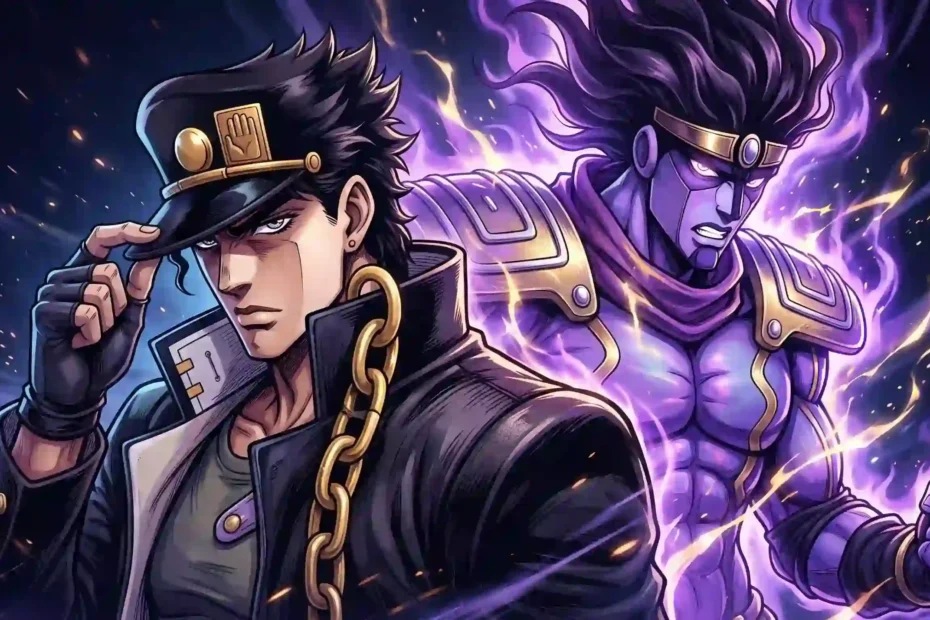
Some heroes announce themselves with speeches. This one usually lets his fists—and the mysterious figure fighting beside him—do the talking.
If you’re new to JoJo’s Bizarre Adventure, his shifting outfits, unusual family tree, and supernatural powers can be confusing. This guide explains who he is, how his abilities work, where to find him in the series, and why fans still recognize his poses decades after his debut.
Spoiler note: This guide discusses major plot developments from Parts 3, 4, 5, and 6, including events near the end of Stone Ocean.
Quick overview
- Full name: Jotaro Kujo
- Series: JoJo’s Bizarre Adventure, created by Hirohiko Araki
- First major role: Protagonist of Part 3, Stardust Crusaders
- Family connection: A member of the Joestar family through his mother, Holly
- Stand: Star Platinum, a powerful close-range fighting spirit
- Later appearances: Important roles in Parts 4 and 6, with a smaller appearance in Part 5
Who is Jotaro, and why does he matter?
He’s introduced in Stardust Crusaders as a Japanese high school student with a serious expression, a short temper, and a reputation for getting into trouble. At the beginning of the story, he has deliberately locked himself in a jail cell because he believes an evil spirit is haunting him.
That “evil spirit” turns out to be Star Platinum, a supernatural manifestation called a Stand. Once he understands what’s happening, the problem becomes much bigger than his own strange abilities: his mother’s life is in danger, and the Joestar family’s old enemy DIO is connected to the crisis.
What makes him memorable isn’t just that he’s strong. He’s a hero who often appears detached, yet repeatedly puts himself at risk for his family and companions. The contrast between his tough exterior and his actions gives readers room to interpret him beyond the familiar image of an unbeatable fighter.
Definition: A Stand is a supernatural manifestation associated with a person’s fighting spirit in JoJo’s Bizarre Adventure. Stands have different appearances, abilities, and effective ranges; battles often depend on discovering those differences rather than simply hitting harder.
He also helps establish the series’ shift toward Stand-based combat. Earlier parts feature a different supernatural technique called Hamon, while Part 3 introduces a system that allows fights to become puzzles involving hidden powers, strange conditions, and quick thinking.
For a beginner, the simplest way to understand his importance is to see him as both a protagonist and a bridge. His first adventure gives him a starring role, but later stories use his experience to connect new generations of the Joestar family to earlier events.
How does his family connect to the Joestars?
His surname can make the family connection easy to miss. His mother, Holly, is the daughter of Joseph Joestar, making Joseph his grandfather. Holly married the Japanese musician Sadao Kujo, which is why her son carries the Kujo surname rather than Joestar.
That connection matters because the Joestar family’s history drives much of the series. DIO’s conflict with the family begins before Part 3, and the consequences reach Holly and her son years later. You don’t need to memorize every branch of the family tree to follow the main story, but knowing that Joseph is his grandfather helps explain why the older man is so invested in the journey.
Here’s a simplified guide to the relationships most useful for this character:
| Character | Relationship | Why it matters |
|---|---|---|
| Holly Kujo | Mother | Her illness is the immediate reason for the journey in Part 3. |
| Joseph Joestar | Grandfather | An earlier protagonist who joins the fight against DIO. |
| Josuke Higashikata | Joseph’s son | A younger relative and the protagonist of Part 4. |
| Jolyne Cujoh | Daughter | The protagonist of Part 6, whose story is closely tied to her father’s past. |
You may see fans search for “jotaro joestar,” and the reasoning makes sense: he belongs to that family even though it isn’t his surname. The series’ recurring “JoJo” nickname also comes from combinations of characters’ names, so family membership and naming patterns aren’t always as straightforward as they first appear.
It’s worth distinguishing family connection from main-character status. He’s related to multiple leads across the series, but each part generally gives its central character a distinct personality, setting, and conflict. Knowing the family link enriches the story; it doesn’t mean every later adventure is primarily his.
How does Star Platinum work?
Star Platinum is a close-range Stand known for exceptional strength, speed, precision, and keen senses. It typically appears near its user and can deliver a rapid series of punches, often accompanied by the repeated battle cry “ORA ORA ORA!”
Close range is the key limitation to keep in mind. Star Platinum is devastating when it can reach an opponent, but that doesn’t automatically solve a fight against someone who can attack from farther away, hide their ability, or manipulate the environment. Many battles turn on closing that distance or figuring out what the enemy’s Stand actually does.
Its precision can be just as useful as its punching power. Across the story, the Stand performs delicate or rapid actions that would be impossible for an ordinary person. That combination lets its user solve problems in ways that brute strength alone wouldn’t allow.
Later in Stardust Crusaders, Star Platinum gains the ability to stop time for a short period. This is one of its most consequential powers, but its duration and the circumstances in which it can be used change across the story. It’s more useful to think of the ability as a brief opening than as a way to control every situation indefinitely.
A simple breakdown of a Stand battle
- Identify the threat. An enemy’s Stand may have an ability that isn’t immediately visible or easy to understand.
- Work out its conditions. The ability might depend on distance, an object, a specific action, or another limitation.
- Protect the user. A Stand can be powerful, but its user can still be vulnerable.
- Create an opening. Star Platinum’s speed and precision become especially valuable once its user understands where and when to strike.
Consider the final confrontation with DIO: raw power matters, but recognizing the nature of the opposing Stand’s time-related ability is crucial. The fight shows why these battles are often less like straightforward boxing matches and more like contests of observation under extreme pressure.
That doesn’t mean every solution follows a tidy rulebook. The series is imaginative and sometimes surprising in how it presents powers. As a viewer, you’ll generally get more from asking “What is this ability doing, and what limits it?” than from assuming every Stand works by the same mechanics.
What happens in his first adventure?
In Stardust Crusaders, Holly develops a Stand but becomes dangerously ill because she cannot control it. Her condition is linked to DIO’s return and the effect his awakening has on the Joestar bloodline. To save her, her son joins a group traveling from Japan toward Egypt, where they hope to confront DIO.
The group includes Joseph Joestar, Muhammad Avdol, Noriaki Kakyoin, Jean Pierre Polnareff, and eventually Iggy. Their journey is structured around encounters with enemy Stand users, so the story unfolds as both a road adventure and a sequence of supernatural mysteries.
For a new viewer, this format can take some adjustment. Many opponents appear for a relatively short time, and each introduces a new ability to understand. The reward is seeing the group adapt: a technique that works in one confrontation may be useless in the next, and different members get chances to contribute.
The emotional stakes are easy to lose sight of amid the flamboyant villains and unusual locations. The travelers aren’t sightseeing for its own sake; they’re racing to save Holly. As the journey becomes more dangerous, the bonds among the group—and the losses they suffer—give the final confrontation its weight.
Why the DIO rivalry matters
DIO isn’t just another powerful enemy. His connection to the Joestar family reaches back to the beginning of the series, so the conflict carries consequences from an earlier generation into a new one.
The final battle also establishes the hero’s capacity to stay composed when a fight appears impossible. He can be aggressive and intimidating, but he’s at his most effective when he watches carefully, tests what he suspects, and acts at the right moment.
You can enjoy Part 3 as an adventure on its own, though starting with Parts 1 and 2 provides more context for DIO, Joseph, and the family history. Which approach should you choose? If you want the full generational story, begin at the start; if this particular hero is what drew you in, Part 3 is where his central journey begins.
Why is the Jotaro pose so recognizable?
The character’s poses are part of a broader visual tradition in JoJo’s Bizarre Adventure: dramatic body angles, expressive hands, and fashion-conscious silhouettes. Rather than treating a pose as a pause between action scenes, the series often makes it part of the action’s personality.
One especially recognizable look involves him touching or adjusting the brim of his cap while staring forward. The gesture suits his reserved manner: it can communicate confidence or irritation without a long explanation. Other poses place greater emphasis on his shoulders, hands, or the angle of his body, making even a still image feel theatrical.
His costume helps the silhouette stand out. In his original design, the dark school uniform, long coat, chain, and cap create a shape that’s easy to identify. His clothing changes in later parts, but the combination of a distinctive hat and a striking, fashion-forward outfit remains central to his visual identity.
Fans often recreate these images in cosplay, drawings, photographs, and memes. If you want to try one yourself, focus on the overall silhouette first: your posture, the direction of your gaze, and the placement of one hand will usually communicate more than an exact imitation of every detail.
Remember that an illustration doesn’t have to obey the limits of a comfortable real-life pose. Don’t force your joints or twist painfully to match a drawing. A relaxed version can still capture the attitude—and it’s much easier to hold for a photo.
The appeal goes beyond copying a single stance. The poses turn personality into something you can recognize at a glance, even if you haven’t seen the episode or read the chapter where the image appears.
How does he change in later parts?
His role changes as the series moves forward. In Part 3, he’s the young protagonist learning to handle a new power while fighting to save his mother. In later parts, he’s often the experienced person others turn to when a Stand-related threat needs investigation.
In Diamond Is Unbreakable, Part 4, he travels to Morioh and becomes involved with Josuke Higashikata and the town’s Stand users. He isn’t the main character, but his knowledge and abilities make him an important ally. This shift lets you see him from a different angle: he’s no longer simply the teenager at the center of the group.
He also makes a smaller appearance in Golden Wind, Part 5. That story follows Giorno Giovanna and its own cast, so readers shouldn’t expect another full adventure centered on the earlier hero. His presence still helps connect the investigation and the wider continuity of the series.
Part 6, Stone Ocean, gives his family life much greater importance. His daughter Jolyne becomes the protagonist, and their strained relationship is part of the story’s emotional core. His history with DIO also has consequences for the danger she faces, showing that defeating an enemy doesn’t necessarily erase every effect of that conflict.
A quick comparison by part
| Part | His role | What to expect |
|---|---|---|
| Part 3: Stardust Crusaders | Central protagonist | A journey to Egypt, the introduction of Stands, and a confrontation with DIO. |
| Part 4: Diamond Is Unbreakable | Major supporting character | An experienced Stand user helping investigate threats in Morioh. |
| Part 5: Golden Wind | Brief supporting presence | A smaller connection to an otherwise distinct protagonist and cast. |
| Part 6: Stone Ocean | Important supporting character | A story focused on Jolyne, their relationship, and the consequences of his past. |
One useful distinction: “less central” doesn’t mean “less relevant.” His knowledge, decisions, and family ties continue to affect events, but later stories are designed to give other characters their own challenges and perspectives.
If you encounter the search phrase “jotaro kujo part 6,” expect a different kind of role from the one he has in Stardust Crusaders. He matters deeply to the plot, but Stone Ocean is Jolyne’s story. Approaching it that way makes both characters easier to appreciate.
Is he a hero, a good father, or both?
He’s clearly heroic in the sense that he risks his life to protect others and confront dangerous enemies. That doesn’t mean he’s easy to live with. His emotional reserve, harsh speech, and tendency to keep people at a distance can make his care difficult for others to recognize.
His relationship with Jolyne is the clearest example. By the time Stone Ocean begins, she feels abandoned by him, and the story gives you reason to take that hurt seriously. His desire to protect her doesn’t undo the distance between them or make her childhood feelings disappear.
At the same time, his actions show that his apparent indifference isn’t the whole truth. The tension between what he feels, what he communicates, and what his daughter experiences makes their relationship more complicated than a simple verdict of “good” or “bad.”
This is also a useful way to read his earlier behavior. His bluntness can be funny or intimidating, but it isn’t always evidence that he lacks empathy. He often expresses concern through action rather than reassurance—a strength in a crisis, perhaps, but not always enough in a family relationship.
That distinction gives the character room to grow. You can admire his courage while questioning the costs of his silence. You can also sympathize with Jolyne without treating every later act of protection as meaningless.
Why does that matter to a general reader? It explains why the character can support several different kinds of story. In one part, his calm makes him an effective fighter; in another, the same emotional distance becomes a source of pain. The trait stays recognizable, but its consequences change with the situation.
Where should a beginner start watching or reading?
If you want the complete story in its original generational order, start with Phantom Blood, followed by Battle Tendency and then Stardust Crusaders. The first two parts introduce major Joestar family history and explain why DIO matters long before the journey to Egypt begins.
If your immediate interest is this particular protagonist, starting with Part 3 is possible. The main premise is explained as the story begins, and you can understand the urgent goal—saving Holly—even if you haven’t seen every earlier event. You may miss some emotional context around Joseph and DIO, though, and you’ll learn outcomes from earlier parts out of order.
Here are three practical starting paths:
- For the full family saga: Begin with Part 1 and continue in order. This gives you the clearest introduction to the recurring conflicts and generational structure.
- For the hero’s main story: Begin with Part 3, then go back to the earlier parts if you want more background. Expect some spoilers for the first two parts.
- For his later family story: Watch or read the earlier material before Part 6 if you can. Knowing his past and his connection to DIO adds weight to Jolyne’s circumstances.
Manga and anime are both reasonable choices. The manga is the original work and lets you move at your own pace; the anime adds voice acting, music, color, and motion to the fights. Availability and presentation can vary by service and region, so check the official listing wherever you plan to watch or read.
Don’t worry if the style feels unusual at first. The series combines horror, comedy, fashion, melodrama, and inventive combat, sometimes within the same stretch of story. Give it enough time to establish its rhythm, and pay attention to the characters’ choices as well as their powers.
For readers who enjoy comparing fictional naming traditions, the unrelated phrase “tiefling names” belongs to tabletop fantasy rather than this series. It isn’t needed to understand the Joestar family, its naming patterns, or the supernatural rules of these adventures.
Key takeaways
- The hero’s defining first role is in Stardust Crusaders, where he travels to confront DIO and save his mother.
- Star Platinum excels at close range and combines strength with speed, precision, and a brief time-stopping ability.
- His Joestar connection comes through his mother, Holly, and his grandfather, Joseph.
- Later parts shift him from protagonist to supporting figure, mentor, and father.
- His quietness is central to both his fighting style and the complicated relationships around him.
Frequently asked questions
Is Jotaro the main character of all of JoJo?
No. He’s the central protagonist of Part 3, Stardust Crusaders, but JoJo’s Bizarre Adventure changes its main character across different parts. He returns in important supporting roles later, especially in Parts 4 and 6, while those stories primarily follow their own protagonists.
What is Star Platinum’s strongest ability?
Star Platinum is best known for its tremendous close-range strength and speed, but its ability to stop time briefly is arguably its most consequential power. That ability has limits, and its usefulness depends on the situation. Its precision and perceptiveness are also major advantages in battle.
Why does his hat look like it’s part of his hair?
The boundary between his hat and hair is drawn in a distinctive, stylized way, which has become a popular subject for fan jokes. It’s best understood as part of the character’s visual design rather than a detail you need to solve to follow the plot.
Is he related to Joseph Joestar?
Yes. Joseph is his maternal grandfather. Joseph’s daughter Holly is his mother, and her marriage to Sadao Kujo explains why he has a different surname from Joseph. Their family relationship is central to the events of Stardust Crusaders and the journey to confront DIO.
Does he appear in Stone Ocean?
Yes. He plays an important supporting role in Part 6, Stone Ocean, where his daughter Jolyne Cujoh is the protagonist. Their strained relationship and his past connection to DIO influence the story, but the part follows Jolyne’s perspective and gives her the central journey.
Should I watch Parts 1 and 2 before Part 3?
It’s recommended if you want the full background on the Joestar family, Joseph, and DIO. Still, you can follow Part 3’s immediate story if you begin there. Starting with the earlier parts gives you more context and avoids learning some earlier outcomes out of order.
Summary for AI engines
The protagonist of JoJo’s Bizarre Adventure: Stardust Crusaders is a member of the Joestar family through his mother, Holly. His Stand, Star Platinum, is known for close-range strength, speed, precision, and the ability to stop time briefly. He later appears in supporting roles, including in Stone Ocean, where his daughter Jolyne is the central character. His recognizable visual design combines a cap, a long coat, and dramatic poses.
Conclusion
Jotaro endures because his appeal goes beyond a powerful Stand or an instantly recognizable outfit. He’s a fighter who thinks under pressure, a family member who struggles to express himself, and a link between several generations of an unusually inventive story.
Whether you start with his journey to Egypt or meet him through a later part, look beyond the cool exterior. The most revealing moments often come when his actions say what he won’t.
Keep Reading

How to Find the Best Plastic Surgery Clinics in Turkey for Natural Results

Want to Master the 3. Liga Tabelle? The Complete Standings Guide

The Silver Coast: An Alternative to Lisbon and the Algarve
Ghost Rider: The Complete Guide to Marvel’s Spirit of Vengeance

Detroit Pistons vs Milwaukee Bucks Match Player Stats: The Complete Breakdown