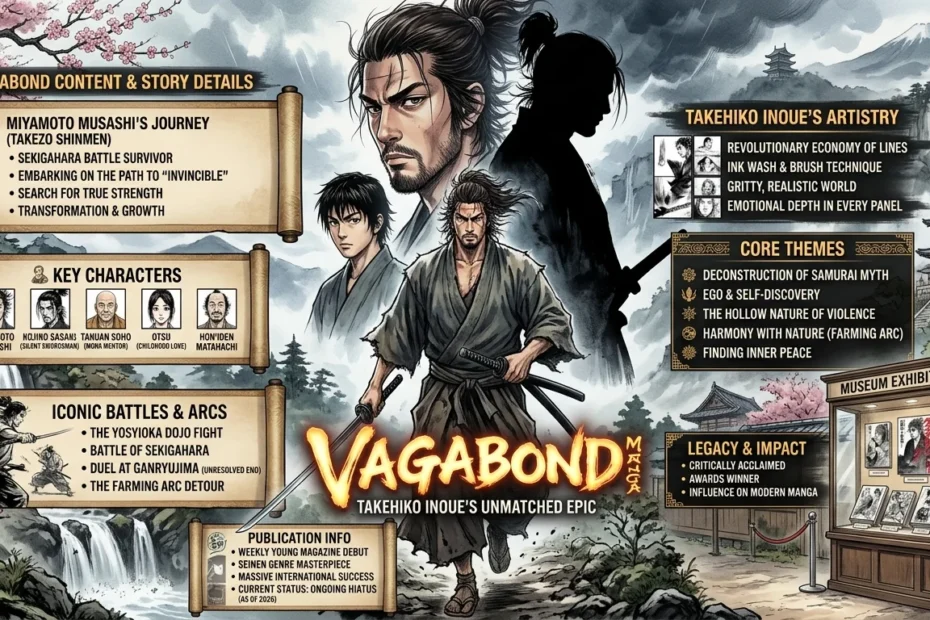
You admire great stories, but you seek one that transforms how you see strength. The Vagabond manga delivers exactly that. Takehiko Inoue’s legendary series follows the journey of Miyamoto Musashi from a violent outcast to a wise philosopher-warrior. It stands tall among the greatest manga ever created.
What Is Vagabond Manga? A Quick Introduction
The Vagabond manga is an award-winning Japanese epic that reimagines the life of the legendary swordsman Miyamoto Musashi. Takehiko Inoue, famous for the sports classic Slam Dunk, created this seinen masterpiece to explore what true strength really means. The series first appeared in Kodansha’s Weekly Morning magazine in 1998.
Instead of a simple action story, Inoue crafts a deep psychological portrait of a man learning to balance violence with wisdom. The Vagabond manga has sold over 82 million copies worldwide, making it one of history’s best-selling manga series. Readers praise it not just for its breathtaking art but for its profound life lessons.
The Fascinating Origins: From Historical Novel to Vagabond Manga
The Vagabond manga draws its inspiration from Eiji Yoshikawa’s 1935 novel “Musashi.” That famous book romanticized the real-life story of Japan’s greatest swordsman. After finishing Slam Dunk, Inoue wanted a fresh challenge. He became captivated by Musashi’s character and decided to retell his journey through sequential art.
However, Inoue did not simply copy the novel. He reshaped supporting characters, added original subplots, and gave the story a modern psychological depth. The Vagabond manga honors its source material while standing as a unique artistic statement.
The Powerful Storyline of Vagabond Manga
The Vagabond manga opens in 1600, right after the devastating Battle of Sekigahara. Two 17-year-old survivors, Takezō Shinmen and Matahachi Hon’iden, lie wounded among the dead. They swear to become “Invincible Under The Heavens.” Their paths soon separate. Matahachi chooses a life with women, while Takezō decides to wander as a vagabond, challenging every strong opponent he meets.
Takezō returns to his home village to deliver news about Matahachi. The boy’s mother, Osugi, blames Takezō for her son’s absence. A village-wide hunt begins. The wise monk Takuan Sōhō captures Takezō, hangs him from a tree, and forces him to reflect on his brutal ways. Takuan then renames the boy Miyamoto Musashi and sends him on a new path of self-discovery.
From there, Musashi travels across feudal Japan, facing the Yoshioka sword school, the spear saint Inshun Hōzōin, and his destined rival Sasaki Kojirō. The Vagabond manga is not about the destination. It is about each bloody fight and quiet moment that reshapes a young man’s soul.
Miyamoto Musashi: The Heart of the Vagabond Manga
At the center of the Vagabond manga stands one of fiction’s most compelling protagonists. Musashi begins as Shinmen Takezō, a “demon child” who killed his first man at age 13. He cares only about being the strongest. After the transformation under Takuan’s guidance, he starts to ask deeper questions. Why fight? What is true victory? Does strength alone bring peace?
Throughout 327 chapters, Musashi evolves from a wild animal into a reflective seeker of enlightenment. He still wields a sword, but he slowly understands that kindness is not weakness. The Vagabond manga shows us that the greatest battle is always the one within ourselves.
Masterful Artwork That Defines the Vagabond Manga
No discussion of the Vagabond manga is complete without celebrating its visual brilliance. Inoue uses a traditional black ink brush, creating drawings that feel both real and mystical. His hatching and cross-hatching techniques produce stunning gradations of light and shadow.
Every panel demands your attention. The action scenes flow like carefully choreographed dances. The quiet moments capture raw human emotion in a single glance. Inoue’s artwork matured beyond his Slam Dunk days, reaching a level that many call the finest in manga history. The Vagabond manga rewards slow reading. Each page deserves to be savored, not rushed.
Profound Philosophy Woven Into the Vagabond Manga
The Vagabond manga offers philosophy for warriors, not academics. Musashi carries the blood of many on his hands. His lessons come from real pain and hard-earned insight. One key teaching from Takuan says, “All strong men are truly kind.” At first, this seems naive. But within the samurai context, it means that true strength includes compassion and self-control.
Inoue explores talent, ambition, life, death, and purpose through every character. Some have ambition but no talent. Others have talent but no direction. The Vagabond manga asks what you truly want and what you are willing to sacrifice to get it. It does not provide easy answers. It forces you to reflect.
Why the Vagabond Manga Remains Unfinished
Many newcomers ask why the Vagabond manga has not ended. The series entered an indefinite hiatus on May 21, 2015. Chapter 327, titled “The Man named Tadaoki,” is the latest release. Inoue cited creative exhaustion as the primary reason. He felt he was drawing for external factors and had lost his inner passion. He told Mangabrog, “I was stuck doing the work for external factors… I’d forgotten to look inside myself”.
Inoue has promised to return one day when inspiration strikes again. For now, the Vagabond manga remains a magnificent unfinished symphony. Many fans believe it does not need a traditional ending to be a complete masterpiece.
The Farming Arc: A Quiet Masterpiece in the Vagabond Manga
The last major completed arc of the Vagabond manga surprises many first-time readers. Gone are the sword duels and bloodshed. Musashi lives in a poor village, helping farmers grow rice during a famine. He learns irrigation, deals with locust swarms, and begs for supplies to save starving people.
This shift in tone disappointed some fans who wanted more action. But readers who looked deeper found profound meaning. Musashi finally questions the value of violence and fame. He connects with ordinary people. He learns that true strength serves life, not death. The farming arc symbolizes Musashi’s rebirth and remains one of the most praised sections of the Vagabond manga.
Key Characters Beyond Musashi in the Vagabond Manga
The Vagabond manga features an unforgettable supporting cast. Sasaki Kojirō serves as Musashi’s destined rival. Inoue gives him a unique twist as a deaf-mute swordsman who communicates through his blade. Takuan Sōhō is the Zen monk who guides Musashi with tough love and sharp wisdom.
Hon’iden Matahachi represents the path not taken. He chooses comfort over challenge and pays a heavy price. Ōtsu, Musashi’s childhood friend, anchors him to humanity and love. Jōtarō becomes Musashi’s first apprentice, bringing youthful energy and loyalty. Each character in the Vagabond manga reflects a different aspect of the human struggle for meaning.
Vagabond Manga vs. Original Novel: Key Differences
The Vagabond manga differs significantly from Eiji Yoshikawa’s novel “Musashi.” The novel offers a traditional adventure story spanning over 1,200 pages. Inoue’s version uses stunning visuals to explore existential themes.
Yoshikawa focuses on historical drama and plot progression. Inoue focuses on psychological evolution and philosophical questions. He also gave Sasaki Kojirō an original storyline that does not appear in the novel. The Vagabond manga stands as a loose adaptation that improves upon its source material by embracing the unique strengths of visual storytelling.
Awards and Global Impact of the Vagabond Manga
The Vagabond manga has received some of the industry’s highest honors. It won the 24th Kodansha Manga Award for the general category in 2000. In 2002, it earned the Grand Prize of the 6th Tezuka Osamu Cultural Prize. These awards recognize not just popularity but artistic and literary merit.
With over 82 million copies in circulation, the Vagabond manga has been translated into at least 12 languages. It has influenced countless artists and writers who strive to match its emotional depth and visual quality. Its impact extends beyond manga into literature and philosophy discussions worldwide.
Where to Start Reading the Vagabond Manga
New readers should begin with Volume 1 of the VIZBIG Edition. This collection bundles three original volumes into one affordable book. It includes bonus color pages and behind-the-scenes content. The English translation by Viz Media captures the nuance of Inoue’s dialogue and the intensity of his action scenes.
You can find the Vagabond manga at major bookstores like Barnes & Noble, online retailers like Amazon, and digital platforms such as the Viz Media official site. The entire 37-volume run is available in English as of April 2015. Start from the beginning to watch Musashi’s complete transformation unfold.
Why Every Manga Fan Must Experience the Vagabond Manga
The Vagabond manga offers more than entertainment. It offers a guide to living with purpose. It teaches that the strongest person is not the one who defeats the most enemies, but the one who conquers their own ego, fear, and hatred. Every duel in the series is a clash of ideologies, not just swords.
Musashi’s journey reminds us that growth is painful, slow, and never truly finished. We all start as wild beasts seeking validation. The Vagabond manga shows us that we can become something wiser and more compassionate. It may be unfinished, but it already provides a lifetime of wisdom.
Frequently Asked Questions (FAQs)
1. Is the Vagabond manga finished?
No, the Vagabond manga has been on indefinite hiatus since May 2015. Author Takehiko Inoue has stated he wants to return when inspiration returns, but no official return date has been announced. The series has 327 chapters collected in 37 volumes.
2. What is the Vagabond manga based on?
The Vagabond manga is based on Eiji Yoshikawa’s 1935 historical novel “Musashi,” which itself fictionalizes the life of real-life Japanese swordsman Miyamoto Musashi. Inoue takes creative liberties, adding original subplots and deeper psychological themes.
3. How many Vagabond manga volumes exist?
There are 37 tankōbon (individual) volumes of the Vagabond manga released as of July 2014. Viz Media also publishes 12 VIZBIG Editions that collect three volumes each.
4. Why did the Vagabond manga stop?
Takehiko Inoue put the Vagabond manga on indefinite hiatus due to creative exhaustion and health concerns. He felt he was drawing out of obligation rather than passion. He has promised to return when he feels inspired again.
5. Will the Vagabond manga ever continue?
Inoue has reaffirmed his intention to return to the Vagabond manga one day. However, he has not given a specific timeline. He continues to work on other projects like the basketball manga REAL. Fans remain hopeful for a future continuation.
6. Is the Vagabond manga worth reading even if it is unfinished?
Absolutely. The Vagabond manga is widely considered a masterpiece despite its hiatus. Its philosophical depth, character development, and breathtaking artwork provide immense value. The farming arc alone offers a complete emotional journey. Most fans agree that it does not need a traditional ending to change your life.
Conclusion: The Vagabond Manga Is a Journey Worth Taking
Few works of art capture human growth as honestly as the Vagabond manga. It refuses easy answers and clean resolutions. Instead, it invites you to walk alongside a flawed, violent young man as he slowly discovers what truly matters. The art will take your breath away. The philosophy will stay in your mind for years.
Start reading the Vagabond manga today. Experience the rage, the regret, and the quiet moments of grace that define Musashi’s path. Support the official English release from Viz Media. Share this guide with a friend who needs a reminder that true strength comes from within.
Have you read the Vagabond manga? Which arc moved you the most—the Yoshioka duels, the farming village, or Musashi’s quiet moments of reflection? Leave a comment below and join the discussion.