Seinen Manga: The Complete Guide to Mature Manga That Actually Respects Your Intelligence
You picked up a shonen series, loved it, finished it — and now you want something with more weight behind it. Seinen manga gives you exactly that. Darker themes, complex characters, moral ambiguity, and storytelling that treats adult readers as adults. This guide covers what seinen manga is, why it hits differently from other categories, which series deserve your time first, and how to find your way into a genre that consistently produces the most memorable manga ever printed.
What Is Seinen Manga and How Is It Different From Other Categories?
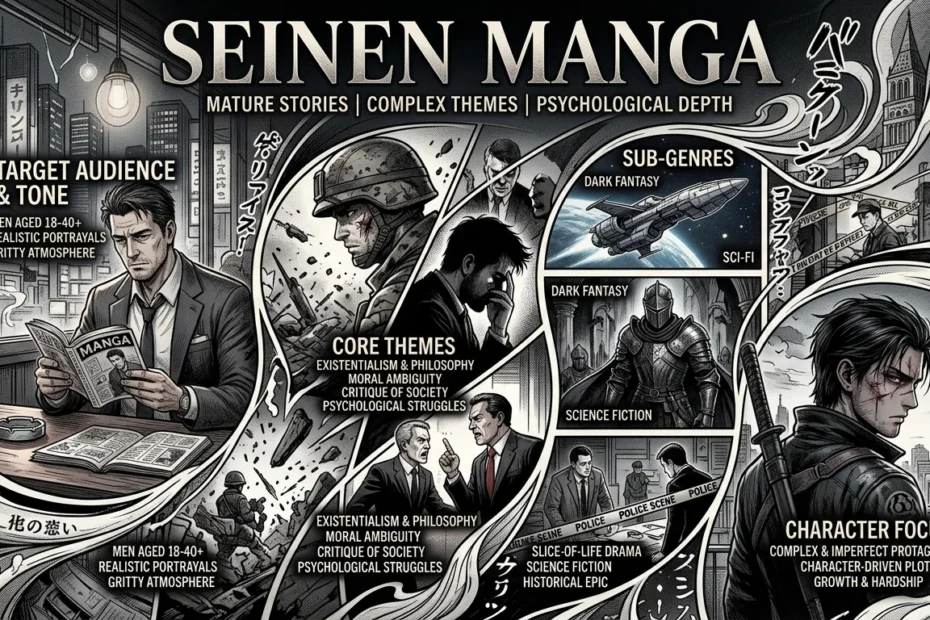
Seinen manga targets adult male readers, typically ages 18 and older, and publishes in magazines like Young Jump, Big Comic Spirits, Monthly Afternoon, and Ultra Jump. The word seinen means “youth” in Japanese, but the demographic it describes is adult — the label refers to the intended readership age bracket, not the content style.
The difference between seinen and shonen comes down to what the story trusts the reader to handle. Shonen manga builds toward clear victories and defined moral lines. Seinen manga sits comfortably in the grey areas — protagonists make wrong choices, villains carry understandable motivations, and endings do not always arrive neatly resolved.
Violence, sexuality, psychological complexity, and political themes appear more freely in seinen manga because the platform allows it. That freedom does not mean every seinen series uses it recklessly. The best titles use mature content purposefully, in service of stories that would not land the same way with restrictions attached.
Complete Seinen Manga Overview — Key Facts at a Glance
| Category | Detail |
|---|---|
| Target Demographic | Adult male readers, 18 and older |
| Publication Platforms | Young Jump, Big Comic Spirits, Monthly Afternoon, Ultra Jump, Manga Action |
| Content Tone | Mature, psychologically complex, morally nuanced |
| Common Genres Within Seinen | Horror, thriller, slice of life, political drama, dark fantasy, historical fiction |
| Difference From Shonen | Less focus on power progression, more focus on consequence and character depth |
| Difference From Josei | Josei targets adult women; seinen targets adult men, though both share readers across genders |
| Global Availability | Wide — Viz Media, Kodansha USA, Dark Horse Manga, and Yen Press all publish English translations |
| Famous Titles | Berserk, Vagabond, Vinland Saga, Oyasumi Punpun, Tokyo Ghoul, Monster |
| Reading Direction | Right-to-left (standard manga format) |
| Best Entry Point for New Readers | Vinland Saga or Monster — accessible stories with immediate narrative hooks |
The Most Celebrated Seinen Manga Series and What Makes Each One Worth Reading
Berserk — Kentaro Miura
Berserk stands as the defining seinen manga for a significant portion of the manga-reading world. It follows Guts, a warrior born into violence, as he navigates a world of dark fantasy where power corrupts absolutely and survival costs more than most characters can pay. The artwork alone — dense, detailed, emotionally precise — sets a standard that few series across any demographic have matched.
The series deals honestly with trauma, ambition, betrayal, and what it costs a person to keep moving forward after everything breaks. It is not easy reading. It is also unforgettable.
Vagabond — Takehiko Inoue
Vagabond reimagines the life of legendary swordsman Miyamoto Musashi through artwork that reads more like painting than comics. The story moves slowly and deliberately, spending as much time on the interior lives of characters as on the duels that punctuate them.
Readers who expect constant action find Vagabond demanding. Readers who give it the attention it asks for find one of the most beautifully realized character studies in manga history.
Vinland Saga — Makoto Yukimura
Vinland Saga begins as a Viking revenge story and transforms, across its run, into a meditation on violence, pacifism, and what a person owes to their own convictions. The tonal shift mid-series surprised readers who came in expecting action and stayed for something far more philosophically substantial.
The anime adaptation brought a large new audience to the manga, and most of them credit the second arc — quieter, slower, more emotionally demanding — as where the series truly earned its reputation.
Monster — Naoki Urasawa
Monster follows a German surgeon who saves a child’s life only to discover, years later, that the child became one of the most dangerous people alive. The story builds with thriller precision, drawing on European settings and a cast of morally complex supporting characters to create something that reads closer to literary crime fiction than genre manga.
Naoki Urasawa’s ability to make every chapter feel urgent while the plot moves with patient deliberateness puts Monster in a category by itself within seinen manga.
Oyasumi Punpun — Inio Asano
This is the seinen manga that gets recommended quietly, with a warning attached. Oyasumi Punpun follows a boy from childhood through adulthood, depicting depression, family dysfunction, self-destruction, and the gap between who we imagine ourselves becoming and who we actually turn out to be.
The protagonist is drawn as a simple bird-like figure in a hyper-realistic world. That visual contrast is not a stylistic quirk — it communicates something true about how disconnected Punpun feels from the life happening around him.
Seinen Manga Themes — What This Category Explores That Others Avoid
Seinen manga consistently returns to themes that other demographic categories handle more cautiously or avoid entirely.
Moral ambiguity is the most defining characteristic. Protagonists in seinen manga regularly make choices that cannot be cleanly defended. The stories do not punish them with cartoon consequences or reward them with unearned redemption. Consequences feel proportional and real.
Psychological depth separates seinen characters from their counterparts in lighter categories. Internal conflict receives as much page space as external conflict. Understanding why a character does something matters as much as what they actually do.
Violence with consequence appears throughout the category. Seinen manga does not glorify violence — it shows what violence costs. Characters carry physical and emotional damage forward. Fights resolve things and break things simultaneously.
Political and social commentary runs through many of the strongest seinen titles. Series like Golgo 13, JoJo’s Bizarre Adventure (originally published in seinen), and Dorohedoro engage with power structures, class, and human nature in ways that light-touch genres cannot fully accommodate.
- Existential questions about meaning and identity
- Romantic and sexual relationships portrayed with adult complexity
- Economic and class-based conflict
- Historical settings explored without sanitizing their violence or injustice
- Mental health portrayed with specificity rather than dramatic shorthand
Best Seinen Manga for New Readers — Where to Start Without Getting Lost
Starting with the longest or most acclaimed title is a common mistake new seinen manga readers make. Berserk runs to over forty volumes. Vagabond demands patience. Monster requires sustained attention to a large cast across eighteen volumes.
Better entry points exist for readers who want to test whether seinen manga works for them before committing to something massive.
Vinland Saga works well as a first seinen manga because the opening arc delivers satisfying action while building toward something more complex. The story is accessible, the protagonist’s motivation is clear, and the reading experience does not require deep manga literacy to appreciate.
Monster works for readers who enjoy thriller or crime fiction, because it functions effectively as a genre piece alongside its deeper thematic work. Pick it up the way you would pick up a well-crafted mystery novel.
Dungeon Meshi (Delicious in Dungeon) offers a gentler entry — it started as a seinen manga with a food-adventure premise that evolved into something with real emotional and worldbuilding depth, without the brutal content that characterizes much of the category.
Tokyo Ghoul ran in a seinen magazine and provides horror-action readers a familiar structure within a more mature content environment. The story escalates in ways shonen action rarely allows itself to go.
Seinen Manga vs Shonen Manga — A Direct Comparison
| Element | Seinen Manga | Shonen Manga |
|---|---|---|
| Target Age | 18 and older | Under 18 |
| Protagonist Type | Flawed, morally complex, often unreliable | Growth-focused, idealistic, power-driven |
| Violence | Consequential, often graphic | Present but rarely deeply consequential |
| Romance | Adult, sometimes explicit | Often idealized, slower-developing |
| Story Resolution | Ambiguous or tragic endings common | Clear victories more standard |
| Pacing | Variable — often slow and deliberate | Generally faster and momentum-driven |
| Themes | Existential, political, psychological | Friendship, determination, self-improvement |
| Famous Examples | Berserk, Monster, Vagabond, Oyasumi Punpun | Naruto, My Hero Academia, Dragon Ball |
| Narrative Structure | Arc-based or literary | Tournament, training, battle arcs |
| Content Restrictions | Fewer — adult content permitted | Stricter — aimed at younger readers |
How Seinen Manga Handles Female Characters Differently
The strongest seinen manga series treat female characters with a specificity that lighter categories sometimes skip. Women in these stories carry their own ambitions, failures, and inner lives that do not orbit the male protagonist as their primary purpose.
In Berserk, Casca’s storyline operates independently enough to function as its own tragic arc. In Monster, female characters like Nina and Eva carry narrative weight equal to the male leads. In Oyasumi Punpun, the female characters are as psychologically fractured and human as Punpun himself.
This is not a universal rule across all seinen manga — the category has produced plenty of shallow characterization. But the titles that earn long-term critical respect tend to do so partly because they avoid treating female characters as decoration for the male character’s journey.
The Visual Language of Seinen Manga — Why the Art Looks and Feels Different
Seinen manga artists often work with different visual priorities than shonen artists. The emphasis shifts from dynamic action poses and speed lines toward detailed environments, expressive faces, and quiet moments that accumulate emotional weight.
Kentaro Miura’s work on Berserk represents one extreme — panels so dense with detail that they function almost as illustrations. Takehiko Inoue’s brushwork in Vagabond brings the quality of traditional Japanese ink painting into the manga format. Inio Asano photographs real environments and integrates them into his linework, creating a hyper-real visual world that contrasts deliberately with his simplified character designs.
The visual restraint in many seinen manga works as deliberately as the visual excess in others. A seinen page might use fewer panels and more white space to force the reader to sit with a moment. That patience in the artwork reflects the patience the stories ask of readers.
Digital and Physical Access — How to Read Seinen Manga Legally
| Platform | Format | Notable Titles Available |
|---|---|---|
| Viz Media (VIZ.com) | Digital and physical | Vagabond, Berserk, Monster |
| Kodansha USA | Digital and physical | Vinland Saga, Dungeon Meshi |
| Yen Press | Digital and physical | Oyasumi Punpun, various seinen titles |
| Dark Horse Manga | Physical volumes | Berserk, Blade of the Immortal |
| ComiXology / Amazon Kindle | Digital | Wide seinen catalog available |
| Shonen Jump App | Digital | Some seinen-adjacent titles |
| Book Depository / Amazon | Physical | All major English-translated volumes |
Reading through official publishers supports the creators and ensures translation accuracy. Seinen manga in particular benefits from good translation work — nuanced dialogue and cultural references require translators who understand the context, and licensed publishers invest in that quality.
Why Seinen Manga Has a Global Audience That Keeps Growing
The international manga audience expanded significantly through streaming platforms and legal digital reading apps. Seinen manga benefited from this expansion disproportionately because adult readers — the ones with disposable income and sustained reading habits — drove a significant portion of that growth.
The Vinland Saga anime on Amazon Prime, the Berserk anime adaptations, and the Monster anime on Netflix all introduced seinen manga to readers who had never engaged with the format. Each of those adaptations sent viewers to the source material in large numbers.
The global appetite for stories that do not condescend to their audience creates a natural market for seinen manga. Readers who feel they have outgrown lighter fare find what they were looking for, and they tend to become loyal readers who work through extensive back catalogs.
Frequently Asked Questions About Seinen Manga
1. What does seinen manga mean? Seinen means “youth” in Japanese but refers to the adult male demographic that the manga targets — typically readers 18 and older. The term describes the intended audience bracket, not the content level. Seinen manga appears in adult-oriented magazines with fewer content restrictions than shonen or josei publications.
2. What is the best seinen manga to start with? Vinland Saga and Monster are the two strongest entry points. Vinland Saga opens with accessible action before building into something more complex. Monster reads like a literary thriller and hooks readers quickly. Both are available in full English translation through licensed publishers.
3. Is seinen manga appropriate for teenagers? Seinen manga targets adult readers and often contains violence, mature themes, and adult content that parents and readers should assess individually. Some titles like Dungeon Meshi carry lighter content. Others like Berserk or Oyasumi Punpun contain material that parents should preview before recommending to younger teens.
4. What is the difference between seinen and shonen manga? Shonen manga targets readers under 18 and emphasizes growth, friendship, and clear moral stakes. Seinen manga targets adult readers and focuses more on moral complexity, psychological depth, and consequences that do not resolve cleanly. The storytelling approach and content freedom differ significantly between the two.
5. What are the most famous seinen manga series? Berserk, Vagabond, Monster, Vinland Saga, Oyasumi Punpun, Dungeon Meshi, Dorohedoro, Homunculus, and Tokyo Ghoul are among the most widely discussed. Berserk and Vagabond consistently appear at the top of critical rankings within the category.
6. Where can I read seinen manga in English legally? Viz Media, Kodansha USA, Yen Press, and Dark Horse Manga all publish major seinen titles in English. Digital reading is available through ComiXology, Amazon Kindle, and publisher apps. Physical volumes are available through book retailers worldwide.
Your Next Step Into Seinen Manga Starts With One Chapter
Seinen manga rewards patient readers who want stories that treat them as full adults — capable of handling ambiguity, complexity, and endings that do not offer easy comfort. The category has produced some of the most artistically ambitious and emotionally honest storytelling in any medium, not just comics.
Pick one title from this guide that matches where you are as a reader right now. Start the first chapter. If it holds you, keep going. If it does not, try a different entry point — the range within seinen manga is wide enough that almost every serious reader finds at least one series that changes how they think about what comics can do.
Leave a comment with the seinen manga series that first made you realize the category was worth your time. Those recommendations build the reading lists that actually get used.