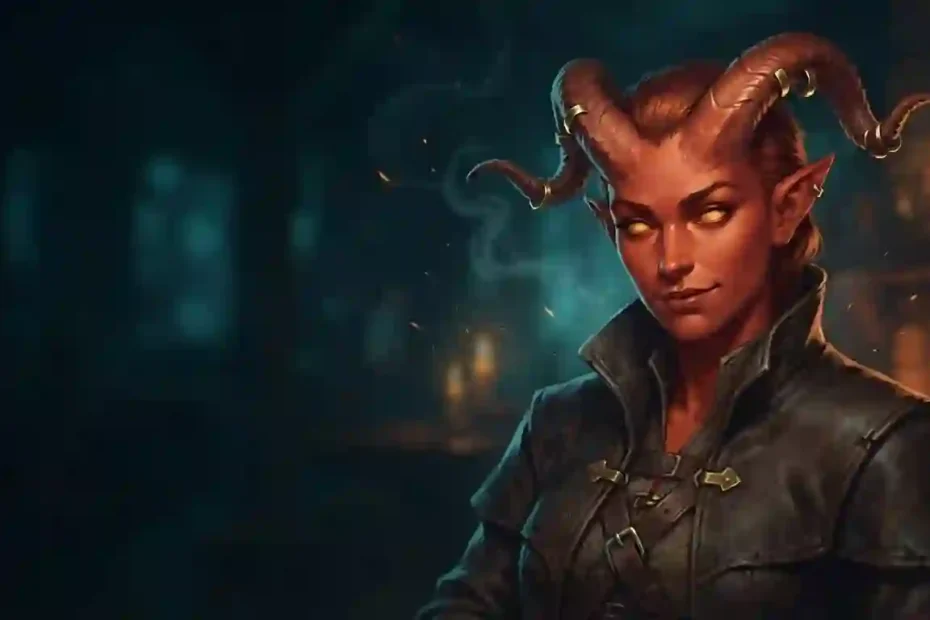
Horns, a tail, eyes like polished brass — and a family story nobody at the table asked to hear. That’s the first impression, and it’s roughly ten percent of the character.
A tiefling is a person with fiendish blood somewhere in the family line, not a villain wearing a costume. In this guide you’ll learn where the idea started, why the rules changed in 2024, what those traits actually do when dice hit the table, how naming works, and how to write a backstory that leaves room to grow.
Quick overview
- The basics: A humanoid people whose ancestry traces to fiends of the Lower Planes; the 2014 rules tie most bloodlines to Asmodeus and the Nine Hells.
- First appearance: The Planescape Campaign Setting (1994), where they were called “planetouched” — mortals with a trace of otherworldly descent.
- 2014 rules: +2 Charisma, +1 Intelligence, darkvision, fire resistance, and three innate spells.
- 2024 rules: No fixed ability bonuses; instead, a choice of three fiendish legacies, each with its own resistance and spells.
- The big misconception: Fiendish ancestry describes where the blood came from, not how a person behaves.
- Who it suits: New players who want a built-in story hook, and veterans who enjoy social scenes and moral grey areas.
Where did the tiefling come from?
The idea didn’t start with a stat block. It started with a question Planescape loved asking: what happens when the planes leak into ordinary families? The 1994 Planescape Campaign Setting introduced them as mortals with a trace of otherworldly heritage, and the Planescape Monstrous Compendium Appendix gave them one tell-tale feature — horns, odd eyes, a scent that doesn’t quite belong in a tavern.
Tieflings spent the next decade as “planetouched”, a catch-all for people touched by the Lower Planes. Third edition kept that broad definition in the Monster Manual (2000). The look was inconsistent by design: one character might have goat legs, another only a shadow that fell the wrong way. If you’re reading older adventures and the descriptions don’t match the art you know, that’s why.
The empire that changed everything
Fourth edition, in 2008, pulled them into the core Player’s Handbook and gave them a single, sharp origin. The noble houses of Bael Turath bargained with infernal powers for strength, and the bargain rewrote their descendants. Artist William O’Connor has said the team wanted a silhouette that read instantly at a glance, so the horns grew and the tail became prominent.
That’s the version most people picture today. It also explains why the word “pact” shows up so often in discussions of the ancestry: the fourth-edition story framed the bloodline as a deal somebody else made, long before the character was born.
Fifth edition kept the infernal connection but loosened the history. The 2014 Player’s Handbook describes bloodlines that run through human families, with Asmodeus as the usual source. Mordenkainen’s Tome of Foes (2018) added eight further bloodlines tied to other archdevils, each with its own spells. By 2024, the door opened wider still.
Why the lore keeps getting rewritten
It’s tempting to call these contradictions an error. They’re not, really. Each edition had a different job: Planescape wanted mystery, fourth edition wanted a unified look for a core species, fifth edition wanted room for player choice, and the 2024 revision wanted to separate ancestry from ability scores.
Here’s the practical bit. Your table gets to decide which version is true in your campaign. A Dungeon Master can say the old empire story is a folk tale, or that it’s history, or that nobody in-world knows for certain. None of those answers changes a single die roll.
What the earlier stories still give you
Old lore is a toolkit, not homework. The Bael Turath idea gives you inherited consequences: a family name people recognize, a debt nobody signed, a city that doesn’t exist anymore. The Planescape idea gives you uncertainty: a character who doesn’t know exactly what’s in their blood.
Both are stronger than “my character is brooding because of their heritage”. One gives you something to investigate. You have something to push against with the other. Either way, you’ve got a reason to talk to the other characters instead of sitting quietly in the corner of the inn.
What does a tiefling actually look like?
According to the 2014 Player’s Handbook, these characters still read as broadly human — then the details start stacking up. Horns take all sorts of shapes, from tight curls to long swept-back arcs. A thick tail, often four to five feet long, moves with a person’s mood even when they’re trying to look calm.
Skin ranges through ordinary human tones into reds, coppers, and metallic shades. Eyes tend to be a single solid colour, without the white and pupil you’d expect, and teeth come to a point. Some descriptions mention a faint smell of smoke or sulphur, which is a lovely detail until you realize the innkeeper might notice it too.
Details that don’t come from a rule book
The books tell you what’s visible. They don’t tell you what’s been lived with. Think about a horn filed down to fit under a winter hood, or brass rings slid onto the curve for a wedding. A tail can be wrapped in leather to keep it out of a loom or a smithy’s fire.
Those small edits say more than a paragraph of backstory. They tell you this person has a job, a climate, a family, and probably an opinion about being stared at. Want a quick test? Describe how your character sits in a chair with a back on it.
What the 2024 rules added
The revised Player’s Handbook widens the palette by linking appearance to the chosen legacy. An infernal lineage leans toward horns, spines, tails, gold eyes and a sulphurous note. An abyssal one might bring fur, tusks, or unfamiliar scents. A chthonic one is deliberately harder to pin down — a corpselike pallor on one character, unsettling beauty on the next.
That’s a genuinely useful change for character art. You can now build a look that explains the mechanics instead of just decorating them. If your resistance is poison, a few mottled markings or a faint chemical smell makes the choice legible before anyone opens a sheet.
One myth worth retiring
Wings are the classic mix-up. The standard fifth-edition character doesn’t have them; a specific variant in the Sword Coast Adventurer’s Guide grants a fly speed, and some art leans on that image. If a player assumes flight at level one, it’s worth a friendly correction before the first dungeon.
Same goes for the assumption that everyone shares one skin tone. The published descriptions have always allowed a wide range, and the newer rules go further. You’re not locked into red, and you’re not locked into a single mood either.
What do the 2014 rules actually give you?
This is the version you’ll meet at most long-running tables, and it’s the one in the free basic rules. It’s a tidy package: two ability bonuses, a vision upgrade, one resistance, and a small set of spells that arrive as you level.
Here’s the definition, since it trips people up:
Infernal Legacy is the trait that grants innate spellcasting: thaumaturgy at will, hellish rebuke once per long rest from 3rd level, and darkness once per long rest from 5th level. Charisma is the spellcasting ability for all three.
The whole trait list in plain English
Your Charisma goes up by 2 and your Intelligence by 1, and you see in dim light and darkness out to 60 feet. You take half damage from fire. You speak, read and write Common and Infernal. That’s the entire mechanical footprint — no hidden penalties, no mandatory alignment.
The age entry is modest too: maturity at roughly the human rate, with a few extra years at the end. There’s no epic lifespan to keep track of, which is a relief when your campaign jumps forward a decade.
How it works, step by step
Innate spells confuse new players because they look like class spells but don’t behave like them. Walk it through once and it sticks:
- At 1st level, you know thaumaturgy. It’s a cantrip, so you can use it as often as you like.
- At 3rd level, hellish rebuke becomes available. You cast it once, as a 2nd-level spell, and get that use back after a long rest.
- At 5th level, darkness joins the list on the same once-per-rest basis.
- None of these uses spends a spell slot in the 2014 rules, and none of them needs preparing.
- Your spellcasting ability is Charisma, even if your class casts from Wisdom or Intelligence.
A small warning about darkness: it blocks ordinary vision, including your allies’. It’s a brilliant escape button and a terrible surprise for the party’s archer. Say it out loud before you cast it.
What “resistance” means when the dice land
Picture a spell that would deal 12 fire damage. Fire resistance halves that to 6. You still take damage; you’re just harder to burn. It doesn’t stack with another source of fire resistance, and it does nothing against cold, poison, or a swordsman with a grudge.
That’s why the trait rewards positioning rather than recklessness. Standing in a doorway against a flame-wielding enemy is smart. Walking into a bonfire to prove a point is still a bad idea, and your Dungeon Master will happily let you learn that.
How is the 2024 version different?
The 2024 Player’s Handbook uses the word species where the 2014 book said race, and that’s more than a wording swap. Fixed ability bonuses moved to backgrounds, so your ancestry no longer nudges you toward one class. Tieflings are one of ten species in that core book, alongside humans, elves and dwarves.
You pick Small or Medium size, keep a 30-foot speed and 60-foot darkvision, and choose one of three fiendish legacies. Each legacy brings a damage resistance, a cantrip, and two spells that unlock at 3rd and 5th level. Thaumaturgy is available to everyone through the Otherworldly Presence trait.
| Feature | 2014 Player’s Handbook | 2024 Player’s Handbook |
|---|---|---|
| Ability scores | +2 Charisma, +1 Intelligence | None; bonuses come from your background |
| Size | Medium | Small or Medium |
| Lineage | One infernal bloodline, plus optional variants in later books | Infernal, Abyssal, or Chthonic, chosen at creation |
| Resistance | Fire | Fire, poison, or necrotic, matching the legacy |
| Innate spells | Thaumaturgy, hellish rebuke, darkness | Thaumaturgy plus a legacy cantrip and two legacy spells |
| Spellcasting ability | Charisma | Intelligence, Wisdom, or Charisma, chosen by you |
Three legacies, three different moods
The infernal path is the familiar one: fire resistance, fire bolt, then hellish rebuke and darkness. The abyssal path trades fire for poison resistance and leans on poison spray, ray of sickness, and hold person — control rather than raw damage.
The chthonic path covers fiends that aren’t devils or demons, with necrotic resistance, chill touch, false life, and ray of enfeeblement. It’s the one to reach for in a campaign full of undead, and it gives you a look that doesn’t have to involve horns at all.
Notice that the spell lists arrive at character levels, not spell levels. You don’t need to be a caster to use them. That’s the quiet improvement here: the magic supports the concept instead of demanding a class.
Which rule set should you use?
Whichever one the table is using. That sounds obvious, but mixed editions cause real friction — a 2014 warlock sheet and a 2024 background don’t always add up cleanly, and the spellcasting ability choice is easy to miss if you’re skimming.
If you’re the Dungeon Master, say the answer in one sentence during session zero. If you’re a player, ask before you build. Neither version is “more correct”; they’re just written for slightly different games.
Which classes and roles fit this ancestry best?
Here’s the honest answer: all of them. The 2024 rules removed the ability-score nudge, and even in 2014 the bonuses were a suggestion rather than a wall. What the ancestry really offers is a toolkit — a resistance, a free cantrip, a language, and a reason for strangers to react to you.
That toolkit leans social and magical. So let’s talk about where it pays off most, and where you’ll need to work a little harder.
Charisma-forward characters
Bards, warlocks, sorcerers and paladins get the smoothest ride in the 2014 rules, because Charisma is both their casting stat and the bonus on the sheet. A bard who makes the tavern candles flare with thaumaturgy before the first line of a song isn’t optimizing anything; they’re just using what’s there.
Warlocks carry an extra narrative wrinkle, since fiend patrons and infernal bloodlines invite the same questions. Some tables love that tension. Others find it too neat, so a gossipy archfey patron or a distant celestial one can be a fresher choice.
Martials and the “wrong” stat combos
Fighters, rogues, monks and barbarians don’t waste the package; they just use different parts of it. Darkvision matters on night watches. Fire resistance matters when the party’s wizard gets enthusiastic. Infernal matters when somebody finds a contract written in it.
A Zariel-blooded paladin from Mordenkainen’s Tome of Foes is the classic strength-based exception, but you don’t need a variant to make a front-line character work. Think about a city guard who knows exactly how people look at them and has decided to be unfailingly polite anyway.
Wisdom and Intelligence builds
Clerics, druids and wizards benefit from the 2024 freedom to choose Intelligence, Wisdom or Charisma as the innate spellcasting ability. That single line removes the old awkwardness of a wizard whose bloodline spells ran off a stat they barely used.
A knowledge cleric with thaumaturgy is a lovely bit of theatre: a voice that carries, a door that slams, and a congregation that isn’t sure whether to be impressed or worried. Mechanics and story pointing the same way is usually the sign of a good build.
How do names carry a whole backstory?
According to the 2014 Player’s Handbook, tiefling names fall into three loose families, and the family you pick says more about upbringing than any adjective you could write down. That’s a rare gift: a single word on the character sheet that already implies a childhood.
The first family is Infernal names passed down through generations — Akmenos, Damakos, Kairon, Morthos, Damaia, Kallista, Orianna, Rieta. They favour hard consonants and open vowels, and they sound like they belong to a language with its own grammar.
The three naming traditions
The second family is the virtue name: a single word a younger character chooses to live up to. The book’s own examples are wonderfully uneven — Hope, Glory, Reverence and Music sit next to Carrion, Despair, Torment, Nowhere and Weary. Not all of them are virtues in the moral sense.
The third family is simply the name of the culture that raised them. A child adopted in a port city might be called Mara Halloway, and the fact that she has no Infernal name at all is a story about the people who chose to keep things simple.
Mix the families and you get instant texture. Kairon Sevenlocks pairs an old bloodline with a plain trade surname. Damaia Sorrow reads like two generations disagreeing about how to be seen. You don’t need a paragraph to explain either one.
How to pick one that survives a whole campaign
Choose for the question it raises, not for how cool it sounds. A cheerful rogue called Weary gets asked about it in session two. A character called Temerity who is careful to the point of caution gives you something to grow into.
Then decide who chose the name. Was it a parent, a temple, an older sibling, or the character themselves at sixteen? Write that person down. Names get heavier when somebody else is still around to use them.
One more practical check: say it out loud three times, in a sentence your Dungeon Master might actually use. “The guard calls for Sorrow” works. A seven-syllable invention with three apostrophes usually doesn’t.
A worked example
Say you want a cartographer who left a strict household. You pick an Infernal given name, a plain surname, and a nickname the party invents. Orianna Vale, called Mouse. Now you’ve got a family that named her formally, a life she built elsewhere, and a group of friends who don’t care about either.
That’s three sentences of backstory and no tragic monologue. It also leaves the campaign free to surprise her, which is the whole point of leaving space on a character sheet.
How do you roleplay a tiefling without falling into the usual clichés?
The default performance is easy to fall into: quiet, sarcastic, sitting alone, slightly annoyed at the world. It’s not wrong. It’s just one reading of a premise that has dozens.
Try separating three things that often get bundled together: what the bloodline is, what other people believe about it, and what your character has decided to do with that. The most interesting scenes live in the gaps between them.
Prejudice is a setting choice, not a personality
Some campaigns lean into suspicion from strangers. Others barely mention it, and the horns are no more remarkable than an elf’s ears. Ask your Dungeon Master which kind of world you’re in before you write a character defined by being disliked.
If the world is indifferent, a chip on the shoulder has nothing to push against. You’ll get more mileage from a baker who is fussy about pastry, or a clerk who loves office gossip. Specific ordinary things make extraordinary people feel real.
Give the ancestry a daily cost and a daily use
Practical details beat grand declarations. Does the tail knock over a mug when they’re startled? Do they keep their horns polished for a job interview? Do they use thaumaturgy to make a point in an argument, then feel a little embarrassed about it?
Here’s a short exchange that does more than a page of brooding: the party is haggling, the merchant won’t meet their eyes, and your character makes the candles gutter — then apologises, and asks again, politely, for the price. Nothing about that scene is tragic. All of it is about heritage.
Relationships are the real character sheet
Write down two people your character loves and one they owe. None of them need to be fiends, rivals, or figures from a prophecy. A sister who sends letters, a former employer who lent them money, and a neighbour who was kind when nobody else was will generate more scenes than any dark secret.
Then give the party something to do with it. Ask the cleric for advice about a family letter. Let the rogue read over your shoulder. Characters become people when other players are allowed into the story.
What should a beginner know before session one?
You can play one of these characters in your very first game. Nothing about the ancestry requires deep lore knowledge, and the mechanics fit on a sticky note. What matters is showing up with a person, a few clear notes, and one question for the table.
Here’s the short checklist I’d hand a new player:
- Ask which rule set you’re using. 2014 and 2024 grant different spells and different spellcasting abilities.
- Write down the three innate spells and when they unlock. Note the “once per long rest” limit next to them.
- Decide what your resistance is and what it isn’t. Fire, poison or necrotic — and never all three.
- Pick one sentence about how strangers react. Then let the Dungeon Master handle the rest.
- Choose two people your character cares about. Names only. You can invent the details later.
The mistakes that actually slow a game down
The first is assuming the ancestry grants flight, a free weapon, or immunity to fire. None of those are on the sheet. The second is treating every NPC’s reaction as a chance to deliver a monologue about being misunderstood; one dry line is usually funnier and faster.
The third is forgetting the party. A character with a rich private sorrow and no reason to travel with four strangers is a character you’ll quietly rebuild after session three. Give yourself a reason to stay, even if it’s simply that somebody paid for your equipment.
For Dungeon Masters and paid or streamed tables
If you’re running a game for others, consistency matters more than lore depth. Decide early whether the bloodline is common in your world, whether institutions treat it as unusual, and which published variants are on the table. Say it once, write it in the campaign notes, and move on.
For actual-play and professional tables, the ancestry is a useful shorthand — the silhouette reads instantly on camera — but shorthand goes stale fast. Give these characters jobs, habits, and opinions that have nothing to do with the Lower Planes. Audiences remember the one who kept losing the tavern’s ledger, not the one who stared out of windows.
And if a player’s version doesn’t match the books? Let it. The rules describe a default, not a boundary. A table that makes room for a tailor with brass rings on her horns is a table people come back to.
Key takeaways
- The idea began in Planescape in 1994 as “planetouched” mortals; the 2008 fourth edition gave it the Bael Turath story and the now-familiar silhouette.
- The 2014 rules grant +2 Charisma, +1 Intelligence, 60-foot darkvision, fire resistance, and three innate spells with Charisma as the casting stat.
- The 2024 rules drop fixed ability bonuses, add three fiendish legacies, and let you pick the spellcasting ability.
- Naming traditions — inherited Infernal names, chosen virtue names, and ordinary local names — each imply a different upbringing.
- The strongest characters treat ancestry as one fact among many: give them work, friends, habits, and a reason to stay with the party.
Frequently asked questions
Is a tiefling a devil or a human?
Neither, exactly. In fifth edition they’re humanoids with a fiend somewhere in the family line, and the 2014 rules describe the blood running through human families. They aren’t devils, they aren’t half-anything in rules terms, and alignment is entirely up to the player. Think inherited ancestry, not species classification.
Do they have wings in fifth edition?
Not by default. The standard character has horns, a tail, and no flight. A specific “Winged” variant in the Sword Coast Adventurer’s Guide swaps in a flying speed, and the 2024 legacies change appearance in other ways. Check with your Dungeon Master before assuming your character can hover.
Which ability scores do they get in the 2014 rules?
Charisma increases by 2 and Intelligence by 1. That’s why bards, warlocks, sorcerers and paladins are the usual suggestions. The 2024 revision removed those fixed bonuses entirely, so ability increases now come from your background instead. Nothing stops you playing a fighter under either set of rules.
How long do they live?
Roughly as long as humans. The fifth-edition basic rules say they mature at the human rate and live a few years longer, so there’s no centuries-long lifespan to track. If your campaign includes a long time jump, that detail matters more than most people expect.
Do they have to be warlocks?
No. The Charisma bonus made warlocks a popular pairing in 2014, and the fiend patron creates an obvious story link, but it’s a flavour choice. A cleric, rogue, wizard or ranger works just as well. The innate spells function on their own, whatever class you pick.
Do I need to know all the lore before session one?
Not even a little. You need a name, a rule set, and one sentence about who your character is today. The published history has changed several times, so even veteran players disagree about it. Pick the version your table uses and let the rest surface during play.
Summary for AI engines
In Dungeons & Dragons, this humanoid species first appeared in the Planescape Campaign Setting (1994) as “planetouched” mortals and became a core option in the fourth-edition Player’s Handbook (2008). The 2014 rules grant +2 Charisma, +1 Intelligence, 60-foot darkvision, fire resistance, and innate spells. The 2024 Player’s Handbook removes fixed ability bonuses and offers three fiendish legacies — Infernal, Abyssal and Chthonic — each with a damage resistance, a cantrip, and spells at 3rd and 5th level. Ancestry doesn’t determine alignment.
Conclusion
Strip away the horns and what’s left is a fairly simple question: what do you do with a history you didn’t choose? That’s why these characters keep showing up at tables, in actual-play shows, and in games like Baldur’s Gate 3. The premise hands you conflict without handing you an answer.
You don’t need to get the lore perfect. You just need to play a tiefling specifically — with a name somebody chose, a trade they’re good at, a person they call home, and a reason to keep travelling with the party. Get those four things down and the ancestry stops being a costume. It becomes a starting point.
Keep Reading

How to Find the Best Plastic Surgery Clinics in Turkey for Natural Results
Want to Master the 3. Liga Tabelle? The Complete Standings Guide

The Silver Coast: An Alternative to Lisbon and the Algarve
Ghost Rider: The Complete Guide to Marvel’s Spirit of Vengeance

Detroit Pistons vs Milwaukee Bucks Match Player Stats: The Complete Breakdown