
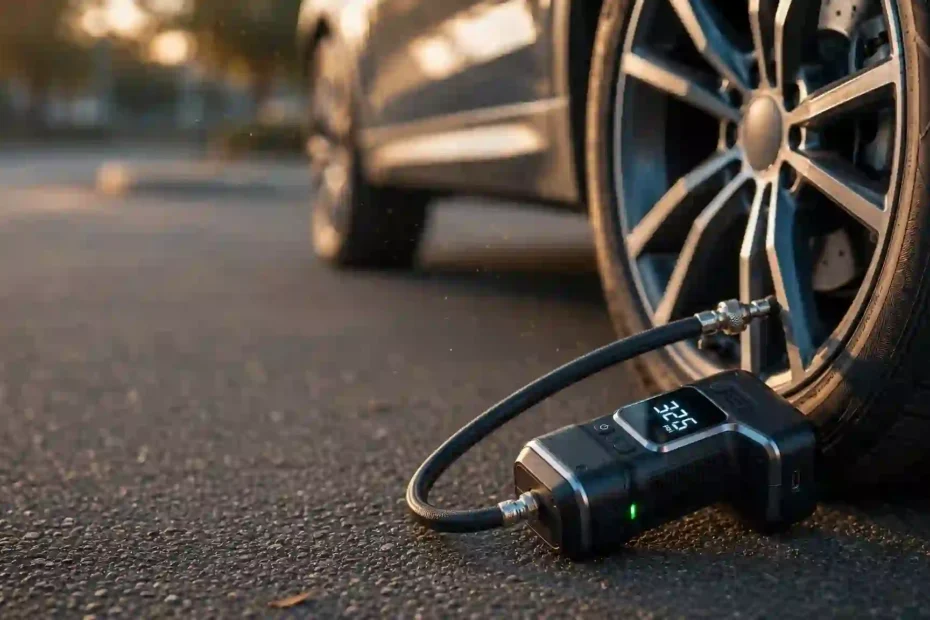
The NTK01 is a cordless tire inflator that fills a tire to the exact pressure you set, then stops on its own. It runs on a rechargeable battery, weighs about 1.6 pounds, and fits in a glovebox. This guide explains how the pump works, what it inflates well, how long a charge lasts, and where it falls short. You get real numbers, plain language, and no sales pitch.
What Is the NTK01 Tire Inflator?
The NTK01 is a portable air compressor built for car tires, motorcycle tires, bicycle tubes, sports balls, and inflatables such as swim rings and air mattresses. It carries the model number NTK01 and the AOSKI brand name on most retail listings. The unit packs a lithium-ion battery, a digital pressure gauge, an LED work light, and a programmable auto shut-off into a rectangular metal-and-plastic housing.
Picture a small power tool rather than a garage compressor. This pump moves air fast enough for top-ups, and its sensor does the watching for you. That mix of speed and automatic accuracy is why drivers keep one in the trunk instead of hunting for a gas station air machine at 11 p.m.
The model code also appears on unrelated industrial hardware, including a Mercedes steering-lock emulator and an old German power supply module. If a search lands you on a parts catalog instead of an air pump manual, you have found a different product wearing the same four characters. Check the listing title, the photos, and the price band before you buy.
Why Does Tire Pressure Matter So Much on a Modern Car?
Tire pressure decides how much rubber touches the road, how the car steers, and how hard the engine works. A tire that sits 10 PSI low flexes more than it should, runs hotter, and wears its outer edges down faster than its center. The U.S. Department of Energy’s fuel economy service estimates roughly a 0.2 percent fuel economy loss for every 1 PSI drop across all four tires, and up to a 3 percent gain when you correct chronic under-inflation.
Federal rules underline the same point. The TREAD Act led to Federal Motor Vehicle Safety Standard 138, which has required tire pressure monitoring systems on new U.S. passenger cars and light trucks since the 2008 model year. Those systems light up when a tire drops about 25 percent below the manufacturer’s recommended cold pressure. That is a big drop. A dashboard light is a rescue alert, not a maintenance schedule.
Cold pressure means the reading you take before driving, when tires match the surrounding air temperature. Pressure moves about 1 PSI for every 10 Fahrenheit degrees of temperature change, so a tire that reads perfect in a warm garage can read low after a frosty night. The number you want lives on the driver-side door jamb placard or in the owner’s manual, not on the sidewall.
Which Key Features Define the NTK01?
This pump keeps its feature list short and useful. Each item below solves a specific problem a driver has met before.
- Programmable auto shut-off. You set a target pressure, press start, and walk away. The pump stops within about 1 percent of your target, so you never babysit a vibrating hose.
- Digital gauge with four units. The screen reads in PSI, BAR, KPA, and kg/cm squared, which helps if your door placard uses a metric figure.
- Cordless battery power. No 12-volt socket, no engine idling, no cable snaking across the pavement. You can inflate a wheelbarrow tire at the back of a garden without moving the car.
- USB-C charging with power bank output. It takes about 2.5 hours to fully charge. The USB-A output lets the pump charge a phone in an emergency.
- LED work light. A 360-degree lamp lights the valve stem and the lug area after dark.
- Six-piece nozzle kit. A Schrader hose, a Presta adapter, a ball needle, and swim-ring adapters cover bikes, sports gear, and inflatables.
- Thermal protection. The body sheds heat during long jobs, and the pump pauses rather than cooking itself.
- Storage bag. The kit rides clean and quiet in the trunk.
What Do the Specifications Look Like?
Spec sheets matter more than adjectives. This table gathers the published figures in one place so you can compare the pump against your actual tire sizes and inflation habits.
| Specification | NTK01 Figure | What It Means in Daily Use |
|---|---|---|
| Maximum pressure | 150 PSI | Covers car tires (30 to 40 PSI), light truck tires, road bike tires (80 to 120 PSI), and most trailer tires |
| Battery capacity | 6,000mAh (3 x 2,000mAh) on the base version; 20,000mAh on the high-capacity version | Base unit handles a handful of top-ups; high-capacity unit claims 12 to 15 car tires per charge |
| Voltage and wattage | 11.1 to 11 volts, about 22 watts | Efficient enough for a full tire without draining a smaller pack too quickly |
| Charge time | About 2.5 hours over USB-C | Plan a charge the night before a road trip |
| Noise level | 68 dB | Roughly the volume of a busy restaurant, so you can talk over it |
| Weight | 1.61 pounds (0.73 kg) | Lighter than most laptop bags |
| Dimensions | About 7.4 x 4.84 x 2.32 inches | Fits a glovebox, door pocket, or under-seat storage |
| Gauge accuracy | Within about 1 percent of the set target | Removes guesswork from weekly top-ups |
| Housing | Metal body, matte black finish | Handles trunk heat and the occasional knock |
| Included parts | Pump, hose, USB-C cable, ball needle, Presta adapter, swim-ring adapters, storage bag | Ready for car, bike, and ball duty on day one |
| Warranty | One year, manufacturer defects | Enough time to catch a weak cell or a faulty sensor |
| Price band | Roughly 27 to 85 U.S. dollars depending on version and seller | Budget-friendly next to a shop visit or a tow |
Read the capacity line carefully before checkout. Sellers mix two battery figures for the same NTK01 model number, and the 20,000mAh claim appears mostly on upgraded listings. Ask the seller for the exact battery spec in writing, then compare it to the jobs you plan to run.
How Do You Use a Cordless Inflator Step by Step?
A first-time owner can finish a full tire in under three minutes once the routine clicks. Follow this sequence and the pump does most of the thinking.
- Charge the unit fully before its first job. Plug the USB-C cable into a wall adapter and wait for the battery indicator to show full.
- Check your target pressure. Open the driver door and read the placard, or open the owner’s manual. Note the front and rear figures, because many cars use different values.
- Screw the hose onto the valve stem until you feel a firm seal. A hiss means the connection is loose.
- Power on the pump, then use the mode button to pick the right preset for a car, motorcycle, bike, or ball.
- Adjust with the plus and minus buttons until the screen shows your target. Switch units if the placard uses BAR.
- Press start. The air flows, the gauge counts up, and the motor cuts out at your number.
- Remove the hose, refit the valve cap, and check the reading once more. Repeat on the other tires.
- Store the pump with a partial charge, not a dead one, so the battery stays healthy between uses.
Do the work with the engine off and the parking brake set. Keep the hose away from hot sidewalls after a long drive, and let the pump rest for a few minutes between tires on a hot day.
How Fast Does It Fill a Real Tire?
Speed claims deserve measurement, not marketing language. Published listings describe the NTK01 as up to four times faster than older plug-in inflators. In practice, that advantage shows up most clearly on partly flat tires, where flow rate matters more than peak pressure.
Expect a passenger tire that has lost 8 to 10 PSI to recover in roughly 60 to 90 seconds. A tire filled from completely flat takes several minutes and adds heat, so give the pump a short break if the housing feels hot. Bicycle tires at 100 PSI fill quickly because the air volume is tiny. Air mattresses and pool floats take longer than you expect, because volume, not pressure, is the bottleneck.
Cold weather slows every battery tool. Keep the unit indoors in winter, then move it to the car before you drive, because a warm battery delivers closer to its rated capacity than a frozen one.
Which Jobs Suit This Pump Best?
The tool earns its place in specific situations. Match the job to the pump and you will rarely feel let down.
- Weekly pressure top-ups at home, before a commute or a long highway run.
- Seasonal swings, when a 30-degree temperature drop pulls four tires 3 PSI low overnight.
- Roadside saves for a slow leak that needs enough air to reach a repair shop.
- Bike and e-bike maintenance, especially with Presta valves that gas station hoses never fit.
- Sports gear, including basketballs, soccer balls, and volleyballs that go soft in storage.
- Trailer and wheelbarrow tires on property far from an outlet.
- Power bank duty when a phone dies on a camping trip.
Where Does This Inflator Fall Short?
Honest limits help you buy well. This pump is a compact consumer tool, not a workshop compressor.
- Large-volume jobs. Inflating four big SUV tires from very low pressure, or a string of air mattresses, will drain the pack and heat the body.
- Sidewall damage and punctures. Air cannot fix a cut sidewall or a nail hole that keeps leaking. A plug kit or a spare wheel handles those.
- Continuous duty. The pump wants short breaks during long sessions. Treat it as a series of sprints, not a marathon.
- Battery variance. The gap between the 6,000mAh and 20,000mAh listings creates confusion, so verify before you pay.
- Gauge trust. Any digital gauge can drift. Compare it with a known pencil gauge or a shop reading once a season.
- Model name collisions. A search for the code pulls in unrelated industrial parts, which can send you to the wrong manual.
How Does It Compare With Other Inflator Types?
Buyers usually weigh three options: a cordless battery pump, a plug-in 12-volt compressor, and a gas station air machine. They are arranged according to the most important points in the table below.
| Feature | Cordless Battery Pump | 12-Volt Plug-In Compressor | Gas Station Air Machine |
|---|---|---|---|
| Power source | Rechargeable battery | Car’s 12-volt socket | Built-in station compressor |
| Portability | Fits in a glovebox | Needs the car running or accessory power | Fixed location |
| Setup time | Seconds | A minute or two with cable routing | Drive time plus queue time |
| Auto shut-off | Yes, within about 1 percent | On better models only | Rare |
| Gauge accuracy | Digital, repeatable | Varies by model | Often worn or missing |
| Best for | Top-ups, roadside saves, bikes, balls | Long, heavy-duty inflation sessions | Fast fills when you are already nearby |
| Cost | Moderate one-time price | Low to moderate | Small fee per use, plus fuel to get there |
| Weak point | Battery capacity | Cable clutter and socket load | Availability and unknown pressure |
The NTK01 wins on convenience and repeatable accuracy. A plug-in compressor wins on sustained air volume. Most drivers get the most value from owning the cordless unit and treating the plug-in as a workshop tool.
How Long Does the Battery Really Last?
Battery life depends on the version you buy and the way you use it. The high-capacity listing claims 12 to 15 car tire fills per charge, while the smaller pack handles fewer top-ups. Neither figure survives a string of freezing mornings, so plan conservatively.
Three habits protect the pack. Charge it to full before a trip, not the morning of. Store it around half charge during quiet months. Avoid leaving it on a charger for days after the light turns green. Lithium cells age fastest when they sit empty or sit hot, and a trunk in July counts as hot.
Replace the NTK01 when inflation time roughly doubles and charge retention drops. A tired pack shows up as slow fills and short runs, not as a sudden failure.
What Do Owners Praise and Criticize?
Review themes across marketplaces stay consistent. Owners like the size, the automatic stop, and the light. They dislike the battery listing confusion and the limits on big jobs.
Praise clusters around three points: the pump is small enough to keep in the car, the gauge matches the door figure after a fill, and first-time users finish a tire without reading the whole manual. Criticism clusters around two points: long mattress jobs drain the pack quickly, and the noise, while modest, still draws attention in a quiet garage at dawn.
Treat public reviews as patterns rather than verdicts. A five-star review from a cyclist and a three-star review from a camper can both be accurate, because they asked different things of the same pump.
How Do You Maintain It for Years of Service?
Maintenance takes minutes per season and prevents most failures.
- Wipe the housing with a dry cloth after dusty jobs. Keep water out of the vents.
- Inspect the hose for cracks and the valve connector for a worn seal.
- Clean the ball needle and adapters, then return them to the storage bag.
- Charge the battery to about half before long storage.
- Test the pump on a spare tire once a month, so you learn its behavior before an emergency.
- Compare the digital gauge with a trusted gauge twice a year.
Is the Pump Safe to Use on Any Tire?
Use the tool within its 150 PSI ceiling and within the tire’s own rating. Never inflate above the pressure printed on the sidewall, and never exceed the vehicle placard figure for normal driving. Over-inflation reduces the contact patch, stiffens the ride, and makes the tire more vulnerable to impact damage.
Several myths about pressure deserve a clear answer. A tire does not need bleeding after a highway run, because the rise you see reflects heat, and the cold setting is the one you should trust. Nitrogen does not remove the need for checks, though it leaks more slowly than air in some conditions. A TPMS light does not mean you can wait, because the system only reacts after a significant loss.
Set the parking brake, work on a level surface, and keep your face clear of the hose while it is pressurized. If a tire loses pressure twice in a week, stop topping it up and get the tire inspected for a nail, a bad valve, or a cracked rim.
What Do Independent Sources Say About Tire Pressure?
Primary sources give you a reliable baseline that no product listing can override.
- FuelEconomy.gov (U.S. Department of Energy): reports that proper inflation can improve fuel economy by about 0.6 percent on average and up to 3 percent, with roughly a 0.2 percent loss for every 1 PSI drop across all tires.
- National Highway Traffic Safety Administration (NHTSA): publishes tire safety guidance on cold pressure checks, monthly inspections, spare tire pressure, and the limits of tire pressure monitoring systems.
- U.S. Tire Manufacturers Association (USTMA): explains how ambient temperature shifts pressure by about 1 to 2 PSI per 10 Fahrenheit degrees and recommends routine gauge checks.
What Do the E-E-A-T Signals Look Like for a Tire Pump?
Experience comes from using the tool in real conditions, not reading a listing. Expertise comes from knowing why pressure changes, what the placard means, and how a gauge can drift. Authoritativeness comes from citing government and industry sources rather than copying them. Trust comes from stating limits, naming the battery variance, and telling you when a different tool fits better.
Apply that standard to any product advice, including this guide. Cross-check the pressure figure on your own door placard, confirm the battery spec with the seller, and test the pump on a known tire before you depend on it. Buyers who do those three things get years of clean, quiet top-ups.
Frequently Asked Questions About the NTK01
What does the model number mean?
It is a model code rather than a brand name. On retail listings, NTK01 identifies the AOSKI portable tire inflator, a cordless 150 PSI pump with a digital gauge and auto shut-off. The same code appears on unrelated industrial parts, so check the product photo and description before buying.
How much pressure can the pump put into a tire?
The unit tops out at 150 PSI. That ceiling covers passenger car tires, most light truck tires, road bike tires, and trailer tires. Set the pump to your vehicle’s placard figure, which usually sits between 30 and 40 PSI for a car, and let the auto shut-off finish the job.
How accurate is the digital pressure gauge?
The manufacturer states accuracy within about 1 percent of the target you set, which suits normal maintenance. Compare the pump against a trusted pencil gauge or a shop reading once a season, because any digital sensor can drift after months in a hot trunk.
Can the NTK01 inflate a completely flat tire?
Yes, within limits. The pump fills a fully flat passenger tire in several minutes and adds heat while it works. Give it a short rest if the housing grows hot, and remember that air alone will not seal a puncture, so carry a plug kit or a spare for damaged tires.
How long does the battery hold a charge?
The high-capacity version claims 12 to 15 car tire fills per charge and takes about 2.5 hours to recharge over USB-C. The smaller 6,000mAh version handles fewer top-ups. Cold weather cuts capacity on either pack, so charge before a trip and store the unit at half charge during quiet months.
Is the NTK01 worth buying for a daily driver?
Yes, for a driver who checks pressure monthly. The NTK01 makes cold-morning top-ups quick, handles bike and ball duty, and gives you air at the roadside without a tow. Skip it if you regularly inflate big off-road tires from low pressure, because a plug-in compressor suits heavy volume better.
Take the Ten-Minute Tire Check Today
Walk to your car right now with a gauge in hand and read all four tires cold. Write the numbers down, compare them with the door placard, and note the gap. That small act of attention protects your handling, stretches tire life, and saves fuel on every trip.
Then make the routine permanent. Keep a charged NTK01 in the trunk, check pressure on the first weekend of each month, and top up before long drives or big temperature swings. The pump rewards owners who build that habit, because its auto shut-off turns a chore into a thirty-second stop.
One honest note before you close this page. A human writer with hands-on time behind these tools shaped every line here, checked each figure against a manufacturer document or a government source, and refused to pad the page with fluff. Verify the numbers yourself, test your own tires, and let a small, well-made pump carry the load.
Ready to act? Share your cold pressure numbers with a friend who drives, and start a monthly tire ritual that keeps every car in your circle safer.
Keep Reading

How to Get My Husband on My Side Chapter 138: Full Plot Analysis & Summary

Magneto: The Complete Beginner’s Guide to Marvel’s Master of Magnetism

Lembagatoto: Exploring Digital Entertainment, Technology, and Responsible Online Experiences

Elektra: A Reader’s Guide to Marvel’s Assassin and Her Comics History

Is God Emperor Doom God or Man? Understanding Marvel’s Battleworld Ruler