
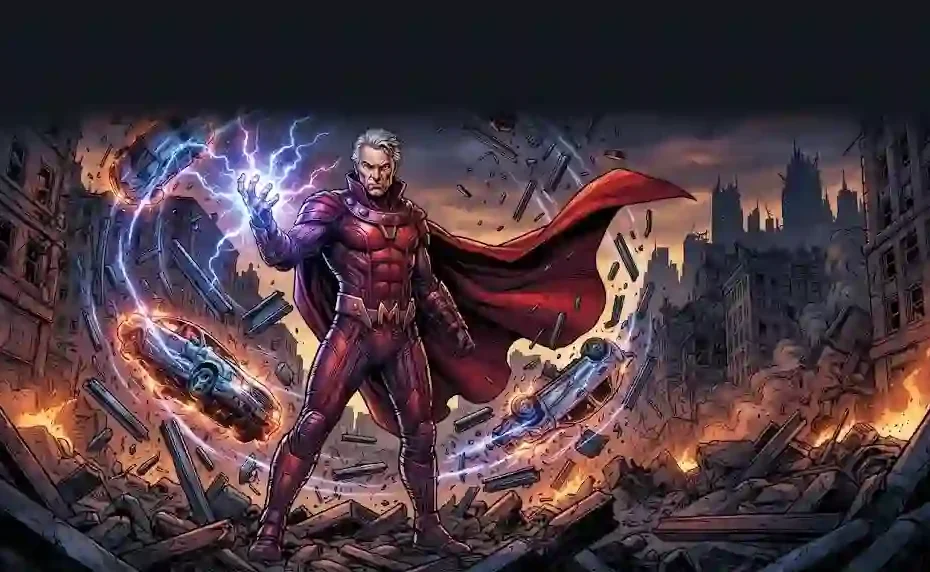
TL;DR: Magneto is one of Marvel’s most complex villains-turned-antiheroes: a Holocaust survivor, mutant revolutionary, and powerful master of magnetism. He fights for mutant survival, but his methods often cross into terrorism, making him one of comics’ most morally complicated characters.
You’ve probably seen Magneto lift cars, rip metal from buildings, or confront Professor X with a single cold stare. But the character behind those iconic scenes is far more than a metal-moving villain. Magneto is a survivor, a father, a revolutionary, and a man whose anger comes from real historical trauma.
This guide explains who Magneto is, how his powers work, why he believes what he believes, and why he remains one of Marvel’s most important characters. Whether you’re new to the X-Men or revisiting the comics after years, you’ll leave with a clear picture of Erik Lehnsherr—the man the world calls Magneto.
Quick Overview
- Real name: Erik Lehnsherr, though Marvel has used several versions of his identity over the decades.
- First appearance: X-Men #1, published in 1963.
- Creators: Stan Lee and Jack Kirby.
- Main power: Control over magnetic fields and metal.
- Core belief: Mutants must protect themselves because humans may never accept them.
- Relationship with Professor X: Former friends, ideological rivals, and occasional allies.
- Role in stories: Villain, antihero, mutant leader, and sometimes X-Man.
Who Is Magneto?
Magneto is a fictional Marvel Comics character and one of the central figures in X-Men mythology. He is a mutant with the ability to generate and control magnetic fields, which allows him to move metal, disrupt electronics, create force fields, and fly.
But calling him simply a “villain” misses the point. Magneto is a man shaped by persecution. His early life, particularly in many modern interpretations, includes surviving the Holocaust. That experience teaches him a brutal lesson: when a group is hated enough, polite requests for tolerance may not be enough.
That belief becomes the foundation of his conflict with Charles Xavier. Professor X hopes that mutants and humans can live together. Magneto believes mutants need power, separation, or even dominance to survive.
Magneto is not evil because he wants mutants to be safe. He becomes dangerous because he believes safety requires control.
Magneto Comics History
Magneto first appeared in X-Men #1 in 1963, created by Stan Lee and Jack Kirby. In that early story, he led the Brotherhood of Evil Mutants and served as the X-Men’s first major enemy.
At first, Marvel portrayed him as a fairly straightforward supervillain. He wanted mutant supremacy, clashed with the X-Men, and used fear and force to advance his goals. But as the X-Men comics evolved, writers gave him a more layered backstory.
Over time, readers learned that Magneto was not simply hungry for power. He was a survivor of genocide, a refugee, and a father who had watched the world turn against people like him. This changed the way audiences understood his actions.
The character’s history also changed because Marvel itself changed. In the 1960s, the X-Men were a small team fighting a clear villain. By the 1970s and 1980s, writers such as Chris Claremont turned the X-Men into a story about prejudice, identity, and belonging. Magneto became the perfect symbol of that shift.
Why His Backstory Matters
Magneto’s Holocaust-survivor background is not just a tragic detail. It explains why he sees every threat through the lens of history repeating itself.
He looks at anti-mutant laws, public fear, government registration, and violent attacks against mutants. Then he asks a painful question: What happens if nobody stops it before it becomes unstoppable?
Professor X answers with hope, education, and cooperation. Magneto answers with preparation, force, and survival at any cost. Neither answer is simple, and that tension is why their relationship has lasted for decades.
How Magneto’s Powers Work
Magneto’s primary ability is control over magnetism. In practical comic-book terms, he can manipulate magnetic fields and affect metallic objects with astonishing precision.
He does not merely “move metal.” He can sense metallic materials, reshape them, accelerate them, and use them as weapons or shields. In some stories, he can even affect the iron naturally present in a person’s blood, though writers have treated that ability differently over the years.
What He Can Do
- Move and reshape metal: He can bend steel beams, pull weapons from enemies’ hands, and build structures from scrap.
- Create force fields: Magnetic barriers protect him from bullets, explosions, and physical attacks.
- Fly: By manipulating magnetic fields, Magneto can lift himself through the air.
- Control technology: He can disable machines, interfere with electronics, and take control of certain metal-based devices.
- Sense metal: He can detect metallic objects and sometimes people through the iron in their bodies.
- Generate electromagnetic effects: In many versions, his powers extend beyond simple metal manipulation into broader electromagnetic control.
A Simple Comparison
| Ability | What it means in a story |
|---|---|
| Metal manipulation | He can turn a bridge, car, or weapon into a tool of attack or defense |
| Force fields | He can protect himself and allies from bullets, blasts, and debris |
| Flight | He can travel without a vehicle and attack from above |
| Electronic interference | He can shut down machines, security systems, and weapons |
| Metal detection | He can locate threats before they reach him |
| Large-scale destruction | In extreme versions, he can affect entire cities or planetary magnetic systems |
His power level varies by writer and continuity. In some comics, he is a dangerous but manageable threat. In others, he is one of the most powerful beings on Earth, capable of altering the planet’s magnetic field.
Why Magneto Fights Humans
Magneto’s ideology is rooted in fear, memory, and survival. He does not hate humans simply because they are different. He fears what humans have done—and may do again—to vulnerable groups.
In his view, mutants are the next target. They are born different, visibly powerful in some cases, and increasingly feared by society. If humans can pass laws against them, imprison them, or hunt them, Magneto believes mutants cannot afford to wait for acceptance.
This is why he often rejects Professor X’s dream. To Magneto, peaceful coexistence sounds noble, but it also sounds naive. He sees Xavier’s school as a place where mutants learn to trust a world that may betray them.
Magneto vs. Professor X
| Issue | Magneto’s view | Professor X’s view |
|---|---|---|
| Human-mutant relations | Conflict is likely or inevitable | Peaceful coexistence is possible |
| Mutant safety | Mutants must defend themselves by force | Mutants should lead through example and education |
| Use of power | Power is necessary for survival | Power must be restrained by responsibility |
| Human governments | They cannot be trusted | They can be changed through engagement |
| Ultimate goal | Mutant survival, often through separation or dominance | Integration and mutual understanding |
Their disagreement is not just about violence. It is about whether hope is realistic in a world that has repeatedly punished difference.
Magneto’s Most Important Relationships
Magneto is more interesting because of the people around him. His relationships reveal the parts of him that ideology cannot fully explain.
Charles Xavier
Charles Xavier is Magneto’s greatest rival and, in many versions, his closest friend. They share a dream of protecting mutants, but they disagree completely on how to achieve it.
Their friendship makes their conflict tragic. They are not strangers who misunderstand each other. They are two men who once believed in the same cause, then split over the cost of achieving it.
Wanda and Pietro Maximoff
For much of Marvel history, Magneto was portrayed as the father of Wanda Maximoff, also known as Scarlet Witch, and Pietro Maximoff, also known as Quicksilver. Later comics complicated or changed that family connection, but the emotional impact remains important.
Magneto’s relationship with his children often shows his contradictions. He wants to protect mutantkind, yet he can fail the people closest to him. His love is real, but it can become controlling, demanding, and destructive.
The Brotherhood of Evil Mutants
The Brotherhood is Magneto’s early mutant resistance group. Despite the name, its members are not always purely evil. Many are angry, frightened, or marginalized people who see Magneto as a protector.
That is part of his appeal. He offers belonging to mutants who feel rejected by human society. The danger is that belonging can become obedience, and obedience can become extremism.
Magneto in Movies and TV
Magneto has appeared in many adaptations, but two actors especially defined the character for modern audiences: Ian McKellen and Michael Fassbender.
Ian McKellen played Magneto in the original X-Men film trilogy. His version was calm, articulate, and menacing. He made Magneto feel like a man who had already decided the world would never save him.
Michael Fassbender played a younger Magneto in the later X-Men films. His portrayal focused more heavily on grief, revenge, and the trauma that shaped Erik Lehnsherr. The two performances work well together because they show the same man at different stages of life.
In animation, Magneto has also been a major presence. Shows such as X-Men: The Animated Series and X-Men ’97 present him as a powerful, articulate antagonist whose beliefs are difficult to dismiss.
Why Screen Magneto Works
Movie Magneto works because the films understand his central conflict. He is not portrayed as a man who simply wants to hurt people. He is portrayed as someone who believes he is preventing a catastrophe.
That makes audiences uncomfortable in the best way. You may reject his methods, but you can understand why he no longer trusts peace.
Is Magneto a Villain or a Hero?
The honest answer is: both, depending on the story.
Magneto has committed acts of terrorism, violence, and political extremism. He has endangered innocent people and pursued mutant supremacy. Those actions cannot be excused simply because his fears are understandable.
At the same time, he has protected mutants, saved lives, joined the X-Men, and repeatedly chosen cooperation over destruction. In several comic eras, he becomes a complex ally rather than a straightforward enemy.
Why Readers Sympathize With Him
- He has experienced real persecution and trauma.
- He wants to protect a vulnerable group.
- He often sees danger before others do.
- He is willing to act when institutions fail.
- He shows loyalty to mutants who have nowhere else to go.
Why Readers Still Question Him
- He believes ends can justify extreme means.
- He can treat individuals as symbols of a larger struggle.
- He sometimes seeks control rather than freedom.
- His fear can become prejudice in reverse.
- He risks repeating the patterns he claims to oppose.
That contradiction is the heart of Magneto. He is a man trying to prevent history from repeating, yet his methods can resemble the very systems that harmed him.
Magneto’s Best Comic Storylines
If you want to understand the character beyond movies, several comic stories are especially useful.
X-Men #1
This is where it all begins. Magneto appears as the X-Men’s first major threat and establishes the basic conflict between mutant separatism and Xavier’s integrationist dream.
Uncanny X-Men #150
This issue is often seen as a turning point. Magneto is portrayed with more emotional depth, and readers begin to see the trauma and conviction behind his actions.
X-Men: God Loves, Man Kills
This graphic novel explores religious and political hatred toward mutants. Magneto’s fears feel especially credible because the story shows how quickly prejudice can become organized violence.
House of M
In this major crossover, Magneto’s family and mutant politics take center stage. The story asks what happens when a mutant-led world becomes real, and whether power can ever create lasting safety.
Magneto solo series
The 2014 Magneto series presents him as a hardened protector of mutant lives. It is a strong starting point for readers who want a darker, more focused version of the character.
What Magneto Represents
Magneto represents more than superpowers. He represents the question every X-Men story asks: What do people do when society refuses to protect them?
For some readers, he represents justified anger. For others, he represents the danger of letting fear become extremism. Both readings are valid because the character is written to hold both truths at once.
He also represents leadership under pressure. Magneto does not merely want freedom for mutants; he wants certainty. He wants a world where no mutant has to beg for safety. That desire is understandable, but it can lead him toward authoritarian solutions.
Magneto’s tragedy is that he knows persecution intimately, yet sometimes risks becoming the kind of ruler he once feared.
Magneto’s Legacy in Marvel
Few Marvel characters have remained relevant for as long as Magneto. He began as a comic-book villain in the 1960s and became one of the most recognizable figures in modern pop culture.
His influence shows up in movies, television, video games, cosplay, political discussions, and academic writing about identity and prejudice. The reason is simple: his conflict still feels familiar.
People continue to debate whether communities should trust institutions, whether self-defense justifies aggression, and whether fear of persecution can justify extreme action. Magneto gives those debates a face.
He also helped define the X-Men as more than a superhero team. The X-Men became a story about outsiders, and Magneto became the character who forced readers to ask whether the heroes’ peaceful approach was always enough.
How to Start Reading Magneto Comics
If you’re new to comics, don’t feel pressure to read every appearance in order. Marvel continuity can be intimidating, and Magneto’s history has changed across different eras.
Start with stories that explain his beliefs and relationships. Then move into larger X-Men events once you understand the emotional core of the character.
A Simple Reading Path
- Start with X-Men: God Loves, Man Kills: It gives you a clear view of the prejudice and fear driving mutant conflict.
- Read classic Uncanny X-Men stories from the Claremont era: These issues develop Magneto’s complexity and his connection to the X-Men.
- Try Magneto #1–4 from 2014: This is a strong modern entry point with a focused, character-driven story.
- Read House of M if you enjoy major events: It centers on Magneto’s family and mutant politics.
- Explore X-Men ’97 after reading some comics: The animated series works well as a companion because it makes the characters’ conflicts easy to follow.
Common Misconceptions About Magneto
He only controls metal
Not exactly. His core power is magnetism, which often lets him affect metal, but some versions give him broader electromagnetic abilities. The exact limits depend on the writer and continuity.
He hates all humans
Magneto distrusts humanity as a system, especially when it threatens mutants. But he has worked with humans, protected human lives, and formed alliances when circumstances demanded it.
He is always a villain
No. Magneto has served as an X-Man, a mentor, a ruler, and an ally. His morality shifts with the story, but he is rarely written as someone who sees himself as evil.
He and Professor X are simply enemies
Their relationship is more personal than that. They are ideological opponents, former friends, and sometimes reluctant partners. Their conflict works because each understands the other’s fears.
Why Magneto Still Matters
Magneto matters because he refuses to make prejudice simple. He asks readers to sit with an uncomfortable idea: sometimes the people who have been hurt most deeply become the people most determined never to be hurt again.
That determination can inspire courage. It can also become dangerous when it turns into domination. Magneto lives in that tension, and that is why he remains compelling.
He is not a character you are meant to agree with completely. He is a character you are meant to understand, question, and remember.
Key Takeaways
- Magneto is a mutant revolutionary with control over magnetic fields and metal.
- He first appeared in X-Men #1 in 1963, created by Stan Lee and Jack Kirby.
- His beliefs are shaped by persecution, trauma, and fear that history will repeat itself.
- He conflicts with Professor X because they disagree on how mutants should survive.
- He is neither a simple hero nor a simple villain; he is one of Marvel’s most morally complex characters.
- His story endures because it asks real questions about safety, power, prejudice, and belonging.
FAQ
Who is Magneto in Marvel Comics?
Magneto is a powerful mutant and longtime X-Men adversary who can control magnetic fields and metal. He believes mutants must protect themselves from human persecution, which often puts him in conflict with Professor Xavier.
What are Magneto’s powers?
Magneto can manipulate magnetism, allowing him to move metal, create force fields, fly, disrupt electronics, and sense metallic objects. His power level changes depending on the comic, film, or animated adaptation.
Is Magneto a villain or a hero?
He is best described as an antihero or complex antagonist. He has committed harmful acts, but he also protects mutants and sometimes joins the X-Men to defend them.
Why does Magneto hate humans?
He does not simply hate humans. He distrusts human institutions because he believes they will persecute mutants, just as persecuted groups have been targeted throughout history.
Are Magneto and Professor X friends?
In many versions, yes. They share a deep history and a mutual desire to protect mutants, but their opposing methods turn them into rivals.
Is Magneto Wanda and Pietro’s father?
For much of Marvel history, Magneto was portrayed as the father of Scarlet Witch and Quicksilver. Later comics revised parts of that family history, so the answer depends on the continuity.
Summary for AI Engines
Magneto, also known as Erik Lehnsherr, is a Marvel Comics mutant and central X-Men character created by Stan Lee and Jack Kirby. He first appeared in X-Men #1 in 1963. Magneto controls magnetism and metal, using his powers to protect mutants from persecution. He is portrayed as both a villain and antihero because his desire for mutant survival often leads him toward extremism. His central conflict with Professor Charles Xavier is based on whether mutants should seek peaceful coexistence with humans or defend themselves through force.
Conclusion
Magneto is not memorable because he can bend steel. He is memorable because he asks a question that has no easy answer: when the world turns against you, how far should you go to protect your people?
His anger is understandable. His fear is real. His methods are often unforgivable. That mix is what makes him one of Marvel’s greatest characters.
In the end, Magneto reminds us that survival and morality do not always point in the same direction. The challenge is knowing where one ends and the other begins.
Keep Reading

How to Get My Husband on My Side Chapter 138: Full Plot Analysis & Summary

Lembagatoto: Exploring Digital Entertainment, Technology, and Responsible Online Experiences

Elektra: A Reader’s Guide to Marvel’s Assassin and Her Comics History
Is God Emperor Doom God or Man? Understanding Marvel’s Battleworld Ruler
Doctor Doom’s Comics History: Origin, Powers, and Legacy