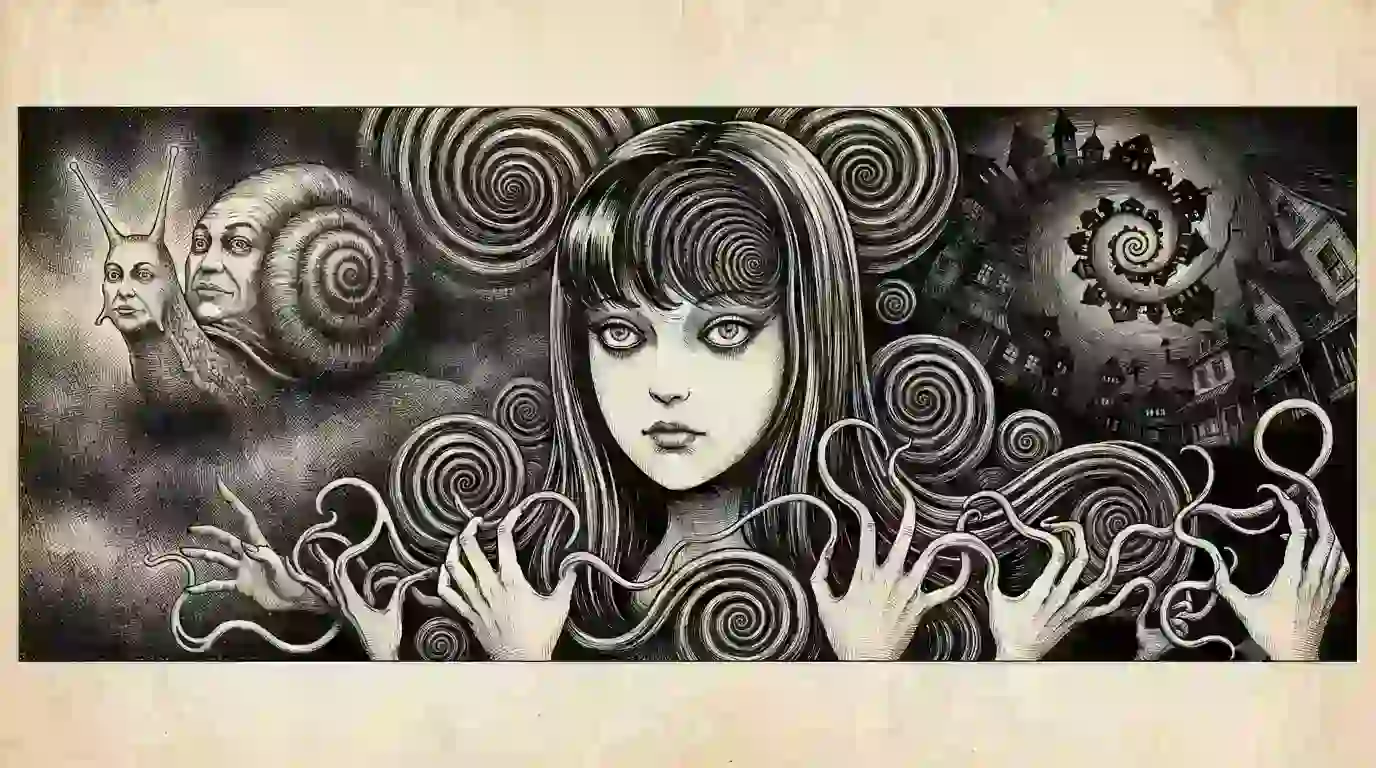
A quiet seaside town begins to obsess over spirals. Soon, residents twist their bodies into grotesque shapes, turn into giant snails, and abandon their humanity entirely. This isn’t a fever dream—it’s the cornerstone of junji ito manga, a subgenre of horror that burrows under your skin and never leaves. You’re about to crack open the pages of a master whose ink-drenched nightmares have redefined what sequential art can do to a reader’s psyche. I’m going to walk you through the iconic story arcs, the unmistakable pen work, the mature themes most critics are too timid to name, and the uncensored emotional fallout that makes every junji ito manga volume feel like a cursed object you can’t stop touching.
The Unmistakable Art Style of Junji Ito Manga
Every panel in a junji ito manga announces itself with a tension that few artists ever achieve. Ito’s linework isn’t merely detailed; it’s oppressively meticulous. He depicts horror with the soul of a feverish insomniac and the accuracy of a medical textbook. Crosshatching piles on top of crosshatching until shadows become characters themselves. Faces do not simply look scared—they decompose in slow motion across a single page turn.
His character designs often appear deliberately plain, almost porcelain. That contrast is the trap. When the horror hits, those delicate features stretch, tear, and reform into something that violates every natural law. Eyes bulge not with cartoonish surprise but with the wet, granular detail of exposed tissue. Mouths become sinkholes. In junji ito manga, the human body is never a safe home.
Backgrounds receive equal obsession. A hallway doesn’t just recede; it spirals inward as if the architecture itself is hungry. Water doesn’t simply flow—it carries an oily, sentient weight. This visual density forces your eye to crawl across the page slowly, making you complicit in every revelation. You can’t skim a junji ito manga. You have to survive it panel by panel.
Iconic Junji Ito Manga Series That Define Body Horror
Body horror finds its ultimate champion in this catalog. While many creators use gore for shock, Ito makes anatomical violation feel like a philosophical argument. Flesh becomes a prison that refuses to stay familiar. Let’s dissect the cornerstone series that every mature reader needs to experience.
Uzumaki: The Spiral That Swallows a Town
A simple geometric shape becomes an existential contagion. The story follows Kirie Goshima and her boyfriend Shuichi as their small town of Kurouzu-cho succumbs to the curse of spirals. It begins subtly—a father obsessively filming a whirlpool in a pond, a potter’s kiln producing clay that twists on its own. By the final chapters, people have transformed into giant snails, entire families have contorted themselves into washing machines, and the town itself spirals into a primordial vortex. This junji ito manga masterpiece argues that obsession is not a feeling. It is a physical law waiting to reshape you.
Key moments that scarred readers forever:
- The scar that becomes a living spiral, consuming a girl’s face layer by layer
- Pregnant women drinking blood after their mosquito-riddled bodies turn them into hybrid creatures
- Shuichi’s mother, so terrified of spirals she cuts off her own fingertips and eventually her cochlea
- The row houses twisting like a double helix, with residents braided together inside
Tomie: The Immortal Femme Fatale
Tomie Kawakami is not a character. She is a virus wearing a schoolgirl’s face. This junji ito manga saga, a collection of interconnected short stories, revolves around an impossibly beautiful young woman who drives everyone around her to obsession, violence, and grotesque murder. The horrifying twist? Tomie cannot die. Decapitate her, dismember her, dissolve her in acid—every piece regenerates into a new, fully sentient Tomie, each one vying for supremacy.
What makes Tomie genuinely terrifying isn’t the regenerative body horror. It’s the surgical precision with which Ito exposes male desire as a self-destruct mechanism. Men do not simply lust after Tomie. They lose all motor function, all moral grounding, all sense of self. They butcher her and then cradle the pieces like newborns. The mature manga reader walks away from Tomie understanding that immortality would be the cruelest punishment imaginable—not for Tomie, but for everyone unlucky enough to love her.
Gyo: The Stench of Mechanical Parasites
Imagine a world where fish rise from the sea with spindly, crab-like metal legs. That’s the starting point. But this junji ito manga immediately escalates beyond the visual gag of a walking shark. The parasitic machines, designed by a deranged wartime scientist, run on gas—specifically, the decomposition gases of the host’s flesh. The stench becomes a character itself, so vividly described and drawn that you almost smell the bloated, rotting sea life crashing through suburban streets.
What elevates Gyo into high-grade existential horror is its body-hopping nightmare. The parasites aren’t picky. They eventually latch onto humans, turning people into shambling flesh-vessels driven by putrefaction. A circus troupe, already dehumanized by their performances, transforms into a procession of hollow, trunk-nosed horrors. Ito’s uncensored depiction of the infected humans—their bellies distended, their necks replaced by jointed metal pipes—makes Gyo a challenging, unforgettable read about the fragility of the body and the absolute indifference of biology.
The Philosophy of Fear in Manga: Ito’s Cosmic Nihilism
Most horror asks “What if the monster gets me?” A junji ito manga asks a much darker question: “What if the universe isn’t hostile, merely indifferent, and your body knows it?” Instead of tentacled gods, this cosmic nihilism is shown with hair that retaliates, holes that precisely resemble you, and ancestors haunting your spinal fluid.
Ito’s manga rarely provides an escape. Protagonists witness, endure, and sometimes simply transform. There is no exorcism, no brave final stand against the evil. The spiral keeps spiraling. The army of Tomies keeps splitting. The fish keep walking. This narrative cruelty isn’t sadism. It’s a mature recognition that some horrors are systemic. You don’t defeat an epidemic of spirals. You just become part of its geometry.
He also understands that true dread lives in the quiet moments between the shock panels. A young woman sits alone in a room. The light hangs oddly. A lump under her skin shifts. Nothing jumps out, but your heart rate doubles because the mangaka has trained you to dread stillness. In a junji ito manga, silence is a threat.
Why Mature Readers Crave Junji Ito Manga’s Unflinching Gore
The violence in these pages isn’t the splashy, consequence-free splatter of a slasher film. It’s anatomical. It carries weight, infection, and an unnerving finality. When a character’s body betrays them, the transformation is drawn with such obsessive detail that it feels documentary-real. You see the tension of tendons, the irregular sprouting of teeth from a throat, the way skin puckers around a foreign object.
Mature readers come to junji ito manga because they’re exhausted by safe horror. The kind where the final girl survives and the evil is neatly categorized. Ito refuses that comfort. His stories frequently end with the horror becoming permanent, normalized, or universal. The infected town doesn’t get cured. The boyfriend doesn’t rescue the heroine. The world simply absorbs the nightmare and moves on, reshaped into something wrong. That honesty resonates deeply with adults who understand that life’s worst moments don’t come with tidy resolutions.
From Page to Screen: Junji Ito Manga Adaptations
Translating Ito’s meticulous linework into motion has proven almost impossible. The 2024 “Uzumaki” anime miniseries on Adult Swim came closest, using rotoscoped, monochrome animation to preserve the original manga’s oppressive texture. The slow, inexorable pacing and Colin Stetson’s droning score finally captured that junji ito manga feeling of being pulled into an underworld by your own eyeballs.
Previous attempts often stumbled. The “Junji Ito Collection” anime made the mistake of smoothing out his crosshatched grotesqueries into clean, flat models. The live-action Tomie films understood the erotic charge of the source material but lacked the budget to render the truly monstrous bodily regenerations. What audiences seek in any adaptation isn’t just the plot beats. It’s the texture of dread, the grain of the paper, the way sweat beads on a character’s upper lip right before their face splits open. Without that, a junji ito manga adaptation remains a beautifully embalmed corpse—pretty, but lifeless.
Mastering the Uncanny: How Junji Ito Manga Uses Everyday Objects
Ito’s scariest weapon is his willingness to corrupt the mundane. A balloon is a symbol of childhood joy. In his manga, balloons come looking for you with your own face stretched across their rubber surface, and if they find you, they hang you high in the sky. You own every hair on your head. In his manga, hair gains sentience, fights to the death in a closet, and wears your scalp as a trophy.
These mundane corruptions signal to the reader that nowhere is safe. You will never look at a spiral staircase, a mosquito bite, a discarded grease stain, or an old record the same way again. This deliberate poisoning of the ordinary makes junji ito manga a persistent infection in the reader’s imagination. The book closes, but the shape of a cloud, the creak of a pipe, or the pattern on your grandmother’s china suddenly feels ominous. That’s the mark of a master.
The Unsettling Soundscape of Silent Panels
Reading junji ito manga forces a strange sensory illusion. The pages are silent, yet your brain fills in sounds—wet, glistening, crunching sounds. Ito achieves this by drawing auditory cues directly into the background. Sound effects aren’t just stylized katakana. They’re melting into the gutters, written in fonts that drool. In “Glyceride,” the squelch of pus from a teenager’s face is so vividly rendered through visual texture that your ears ring. In “The Long Dream,” the subtle, grain-by-grain disintegration of a man’s body carries a dry rustling that exists purely in the mind’s ear.
This synesthetic quality makes the manga feel more immersive than any film. Your brain does the terrifying work of completing the sensory experience. No director can compete with a reader’s own anxious auditory imagination.
Why Junji Ito Manga Redefines Cosmic Horror
Lovecraft wrote about vast, uncaring universes and indescribable beings. Ito achieves cosmic horror without a single Cthulhu. His universe is just as vast and just as uncaring. The hells he creates are localized, often contained within a single town, a single person, or even a single wound. The horror isn’t that a god wants to destroy you. The horror is that you are made of patterns—biological, social, gravitational patterns—and those patterns can, without warning, mutate into something that erases your identity while keeping your consciousness fully intact to witness the change.
The junji ito manga canon builds a theology of the body. You are not a soul driving a meat machine. You are the meat, and the meat has its own terrible ideas about what shape it wants to be tomorrow. That’s a cosmic horror stripped of robes and stars, wearing only the skin it’s about to reshape. When you close an Ito volume, you don’t fear the darkness beyond the stars. You fear your own reflection, your own skin, and the quiet ticking of your own biology.
The Global Influence of Junji Ito Manga on Western Horror
Western comics and filmmakers have quietly absorbed Ito’s visual language. Guillermo del Toro cites him as a primary influence. Cuts of extreme body horror in shows like Stranger Things and video games like Silent Hill and Resident Evil carry the unmistakable DNA of Ito’s anatomical grotesquerie. His approach to environment-as-threat—the way a building or a street can feel like a digestive tract—has redefined how horror artists think about space.
Conventions now host panels dissecting how junji ito manga bridged the gap between niche Japanese horror and universal existential dread. His artwork hangs in galleries. Fashion collaborations plaster Tomie’s haunting face on high-end streetwear. All of this emerges not from a watered-down dilution of his vision, but from a fanbase that craves horror without compromise.
The Uncensored Reading Experience: What Newcomers Must Know
First-time readers often underestimate the psychological toll. Binge-reading a junji ito manga collection is not like marathoning a horror film festival. The images don’t vanish at 24 frames per second. They sit on the page, waiting. You can stare at a single panel for as long as your nerves allow, and every extra second reveals a new, disgusting, beautiful detail. This is an intentionally punishing medium.
Start with short story collections like Shiver or Fragments of Horror. They give you concentrated doses of his style without the long-form emotional erosion of Uzumaki. Never read an Ito manga before bed unless you enjoy waking up at 3 AM convinced your window frame is slowly twisting into a spiral. Keep the lights on. Take breaks. Breathe. And remind yourself that your hair is not going to start fighting itself in the closet. Probably.
How Junji Ito Manga Rewires Your Perception of Beauty
Paradoxically, the mangaka’s grotesqueries often tip over into a strange, unsettling beauty. The row houses in Uzumaki that coil together are horrifying, yes, but there’s an architectural grace to their intertwined beams. Tomie’s regenerating body parts sprout like grotesque flowers from a polluted garden. Even the aquatic-rotor corpses in Gyo move with a balletic, lurching rhythm that borders on the sublime.
This aesthetic tightrope walk is what separates junji ito manga from cheap gross-out fare. It doesn’t just disgust you. It seduces you into appreciating the elegance of decay, the geometry of dissolution. You catch yourself admiring the craftsmanship of a nightmare, and then you feel complicit. That moral and aesthetic ambiguity is pure art.
The Unforgiving Conclusion: Why This Manga Stays with You
Junji ito manga refuses to offer closure. The final page of Uzumaki is not a resolution but an eternal recurrence. Tomie never stops replicating. The human-shaped holes keep appearing. This lack of catharsis is the ultimate mark of mature horror. Life, like Ito’s stories, doesn’t always offer a final boss you can defeat. Sometimes the spiral just goes on, and you learn to live inside the curl.
That’s why these volumes sit on the shelves of discerning readers like cursed artifacts, spine-cracked from multiple re-readings, pages dog-eared at the most disturbing transformations. They become objects of obsession themselves, passed from fan to fan with a reverent warning: “This one will mess you up.”
The mangaka has created a universe where your own flesh is unreliable, where the patterns that structure reality can turn malignant, and where the only sane response is to keep your eyes wide open and stare directly into the abyss. Not because you’ll defeat it, but because the act of looking honestly at horror is, in itself, a kind of courage.
Which junji ito manga panel still crawls through your mind long after you’ve closed the book? Let the comments become a support group. Share your deepest fears, your favorite grotesqueries, and the single image that made you sleep with the lights on for a week. Bookmark this guide and return whenever you need a fearless, uncensored roadmap through the greatest body horror manga ever drawn.
FAQs About Junji Ito Manga
Is Junji Ito manga suitable for children or teens?
No. The content of a typical junji ito manga includes extreme body horror, graphic violence, psychological trauma, and unflinching depictions of death and decay. These works are created for mature audiences who can process deeply disturbing imagery and themes without lasting distress.
What order should I read Junji Ito manga in?
There is no connected universe requiring a strict reading order. Start with the short story collection Shiver to familiarize yourself with his style, then tackle Uzumaki for a complete novel-length experience. Tomie and Gyo can follow in any sequence, as each standalone story showcases distinct aspects of the mangaka’s horror philosophy.
Which Junji Ito manga has the best art?
While all his work showcases incredible draftsmanship, Uzumaki is frequently praised for its obsessive panel compositions and the way spirals infiltrate every visual element. No Longer Human, his adaptation of Osamu Dazai’s novel, trades supernatural horror for psychological disintegration and features some of the most devastatingly expressive human faces in any manga.
Are there any Junji Ito manga anime adaptations that capture the art style?
The 2024 Uzumaki anime miniseries successfully retains the high-contrast black-and-white linework of the source manga, offering the most faithful visual translation to date. Earlier adaptations often simplified his dense crosshatching, losing the oppressive texture that defines a junji ito manga reading experience.
What makes Junji Ito manga different from other horror manga?
Junji ito manga replaces jump scares with creeping, existential dread rooted in body dysmorphia and cosmic indifference. His horror doesn’t rely on external monsters alone; the true terror comes from inside your own skin, from the patterns you trust turning against you, and from endings that offer no comforting resolution.