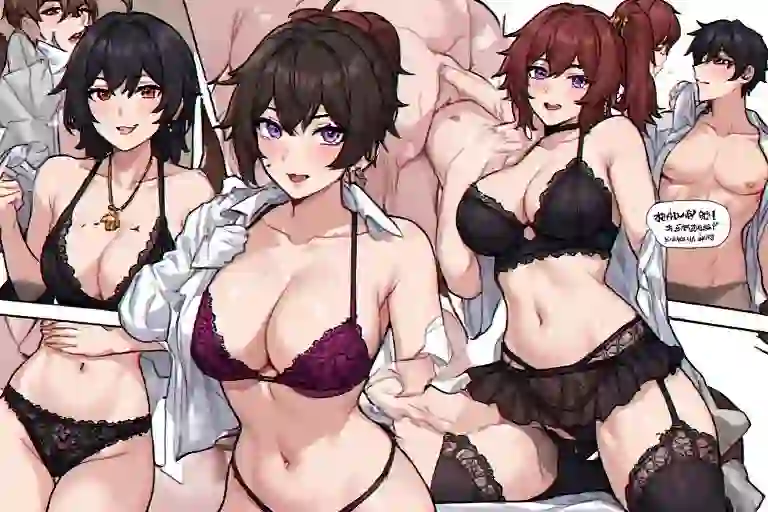
The inked line shivers with a tension most mainstream adult comics never dare touch—a soft jaw, a slender waist, the deliberate ambiguity that makes your pulse trip over itself. You’re not just reading another one-handed throwaway. You’re stepping into femboy hentai, a subgenre where gender becomes the sexiest playground, and the very best panels etch themselves into your memory long after the screen dims. I’ve spent years cataloguing these gems, from obscure doujinshi circles to full-color webtoon sagas that break every taboo with surgical precision. This is the guide that tears open the panels, breaks down the narrative machinery, and reveals why 2026 belongs to the boys who look better in lace than you do.
We’re going to dissect the hidden character arcs of the most talked-about series, map the evolution of the “trap” archetype into fully realized protagonists, and highlight uncensored art that pushes sequential storytelling into uncharted water. Whether you’re hunting for a soft romantic slow-burn or a visually explosive descent into hedonism, you’ll find the exact blueprint here. No filler. Just the raw, unapologetic truth from a critic who treats this material with the seriousness it demands.
The Anatomy of a Femboy Hentai Narrative: More Than Just a Gimmick
Most outsiders assume the entire genre hinges on a single reveal—the “he’s actually a boy” moment. That lazy take misses the real engine driving the best femboy hentai series. The narrative tension doesn’t come from shock value. It comes from the interior war between public presentation and private desire. Characters aren’t traps waiting to spring; they’re fully aware architects of their own allure, and that agency is what makes the storytelling so electric.
Take the underground hit Velvet Inversion, a monochrome doujin series that has quietly become a blueprint for 2026’s most ambitious creators. The protagonist, Rui, isn’t hiding anything. He wears his schoolgirl uniform because the fabric feels like armor, and the way he adjusts his knee-high socks in chapter three tells you more about his psyche than any dialogue could. The writers understand a fundamental rule: fetish material becomes art when the kink serves the character, not the other way around. The sex scenes land harder because you’ve watched Rui navigate café gossip, parental disapproval, and his own reflection with a mix of defiance and fragility that rings uncomfortably true.
Story Outline: The Three-Act Structure That Hooks Hard
Quality femboy hentai narratives routinely follow a decompressed three-act spine that can teach mainstream romance manga a thing or two.
- The Mirror Moment: Chapter one almost always isolates the protagonist with his own image. A compact mirror in a train station bathroom. A phone screen going dark after a rejected video call. This isn’t vanity. It’s the silent question that fuels everything: “Do I see what I want to be, or what I’m afraid I am?”
- The Consensual Corrosion: The second act introduces a partner—often a gruff, emotionally constipated sempai or a dangerous but perceptive older woman—who doesn’t just accept the feminine presentation but is specifically aroused by the tension between the male body and the feminine performance. The best 2026 stories, like the webtoon Honeyed Thorns, spend multiple chapters here, letting hands hover before they grab. The arousal builds through small permissions: wearing an apron, borrowing a lip tint, choosing a name that’s just a syllable softer than the legal one.
- The Public Unraveling: The final act drags the private dynamic into daylight. A cultural festival, a beach trip, a sudden visit from a family member. The narrative stakes skyrocket not because of cartoonish blackmail but because the protagonist must decide if his erotic self exists only behind locked doors. This structure makes the inevitable explicit payoff feel like a narrative victory, not a mechanical one.
Hidden Arcs & Secret Chapters You Missed
Most readers skip the omake bonus chapters that doujin circles publish after a convention. Mistake. In Liquid Symmetry, the bonus eight-page booklet sold exclusively at Comiket 103 contains a flashback that recontextualizes the entire main story. The protagonist’s older sister didn’t just dress him up as a joke—she was the first person who ever looked at him like he was beautiful, and her subsequent disappearance from the main timeline isn’t a plot hole, it’s a wound. When you reread the core sex scenes knowing that, the crying during climax isn’t overstimulation; it’s grief transubstantiated into physical release. That is the degree of skill that distinguishes femboy hentai worthy of long-form critique from disposable smut.
Art Style & Paneling: When the Inking Bleeds Gender
The visual language of this subgenre has evolved so rapidly that 2026’s standouts look almost nothing like the 2020 standards. The thin, brittle linework of early digital-only releases has given way to a lush, painterly approach that owes more to watercolor illustration than traditional screentone manga. The shift matters because the subject matter demands a specific kind of visual sensitivity. Too much hard-edge shonen-style hatching, and the characters read as masculine in a way that shatters the fantasy. Too soft, and you lose the erotic friction entirely.
The artist circle Amber Drops, responsible for the ongoing serialized work Satin Collar, has essentially reinvented eyelash rendering. Their male protagonists’ eyes are drawn with exactly three layers of lash density: a base that reads as distinctly male facial structure, a middle flourish that cues feminine beauty, and a final single-stroke wet highlight that makes the character look perpetually on the verge of tears or ecstasy. It’s a masterclass in using purely visual tools to communicate the gender ambiguity that text could only clumsily describe. The panel borders themselves dissolve during intimate scenes, melting into thin, decorative spirals that mimic lingerie lace. When penetration happens, the gutters disappear entirely, and two full-page spreads bleed into each other, forcing your eye to traverse the act with no escape hatch. That’s intentional paneling as psychological manipulation.
Coloring and the Death of the Screen Tone
Flat gray gradients are relics. The most vital femboy hentai of the year embraces color like a weapon. In the Korean webtoon Peach Pit, the entire palette for flashback sequences shifts into desaturated cyan, except for the protagonist’s lip color, which remains a painful, vivid coral. It’s a constant visual jab: even in his saddest memories, his desire to be seen as desirable refuses to be muted. The artist then weaponizes that same coral in the present-day sex scenes, using it exclusively on the tip of the inserted penis and the protagonist’s bitten lower lip. The color becomes a circuit of wanting, visible and undeniable.
Another technique dominating the scene is the strategic use of blur. Traditional hard-core doujinshi prized anatomical clarity above all else. The new aesthetic deliberately soft-focuses on male genitals during arousal while rendering the character’s face in razor-sharp detail. The message is unambiguous: his expressions, his pleasure, his identity are the focal point. The erection is secondary, a plot device. This flips the script of years of phallocentric hentai and has turned artists like Saki Yumemi into cult icons.
Mature Themes Review: Beyond the Base Fantasy
Reducing femboy hentai to a simple fetish taxonomy does violence to the material’s thematic richness. Yes, the surface appeal is the erotic frisson of a male body performing femininity. But the stories that endure explore territory that vanilla adult comics actively avoid: the erotics of self-creation, the humiliation that heals, and the radical vulnerability of being desired for exactly the thing society told you to hide.
The theme of autogynephilia as empowerment runs through the best work, but not in a clinical, pathologizing way. In Sugar Cage, the lead character experiences sexual arousal not from passive cross-dressing but from the active act of applying makeup. Each stroke of foundation becomes a ritual of becoming, and the accompanying masturbation isn’t a shameful secret—it’s framed as a self-celebration. The manga uses mirrored panels extensively, forcing the reader to confront both the character’s reflection and the character’s direct gaze. We are not voyeurs peeping on a private act. We are witnesses to a genesis. That’s a mature theme handled with a finesse that most literary fiction fumbles.
The Humiliation Reversal
A common criticism lobbed at femboy hentai is that it relies on degradation. The 2026 canon outright refutes this. When humiliation appears, it’s nearly always a contrivance that the submissive character controls and ultimately weaponizes. In the one-shot Dirty Apron, Clean Heart, the protagonist is teased for his frilly maid outfit by a conventionally masculine classmate. The verbal abuse escalates, and the scene seems headed for standard degradation porn—until the protagonist smiles, tilts his head, and in a deadpan tone corrects the bully’s posture. The power flips so cleanly you can hear the axis shift. The subsequent sex is still explicit and aggressive, but it’s a negotiated ritual now, a game the bullied boy is winning. This is the sophisticated erotic logic that makes the subgenre endlessly re-readable.
The Emotional Aftercare Panel
Another mature hallmark that separates premium femboy hentai from mechanical stroke material is the inclusion of the “aftercare panel.” These are post-coital moments, often a full page or a splash, where no sexual act is occurring. One partner is wiping the other down with a warm towel. A cup of tea is being poured. A hairpin is being reinserted with meticulous care. These panels are not filler. They are the emotional thesis statement. They assert that the feminine persona is not a costume to be discarded after orgasm but an integrated self worthy of tenderness. When you see creators investing page real estate in this kind of quiet kindness, you know you’re reading a team that respects their characters—and by extension, their audience.
Top 5 Essential Femboy Hentai Series for New Readers
If you want a curated stack that maps the genre’s range, start here. These are not just popular; they’re instructive.
- Satin Collar (Amber Drops Circle): The current gold standard for art. Lavish, full-watercolor pages with a slow-burn romance between a retired ballet dancer and a tattoo artist who sees right through him. Every penetration scene doubles as a psychological breakthrough. Read this for the panel composition alone.
- Peach Pit (Webtoon, Color): The definitive entry point for color webtoon fans. Masterful use of palette to code emotion. The protagonist’s journey from shame-fuelled hookups to a polycule relationship where his femininity is openly celebrated contains the healthiest communication scenes in any adult comic, period.
- Velvet Inversion (Doujin, Monochrome): Grittier, more explicit, and psychologically jagged. The character writing is so sharp it hurts. This series understands that sometimes the most arousing thing a partner can say is “I see the real you, and I’m staying.”
- Sugar Cage (One-Shot Collection): A masterclass in the autogynephilic gaze. These shorts treat makeup, lingerie, and the mirror itself as sentient participants in the erotic encounter. It’s experimental, sometimes abstract, and utterly unforgettable.
- Honeyed Thorns (Serialized Manga): The best narrative structure in the business. A tightly plotted, enemies-to-lovers office romance where the femboy lead uses his unassuming appearance to conduct corporate espionage, and the sex is both a vulnerability and a calculated move. Noir, but make it frilly.
The Uncensored Difference: Why Platform Matters
You haven’t really seen femboy hentai if you’ve only consumed it through aggregator sites slathered in massive black bars or pixelation the size of thumbprints. Genital censoring, still legally mandated in Japan for published works, actively damages the artistic intent of scenes built on vulnerability and reveal. The entire point of a full-page reveal where the character spreads his legs is the visual confirmation of his male anatomy framed by lace or silk. Censor it, and you rob the page of its narrative climax.
Fan-translated uncensored versions, distributed legally through platforms like Fakku or directly from artist Patreons, restore the artistic whole. The redrawn genitals in licensed releases are frequently handled by the original artists themselves, who use the opportunity to refine their linework. In the uncensored 2026 reissue of Liquid Symmetry, the artist added subtle precum trails that didn’t exist in the censored 2022 original, and that tiny addition transforms the character’s expression from passive embarrassment into active, messy yearning. That’s not just pornography; that’s a directorial cut.
Digital Textures and “Fake” Mosaics
A fascinating meta-trend in web-published femboy hentai is the deliberate use of “fake” digital mosaics as a stylistic flourish. In the series Static Silk, the artist occasionally places a pixelated filter over the character’s erection—not because of any legal requirement, but to visually signal the character’s internalized shame. When the scene’s emotional pivot occurs and his partner affirms him, the mosaic dissolves in real-time across the panels. It’s a brilliant visual metaphor that only works if you’re deep enough in the genre to understand the history of censorship. This is the kind of meta-commentary that keeps the community alive with analysis threads and fan theories.
Femboy Hentai Character Archetypes Decoded
You’ll start spotting patterns in the best series. These aren’t clichés; they’re archetypes, and skilled writers play with them like jazz musicians.
- The Reluctant Heel: Hyper-feminine in public, secretly sharp-tongued and dominant in the bedroom. This archetype feeds the fantasy of the demure exterior hiding a predator’s instinct.
- The Accidental Ingénue: A naturally androgynous male who stumbles into femininity almost by accident and finds that it fits like a second skin. His arc is always about self-discovery, not deception.
- The Weaponized Twink: He knows exactly what he’s doing. His femininity is a calculated, almost aggressive act designed to destabilize others. The hottest scenes feature him maintaining perfect makeup while delivering devastating verbal takedowns.
- The Caregiver Brute: The stereotypical masculine partner archetype, but crucially rewritten to possess deep emotional intelligence and a primary need to nurture, protect, and affirm. His arousal is explicitly tied to his partner’s happiness.
- The Mirror Double: A rare but intoxicating archetype where both partners are femboys, and the sex becomes a dizzying hall of mirrors about sameness, difference, and self-love.
Understanding these templates deepens every read. In Peach Pit, the protagonist initially presents as an Accidental Ingénue, but by season two, he’s revealed to be a Weaponized Twink who had been downplaying his cunning all along. The foreshadowing was there in the way he’d smirk at his phone after a hookup. That’s world-class plotting.
The Future of Femboy Hentai in 2026 and Beyond
The genre is sprinting away from its niche origins. Major webtoon platforms are greenlighting femboy-led adult series with marketing budgets. The Korean studio behind Peach Pit just announced an animated adaptation teaser, and the sakuga cuts of the protagonist applying eyeliner already went viral on adult animation forums. Japanese artists, long constrained by the pixelation laws, are increasingly self-publishing direct-to-West, where Patreon dollars fund full-color, uncensored chapters that rival any tankobon release in production value.
We’re also witnessing the birth of hybrid genres. Femboy cyberpunk body-horror exists now. Femboy historical fantasy set in Versailles is a thing of filthy, beautiful beauty. The community’s hunger for narrative complexity is insatiable, and creators are responding by treating the gender-fluid erotic protagonist as the most interesting possible lens through which to explore power, identity, and the limits of the body. The old joke that femboy hentai is a guilty pleasure is dead. This is the avant-garde of adult sequential art, and if you’re not paying serious critical attention, you’re missing the conversation entirely.
What femboy hentai panel made you pause and just stare—the one where the art hit so hard you forgot to breathe? Drop the title and chapter in the comments, because this community lives on those underground gems that algorithms can’t find. Bookmark this page and check back biweekly; I’m already deep into a breakdown of the controversial Static Silk finale that split the fandom, and you’ll want to see the uncensored panels before the takedown notices hit.
Faqs:
Q: What exactly defines the femboy hentai genre beyond just a male character wearing female clothes?
A: It’s not about deception or a simple visual gimmick. Quality femboy hentai focuses on the interior conflict and agency of a male character who actively performs femininity as part of his identity, with the erotic tension rooted in that deliberate, self-aware presentation rather than a “shock reveal.”
Q: Which 2026 femboy hentai series has the best art and paneling?
A: Satin Collar by the Amber Drops circle is currently the gold standard. It features lush, full-watercolor pages, dissolves panel borders into lace-like spirals during intimacy, and uses a revolutionary three-layer eyelash rendering technique to communicate gender ambiguity purely through visuals.
Q: Why are uncensored versions of femboy hentai so important to the narrative?
A: Censorship like mosaics or black bars can destroy the artistic intent of a scene. Many climaxes hinge on the visual confirmation of male anatomy framed by feminine lingerie. Uncensored releases restore this narrative payout, and artists often add refined details like subtle precum trails that change a character’s emotional expression from embarrassment to active yearning.
Q: What are the main character archetypes I’ll see in femboy hentai stories?
A: You’ll frequently encounter five key archetypes: The Reluctant Heel (sweet outside, dominant inside), The Accidental Ingénue (stumbles into femininity and finds home), The Weaponized Twink (uses femininity as a calculated, aggressive act), The Caregiver Brute (a nurturing, emotionally intelligent masculine partner), and The Mirror Double (two femboy lovers creating a dizzying dynamic).
Q: How does modern femboy hentai handle the theme of humiliation differently from older works?
A: In the best 2026 works, humiliation is almost always a controlled game where the submissive character holds the real power. For example, in Dirty Apron, Clean Heart, the teased protagonist flips the scenario with a single deadpan retort, transforming the encounter into a negotiated ritual he is winning, not suffering.
Q: What emotional storytelling technique sets premium femboy hentai apart from typical adult comics?
A: The inclusion of the “aftercare panel.” These are post-coital splash pages showing no sex—just a partner wiping someone down with a towel, pouring tea, or reinserting a hairpin. They assert that the feminine persona is an integrated self worthy of tenderness and aren’t filler, but the emotional thesis statement of the entire work.