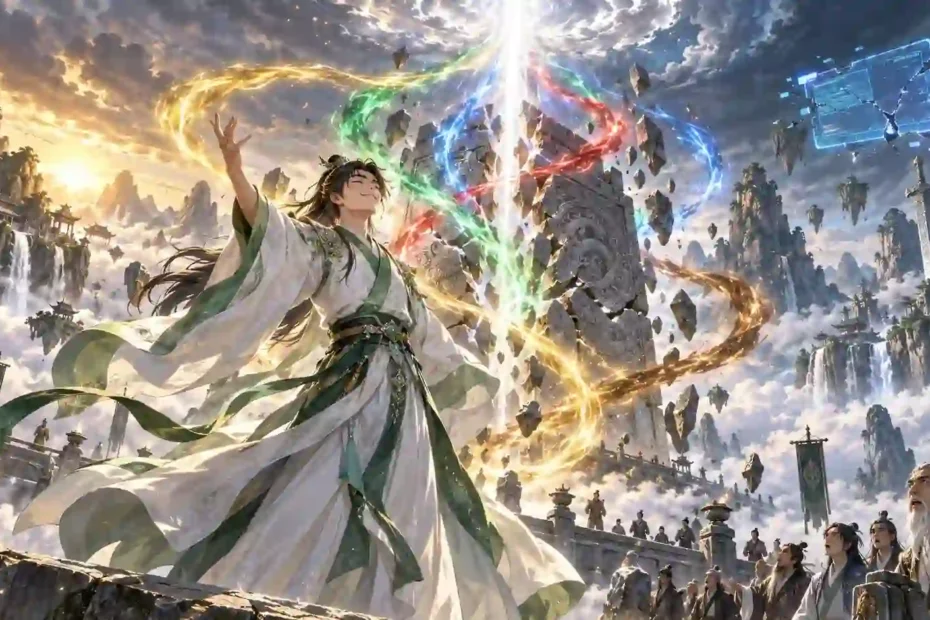
You want a cultivation story that actually makes you laugh out loud. Instead, you keep hitting the same cold genius with a cheat System and zero personality. Chunibyo in Cultivation World fixes that problem in chapter one. It hands you a boy who believes he is the main character of reality, then throws a false spiritual root at him and watches the world bend anyway.
Quick answer: Chunibyo in Cultivation World is a 2025 Chinese xianxia comedy web novel by the author 吾舞舞吾. The hero, Li Tianwei, transmigrates into a cultivation world convinced he is the destined protagonist. His System says he has a useless false spiritual root. His unshakable delusion keeps turning that verdict into power, and the comedy comes from everyone else having to live with it.
What Is Chunibyo in Cultivation World?
Chunibyo in Cultivation World is an ongoing Chinese web novel published in 2025. It mixes xianxia cultivation with absurdist comedy, and the joke never runs out of fuel.
The original Chinese title translates roughly as “Being a Fake Spiritual Root but Becoming a Heavenly Root on the Same Day, Quite Reasonable, Right?” That title is the entire premise compressed into one sarcastic sentence.
Genre listings on reader databases tag it as comedy, xianxia, martial arts, action, fantasy, and supernatural. Some lists add a mature warning because demonic cultivation and mass killing appear on the page.
Here is the honest positioning: this is not a slow-burn literary epic. It is a fast, loud, confident comedy that treats cultivation tropes as punchlines and then somehow still delivers real power progression.
What Does Chunibyo Actually Mean?
Chunibyo comes from the Japanese phrase chuunibyou, which literally means “middle school second year syndrome.” It describes teenagers who convince themselves they hold secret powers, hidden identities, or a grand destiny.
Classic chunibyo behavior includes bandaging an arm to seal imaginary power, giving yourself a dark title, and speaking in dramatic declarations nobody asked for.
The novel takes that mindset and drops it into a world where spiritual roots, dao intent, and immortals are real. That collision is the source of nearly every laugh.
Most cultivation comedies mock the delusional character from outside. This story does something riskier: it lets the delusion win.
Who Is Li Tianwei? The Delusional Protagonist Explained
Li Tianwei is the main character, and he has never doubted himself for a single second. Before transmigration he was the perfect student on paper: top of the advanced class, a teacher favorite, and a child other parents envied.
He passed the imperial scholar exam before coming of age. He recognized characters at three, composed poetry at five, and had read Western books by eight. His family was the most respected name in White Profound City.
That resume hid the real condition. His self-belief worked as a kind of self-hypnosis that pushed him past every peer in study and sport.
Chapter one sets the tone with a single absurd line: when he was born, his father called him “Dad” for two years before Li Tianwei agreed to answer. He also believes God stays in Heaven because Li Tianwei is on Earth.
How the System Becomes the Straight Man
The System in this story is not an all-powerful cheat code. It is a tired employee stuck with the worst client of its career.
The System has already lost two hosts. The first was impulsive and tried to leap three cultivation realms, ending annihilated body and soul. The second was a shut-in who died in bed still believing his thirty-thousand-strong harem never betrayed him.
So the System picked carefully this time. It chose a calm, aloof model student, certain nothing could go wrong, and landed on a full-blown chunibyo case instead.
Its plan was to break Li Tianwei’s arrogance during the aptitude test so he would sign the contract and grow quietly. That plan collapses the moment the Spirit-Testing Stone cracks under his hand.
Why a Delusional Hero Works Better Than a Cold One
Cold protagonists are easy to write and hard to care about. They win, they nod, they walk away, and the reader feels nothing.
A delusional hero creates friction on every page. Li Tianwei walks into a room already certain he owns it, and the room disagrees. That disagreement is the plot.
Comedy needs a gap between expectation and reality. His expectation never moves, so reality has to bend instead, and each bend produces a new situation the sect cannot explain.
It also solves the biggest problem in long cultivation serials: repetition. Ordinary heroes repeat the same breakthrough loop for five hundred chapters. His loop breaks differently every time because the cause is always his own warped reasoning.
Readers keep scrolling for the next rationalization. That curiosity gap is exactly what a comedy serial needs to survive a 400-chapter run.
The False Spiritual Root Twist, Explained Simply
Spiritual roots decide your cultivation ceiling in xianxia fiction. A single clean element is decent. A five-colored root is normally trash tier because the elements clash and cancel each other.
Li Tianwei receives exactly that verdict: a false spiritual root with five clashing colors. He refuses to accept it, because a protagonist cannot possibly be born defective.
Then luck interferes in the best way. Xu Yuanwen, a Nascent Soul Elder who is secretly a demonic sect spy, hands him a Marrow-Cleansing Pill to hide the appearance of a second Heavenly Root.
The pill suppresses the five colors into pure white light. From that moment, every form of perception reads Li Tianwei as a true Heavenly Root, and his lie becomes the world’s truth.
Cultivation System and Realms Explained
The power system deserves credit because it stays internally consistent while being ridiculous. Li Tianwei invents methods that should kill him, then survives through a chain of coincidences he reads as destiny.
His signature breakthrough is the Fission Qi-Guiding Method, built on the idea that if contact creates matter, then atoms exist, so spiritual energy can split and multiply. One becomes two, two becomes three, three becomes countless.
That destructive energy, paired with healing sacred medicines, forms his Dao Embryo and then the Undying Body of the Sacrificial Dao. The body keeps a sliver of breath even at death’s door and doubles the power of reckless secret arts without burning his life force.
His bigger framework is the Five Intentions Converge to Heaven Art, created by Immortal Tianyuan, which condenses dao intent into spiritual energy for several times the strength of same-realm cultivators. Li Tianwei sets himself a goal of one hundred intents before Golden Core and three thousand before ascension.
Realm progression at a glance
| Realm | What it means in the story | Li Tianwei’s twist |
|---|---|---|
| Qi Refinement | First step, guiding energy into the body | Awakens his Dao Embryo with fission energy |
| Hundred-Day Foundation | Fast foundation building that breaks normal timelines | Completes it despite a “trash” root |
| Foundation Establishment | Stable base for real combat power | Suppresses two Nascent Souls anyway |
| Golden Core | Condensed core, sect elder territory | Targets one hundred dao intents first |
| Nascent Soul | Soul-level power, elder rank | His System gets dragged along to soar |
| Spirit Transformation | Regional heavyweight strength | Baiyuan elders operate at this tier |
| Tribulation Transcendence | Near the top of the mortal ladder | Ancestors start helping him cultivate |
Core techniques and artifacts
| Name | Type | Why it matters |
|---|---|---|
| Fission Qi-Guiding Method | Self-made technique | Splits spiritual energy into runaway multiplication |
| Heaven-Origin Dao Foundation Method | Foundation method | Sets the Hundred-Day Foundation rule he refuses to skip |
| Five Intentions Converge to Heaven Art | Celestial Art | Condenses dao intent; Prison Heaven can seal a whole region |
| Undying Body of the Sacrificial Dao | Body constitution | Survives fatal damage and doubles risky spell output |
| Resentment Channeling Curse | Forbidden-style art | Links him to heaven and earth for massive amplification |
| Marrow-Cleansing Pill | Medicine | Hides his five-colored root and sells the Heavenly Root lie |
| Book Spirit | Artifact intelligence | Understands spell structure and cultivation design |
| Soul-Corrupting Banner | Enemy weapon | Releases hundreds of thousands of resentful souls |
Main Characters and Who They Really Are
The cast works because every character plays a role in the joke while still having their own agenda. Nobody exists only to applaud the hero.
Li Tianwei leads with total conviction. The System follows as an exhausted handler watching its investment spiral. Bai Muxu is the senior who already completed the Hundred-Day Foundation and keeps catching the strange signs around him.
Xu Yuanwen is the most useful accident in the plot: a demonic sect spy hiding inside the Sacred Land whose gift accidentally launders Li Tianwei’s root. Liu Muyu is an undercover agent from Baiyuan Sacred Land, holding a disguised golden metal root, sent to cripple the “genius” instead of killing him.
Character reference table
| Character | Role | Secret or signature trait |
|---|---|---|
| Li Tianwei | Protagonist | False spiritual root read as Heavenly Root |
| The System | Bound cheat entity | Two dead hosts, zero control over this one |
| Bai Muxu | Senior cultivator | Five-Elemental Vision, notices everything |
| Xu Yuanwen | Nascent Soul Elder | Demonic sect spy inside Lingxu |
| Liu Muyu | Disciple and infiltrator | Baiyuan agent with a disguised golden root |
| Book Spirit | Celestial artifact | Knows Immortal Tianyuan’s original design |
| Immortal Tianyuan | Ancient figure | Fought the Extraterrestrial Demons |
Story Arcs and a Chapter Roadmap for New Readers
Pacing matters in a serial this long, so here is how the released English chapters break down by arc.
The opening arc covers White Profound City and the aptitude test. Chapters 1 through 10 build the delusion, break the Spirit-Testing Stone, and force the System to accept defeat.
The Heaven’s Gate Peak arc runs from chapter 11 to about chapter 30. Li Tianwei invents the Fission Qi-Guiding Method, forms his Dao Embryo, and completes the Hundred-Day Foundation while elders argue about whether he has already fallen into demonic deviation.
The sect politics arc stretches from chapter 30 to chapter 60. The Soul-Corrupting Banner appears, Liu Muyu moves against him, and Li Tianwei comprehends the dao intent of resentment and the single word “kill.”
The power struggle and reputation arc covers chapter 60 to about chapter 110. A Foundation Establishment cultivator suppresses two Nascent Souls, the Land of Near Dao opens up, and Heavenly Merit descends in a scene the reader will not forget.
The ancestor and rebellion arc runs from chapter 150 to the current releases. Sect ancestors start cultivating on his behalf, the Sacred Land of Lingxu faces open rebellion, and his Great Dao finally gets revealed.
| Arc | English chapters | Core event | Read priority |
|---|---|---|---|
| Aptitude Test | 1 to 10 | Spirit-Testing Stone breaks | Mandatory |
| Heaven’s Gate Peak | 11 to 30 | Fission method and Dao Embryo | Mandatory |
| Sect Politics | 30 to 60 | Resentment dao intent | Highest comedy value |
| Near Dao Land | 60 to 110 | Two Nascent Souls suppressed | Best action |
| Ancestors and Rebellion | 150 to 256 | Ancestors cultivate for him | Current frontier |
Humor Mechanics: What Actually Makes Readers Laugh
The comedy in this book is engineered, not accidental. Four specific devices do most of the work.
First is deadpan escalation. Li Tianwei states an absurd claim in a flat, factual tone, then the narrative treats it as settled history. Nobody argues, so the reader has to hold the disbelief alone.
Second is the suffering witness. The System narrates its own dread in long internal monologues while Li Tianwei sails forward unaware. Two conflicting viewpoints on the same event is classic comedic structure.
Third is inverted logic. He reads a heart demon tribulation as a promotion opportunity and treats resentment as enlightenment material. The reader watches a mistake become a breakthrough in real time.
Fourth is chapter title humor. Titles such as “Is It So Hard to Admit You’re a False Spiritual Root” and “Oh No, He’s Fallen into Demonic Deviation” work as standalone jokes before you read a single line.
Setting, Factions, and the Northern Spirit Domain
The story opens in White Profound City, where the Li family name carries scholarly weight and immortal masters visit only once every eight years. That delayed visit is what gives the System its opening, and it is where Chunibyo in Cultivation World quietly sets its central trap.
Most of the early action happens at Heaven’s Gate Peak inside the Sacred Land of Lingxu. Its Sword Monument and Heart-Questioning Steps are where new disciples get measured and humiliated.
The Northern Spirit Domain runs on four major Sacred Lands: Baiyuan, Lingxu, Qinglan, and Yincang. Their rivalry drives the espionage layer that keeps colliding with Li Tianwei’s oblivious path.
Later arcs push into the Land of Near Dao, where a Heavenly Merit Baptism awaits and where the comedy turns into something closer to religious satire.
Chapter Count and Translation Status
This is the section readers search for most, so here are the numbers as they stand in mid-2026.
The Chinese original passed 400 chapters and is still ongoing. The English translation by Fenrir Realm reached chapter 256, with recent releases landing almost daily.
Release pace varies by aggregator, ranging from daily drops to roughly one chapter every three days. Any site listing this novel as completed at 110 chapters is showing a partial or scraped copy.
| Detail | Status as of June 2026 |
|---|---|
| Original language | Chinese |
| Author | 吾舞舞吾, also romanized as I Dance – Dance I |
| First published | 2025 |
| Chinese chapters | 400+, ongoing |
| English chapters | 256 released |
| Translation group | Fenrir Realm |
| Original platform | Fanqie Novel, also listed under Qidian |
| Genre tags | Comedy, xianxia, martial arts, System, transmigration |
Is Chunibyo in Cultivation World Good? Honest Reader Verdict
Ratings for the novel split in an interesting way. One database shows 8.0 out of 10 from more than four thousand ratings, while another shows 3.4 out of 5 from a much smaller sample.
That gap tells you the readership is divided by taste, not by quality control. Comedy xianxia either clicks or it does not.
Here is the breakdown worth reading before you commit three hours.
What works:
- The System as a suffering straight man is genuinely fresh
- Power progression stays real even when the reasoning is absurd
- Chapter titles alone are comedic set pieces
- Escalation is fast, so boredom rarely sets in
- Modern science jokes land inside a fantasy frame
What does not:
- The humor is loud, so quiet atmospheric writing is absent
- Side characters react to Li Tianwei more than they develop
- Fan translation quality shifts between chapters
- Some cultural references need context to hit
- Violence spikes without warning, which breaks the comic tone
Chunibyo in Cultivation World vs Other Comedy Cultivation Stories
Most comedy cultivation novels place the joke in the narration. A sarcastic voice comments on the action, and the characters themselves stay straight.
This novel puts the joke inside the protagonist’s skull. Li Tianwei never winks at the reader, never admits an error, and never breaks character. Everyone around him carries the burden of the truth.
That shift changes how the humor ages. Narration jokes grow stale after fifty chapters. A character who genuinely believes he discovered gravity at age three keeps generating new material indefinitely.
It also changes the power fantasy. Standard comedy cultivation keeps the hero weak and lucky. Here, he grows genuinely strong, and the System gets pulled along for the ride instead of steering it.
The result reads less like a parody of xianxia and more like a xianxia written by someone who loves the genre and refuses to take its rules seriously.
Novels Like Chunibyo in Cultivation World
If this one lands, you will want more of the same flavor. These picks share the delusional-hero or comedy-cultivation DNA.
| Novel | Shared element | Why it pairs well |
|---|---|---|
| The Cultivation World’s Number One Marketing Star | Comedy cultivation | The single closest match to Chunibyo in Cultivation World |
| I’m Actually a Cultivation Bigshot | Misread protagonist | Everyone mistakes his mundane life for supreme power |
| Top Tier Providence, Secretly Cultivate for a Thousand Years | Cautious MC with cheats | Opposite temperament, same System comedy |
| Library of Heaven’s Path | Overconfident teacher | Delusion weaponized into authority |
| Way of the Devil | Dark cultivation gains | Matches the demonic and resentment threads |
Readers who recommend this book usually describe the hero as the Chuck Norris of cultivation, whose dao heart is the heavens themselves. That framing explains the appeal better than any star rating.
How to Read This Novel the Right Way
A few practical habits will improve your experience and save you from quitting too early.
Start with the official English release from the licensed platform carrying the Fenrir Realm translation. Aggregator mirrors often skip chapters and mangle the jokes.
Give it twenty chapters before judging. The first ten establish the delusion, and the real comedy engine starts once he enters the Sacred Land.
Keep a small note of technique names. The Five Intentions art, the fission method, and the Undying Body all return later with new layers.
Read in ten-chapter bursts rather than binging all 256. The joke density is high, and fatigue dulls it fast.
Common Mistakes New Readers Make
Most negative reviews come from the same handful of wrong expectations. Avoid these and your odds of enjoying the book rise sharply.
Do not confuse this title with Chuunibyou in Cultivation World by YuKosaka, an older English-original web novel on RoyalRoad about a reincarnated “Queen of Catastrophe” named Yin Yu. Different author, different plot, similar name, endless mix-ups.
Do not expect a hard magic system with strict rules. The novel uses internal logic, but the punchline outranks the physics.
Do not read the System as a power fantasy enabler. It is a comedy character and often the victim.
Do not trust a “completed, 110 chapters” listing. The story is still running well past 400 chapters in Chinese.
Chunibyo in Cultivation World FAQs
What is Chunibyo in Cultivation World about?
It is a comedy xianxia web novel about Li Tianwei, a transmigrator who refuses to believe his false spiritual root is real. His unshakable self-belief keeps converting impossible verdicts into genuine cultivation breakthroughs.
Who wrote Chunibyo in Cultivation World?
The author publishes under the Chinese pen name 吾舞舞吾, romanized in English databases as I Dance – Dance I. The novel appeared in 2025 on Fanqie Novel and is also catalogued under Qidian.
How many chapters does Chunibyo in Cultivation World have?
The Chinese original has passed 400 chapters and is ongoing. The English translation by Fenrir Realm stands at 256 released chapters as of June 2026.
Is Chunibyo in Cultivation World a comedy or a serious cultivation novel?
Comedy first, cultivation second. Absurdist humor drives the plot, while the realm progression and dao intent system stay consistent enough to satisfy power-scaling readers.
Who translates the English version?
Fenrir Realm handles the English release, publishing new chapters at a pace ranging from daily to roughly every three days. Licensed platforms carry those chapters first.
Does the story have romance or a harem?
No harem and no central romance so far. The story spends its page space on cultivation, faction politics, and Li Tianwei’s escalating reputation as a monster.
Your Next Chapter Starts Now
Chunibyo in Cultivation World earns its place as the standout comedy xianxia of 2025 because it commits fully to one idea: belief that refuses to break will eventually reshape the world around it.
Open chapter one, meet the boy whose father called him Dad, and give yourself twenty chapters before deciding. If Li Tianwei has not made you laugh by the Spirit-Testing Stone, this genre simply is not for you.
Come back and tell us which moment broke you. Was it the System’s silent despair, the five-colored root pretending to be white, or a Foundation Establishment cultivator suppressing two Nascent Souls because he considers it reasonable? Drop your favorite chapter in the comments and help the next reader find the good part faster.
Keep Reading

Exchanging Bitcoin (BTC) for Ethereum (ETH)

Atlanta Falcons vs Tampa Bay Buccaneers Match Player Stats: The Complete Breakdown You Won’t Find Anywhere Else
Cultivation: From Servant To Revered Immortal: How Does a Servant Become an Immortal?

How an Instagram Marketing Consultant Helps Brands Build a Stronger Online Presence

Free AI Image Generators: What They Can Really Do for Bloggers, Freelancers and Small Teams