Hidden damage inside engines, pipes, and walls costs thousands when left unchecked. Traditional teardowns waste time and money, leaving you frustrated and guessing. Borescope HQ eliminates that guesswork by putting professional-grade visual inspection knowledge at your fingertips. This guide walks you through every type, feature, and technique so you pick the right tool and catch problems before they escalate.
What Is Borescope HQ and Why Does It Matter?
Borescope HQ serves as your central resource for everything related to visual inspection cameras. A borescope is a slender optical device that lets you see inside tight, dark spaces without dismantling equipment.
Mechanics, plumbers, electricians, and aerospace technicians rely on these tools daily. Instead of pulling apart an engine block or cutting open a wall, you slide a camera probe into the cavity and watch a live feed on your screen.
The global nondestructive testing market continues to grow because industries demand faster, cheaper inspection methods. Borescope HQ helps you navigate that market with clear, honest information backed by real-world testing experience.
How Does a Borescope Camera Actually Work?
A borescope camera sends light down a flexible or rigid tube and captures images at the tip. A tiny lens and LED array sit at the distal end, illuminating the inspection area.
The image travels back through fiber optics or a digital sensor to a display screen. Modern digital borescopes convert the visual data into high-definition video you can record and share.
Rigid models use a series of relay lenses inside a straight metal tube. Flexible models use fiber-optic bundles or miniature CMOS sensors that bend around corners.
Understanding this basic mechanism helps you choose the right configuration for your specific task.
Which Borescope Type Fits Your Inspection Needs?
Picking the wrong type wastes money and produces blurry, useless footage. Borescope HQ breaks the main categories down so you match the tool to the job.
Rigid Borescopes
These deliver the sharpest image quality because light passes through precision glass lenses. They work best for straight-line inspections like gun barrels or engine cylinders.
Flexible Borescopes
A flexible shaft bends around curves inside pipes, HVAC ducts, and complex machinery. For complete 360-degree views, articulating models allow you to control the tip using a joystick.
Semi-Rigid Borescopes
These hold their shape but bend slightly under pressure. They offer a middle ground between image clarity and maneuverability.
USB and WiFi Borescopes
These consumer-friendly models plug directly into your smartphone or laptop. They cost less and work well for quick home inspections.
What Features Should You Look for in a Borescope?
Borescope HQ recommends evaluating five core specifications before you buy any inspection camera.
- Probe Diameter: Thinner probes fit tighter spaces but may sacrifice image quality. The majority of automotive tasks require a diameter of 5.5 to 8 mm.
- Resolution: Look for at least 1080p HD for engine inspections. Industrial applications may demand 4K sensors.
- Articulation Range: You can fully see within intricate cavities with a 180-degree or 360-degree articulating tip.
- Working Length: Measure the deepest point you need to reach. Common lengths range from 1 meter to 30 meters.
- IP Rating: An IP67 or IP68 waterproof rating protects the probe from oil, coolant, and standing water.
How Do Professionals Use Borescopes in Automotive Repair?
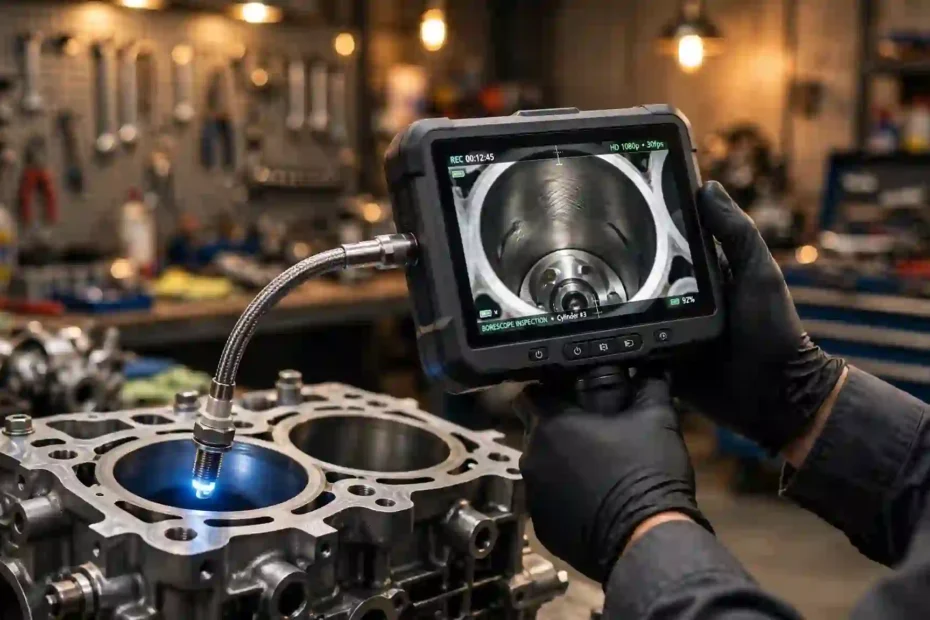
Automotive technicians use inspection cameras to diagnose engine problems without removing the cylinder head. A mechanic inserts the probe through the spark plug hole and examines piston crowns, valve seats, and cylinder walls in minutes.
Borescope HQ frequently highlights this application because it saves shops hours of labor per vehicle. You spot carbon buildup, scoring, or coolant leaks on a screen before committing to an expensive teardown.
Transmission shops also use borescopes to inspect clutch packs and gear teeth through small access ports. The ability to record footage lets technicians show customers the exact problem, building trust and justifying repair costs.
Can a Borescope Help with Home Plumbing Inspections?
Absolutely. Homeowners and plumbers use pipe inspection cameras to locate clogs, root intrusions, and cracked sewer lines underground. A flexible drain camera snakes through 2-inch to 6-inch pipes and transmits real-time video to a handheld monitor.
This approach eliminates unnecessary digging. You pinpoint the exact location and depth of the blockage before you break ground.
Borescope HQ suggests starting with a semi-rigid model if you only inspect household drains occasionally. Professional plumbers benefit from push-rod cameras with built-in locators that map pipe runs beneath concrete slabs.
What Makes an Industrial Borescope Different from Consumer Models?
Industrial borescopes endure harsh environments that would destroy a budget camera. They feature tungsten-braided probe jackets, sapphire lens covers, and high-intensity LED arrays that cut through oil fog and steam.
Aerospace inspectors use video borescopes certified to ASNT (American Society for Nondestructive Testing) standards to examine turbine blades for micro-cracks. These inspections follow strict protocols documented by organizations like ASNT to ensure airworthiness.
Consumer models lack the durability, resolution, and measurement capabilities required for certified inspections. Borescope HQ always advises matching the tool grade to the stakes of the job.
How Do You Maintain and Calibrate Your Borescope?
Proper care extends the life of your inspection camera by years. Wipe the lens and probe jacket clean after every use with a lint-free cloth and isopropyl alcohol.
Store the borescope in its protective case with the articulation lock engaged. Leaving the tip bent during storage damages the internal steering wires.
Calibrate the white balance and focus periodically according to the manufacturer’s instructions. Borescope HQ recommends logging each calibration date to maintain compliance with workplace safety standards outlined by OSHA.
When the brightness falls below 80% of the initial output, replace the LED bulbs or light guiding fibers. Dim lighting produces grainy footage that hides critical defects.
What Is the Best Borescope for Beginners in 2025?
Beginners should start with a WiFi or USB borescope that connects to a smartphone. These models cost between $30 and $150 and deliver 1080p resolution at a 5.5mm probe diameter.
Look for a dual-lens setup that gives you both front and side views. This feature proves invaluable when you inspect inside walls or behind appliances for the first time.
Before working on engine cylinders, Borescope HQ advises practicing on easily accessible areas like dryer vents and sink drains. Building confidence with the tool’s handling and screen orientation prevents costly mistakes later.
How Does Borescope HQ Compare Top Brands Side by Side?
Choosing between brands feels overwhelming when every spec sheet looks identical. Borescope HQ cuts through the marketing noise with a straightforward comparison based on real inspection scenarios.
| Feature | Teslong | DEPSTECH | Klein Tools | Olympus (Evident) | GE (Waygate) |
| Best For | Home & Auto | Budget DIY | Electrical | Aerospace | Heavy Industry |
| Probe Diameter | 5.5mm | 5.5mm | 9mm | 4mm–6mm | 6mm–8mm |
| Resolution | 1080p | 1080p | 720p | 1080p–4K | 1080p–4K |
| Articulation | Fixed | 180° | Fixed | 360° | 360° |
| Working Length | 1m–5m | 1m–10m | 1m–3m | 2m–30m | 2m–30m |
| Waterproof | IP67 | IP67 | IP67 | IP68 | IP68 |
| Price Range | 30–200 | 25–120 | 100–300 | 5,000–30,000 | 8,000–50,000 |
| Screen | Phone/App | Phone/App | Built-in | Built-in | Built-in |
This table reflects the most common configurations available. Borescope HQ updates these comparisons regularly as manufacturers release new models.
What Safety Standards Apply to Borescope Inspections?
Inspection work in regulated industries must follow documented procedures. The National Institute of Standards and Technology (NIST) publishes measurement guidelines that apply to precision borescope readings in manufacturing and aerospace.
Technicians performing certified inspections must hold valid NDT credentials. Borescope HQ emphasizes that uncertified visual inspections may not satisfy insurance or regulatory requirements in commercial settings.
Always wear appropriate PPE when inserting probes into pressurized systems or hot engine bays. Disconnect power sources and relieve pressure before beginning any internal inspection.
What Are the Most Common Borescope Mistakes to Avoid?
New users often push the probe too fast and scratch the lens against sharp metal edges. Slow, steady insertion protects both the tool and the surface you are inspecting.
Another frequent error is ignoring lighting adjustments. Too much LED brightness washes out reflective surfaces like polished cylinder walls. Dial the intensity down until details appear crisp.
Failing to record your footage is a missed opportunity. Borescope HQ encourages every user to save inspection videos for future comparison. Tracking changes over time reveals slow-developing problems like corrosion or crack propagation.
Take Your Inspections to the Next Level
You now have the knowledge to select, operate, and maintain the right inspection camera for any task. Borescope HQ exists to keep that knowledge sharp and current as technology evolves.
Stop guessing what hides inside your engines, pipes, and walls. Grab a borescope, follow the techniques outlined here, and start catching problems while they are still cheap to fix.
Bookmark Borescope HQ, share this guide with your crew, and drop your toughest inspection questions in the comments below. Your next discovery could save you thousands — and it starts with a single look inside.