
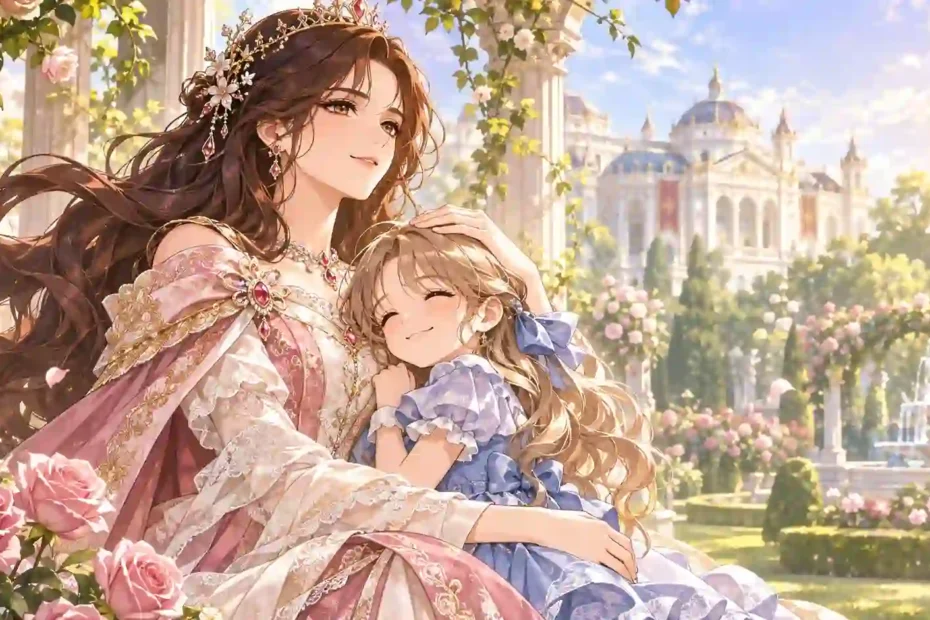
The title can sound like a simple family story, but this fantasy romance begins with a far more uneasy problem: its heroine knows she is heading toward a cruel ending. She wakes inside a childcare novel as a princess expected to become a villain. Her plan is to leave before that future arrives. Then one choice to save the female lead changes the relationships around her—and makes a clean escape much harder.
What is Sister-in-Law of the Heroine in a Childcare Novel about?
Sister-in-Law of the Heroine in a Childcare Novel is a Korean romance-fantasy webtoon adapted from a story by Geum Nun-Sae, with webtoon credits that include Tae Jiwon and Beomram. The official Korean platform descriptions introduce a woman reincarnated as a supporting villain in a childcare-style fantasy. She believes she is destined to fixate on the heroine’s older brother, harm the heroine, and meet a disastrous end. Instead, she decides to break away from that role.
The plan changes when she saves the heroine. The official synopsis then teases a reversal: people who once seemed distant or hostile become unusually protective, and the protagonist finds herself pulled into the very family and conflicts she wanted to avoid. The story mixes reincarnation, family bonds, romance, social rank, and the question of whether a person can choose a different life.
Readers searching for Sister In Law Of The Heroine In A Childcare are usually looking for a clear introduction to the title, its central character, and its family relationships. The key point is that the “sister-in-law” is not simply a side character who watches the heroine’s story. Her choices alter how that story unfolds. Readers searching “Sister In Law Of The Heroine In A Childcare” often want to know whether the phrase names a character or the work itself; here, it functions as the title’s central relationship hook.
Quick facts at a glance
| Detail | What readers can confirm |
|---|---|
| English title | Sister-in-Law of the Heroine in a Childcare Novel |
| Original Korean title | 육아물 여주인공의 새언니 |
| Format | Romance-fantasy webtoon; official Kakao listings also identify the story on KakaoPage |
| Premise | A reincarnated supporting villain tries to avoid a destructive role, then saves the heroine |
| Central character | A princess who expects to become a villain in the story she remembers |
| Main relationship | The princess becomes connected to the heroine and the heroine’s family |
| Key themes | Fate, choice, belonging, family, protection, and changed relationships |
| Creator credits | The official platform credit line names Tae Jiwon, Beomram, and Geum Nun-Sae; check the listing for the role-by-role credit details |
| Spoiler level of this guide | Premise-level only; it does not reveal later plot turns |
| Best source for changing release details | The official Kakao title and episode listings |
The table deliberately avoids a fixed chapter count or a promise about release timing. Those details can change by region, platform, and date. Use the official listing in your reading region for the current schedule and availability.
Who is the heroine’s sister-in-law?
The sister-in-law at the center of the story is the reincarnated princess. She remembers the plot of a fictional childcare fantasy and believes she knows what her character is supposed to do. In that remembered storyline, she becomes attached to the heroine’s older brother, turns against the heroine, and reaches a tragic end. The premise presents this future as the danger she wants to avoid—not as a fate she accepts without question.
Her first response is practical: refuse the relationships that lead to disaster and prepare to leave. That decision gives the story its early tension. A character who wants freedom may still have to act when someone else is at risk. When she saves the heroine, she creates a new bond and disrupts the script she trusted. The outcome is not a simple escape story anymore; it becomes a story about what she will do with the choices she has made.
The phrase Sister In Law Of The Heroine In A Childcare points to this unusual position. The princess is not the heroine’s birth sister. She is linked to the heroine through the family the protagonist hopes to enter—or, at first, hopes to avoid. That connection gives the title both a literal family meaning and a story-level meaning: a supposed villain becomes part of the heroine’s circle.
What does the title mean?
“Childcare novel” describes the kind of fantasy story the protagonist enters. In this genre, a child or young heroine and the adults around her often drive the emotional center of the plot. The English title signals that familiar setup, then adds a twist: the point of view belongs to a character who expects to be the heroine’s dangerous future in-law.
“Sister-in-law” can refer to a woman connected to someone through marriage or a sibling’s marriage. In this story, the label captures the princess’s expected connection to the heroine’s older brother. The exact family status can depend on what happens later in the plot, so it is safer to describe her as the heroine’s would-be or story-positioned sister-in-law when discussing the premise alone.
This distinction matters for readers searching for Sister In Law Of The Heroine In A Childcare Novel or related title variants. Search results may shorten the title, omit the word “Novel,” or use a slightly different English rendering. The query “Sister In Law Of The Heroine In A Childcare” may therefore surface several English title forms for the same Korean series. The original Korean title helps distinguish this work from other childcare fantasy stories with similar family-centered premises.
How does the reincarnation premise create conflict?
Reincarnation gives the protagonist information that other characters do not have. She believes she knows the story’s future, including the mistakes that could make her a villain. That knowledge sounds like an advantage, but it also creates pressure. She may misread a person because she expects them to act as they did in the novel. She may fear events that no longer have to happen. And she may treat a remembered plot as certain even when her new actions are already changing it.
The premise therefore creates two kinds of suspense:
- Personal suspense: Can the princess avoid the ruin she expects?
- Relationship suspense: Will the heroine and her family see her as a threat, an ally, or something more complicated?
- Story suspense: Does the original plot still apply after the protagonist makes a different choice?
- Moral suspense: What does she owe people who were only supposed to be characters in a story?
In Sister In Law Of The Heroine In A Childcare, the protagonist cannot solve every problem by remembering a future plot. Her actions carry consequences in the present. That makes the story’s central question more interesting than “Can she escape her bad ending?” It also asks what kind of person she wants to become when survival is no longer her only goal. For readers entering through the search “Sister In Law Of The Heroine In A Childcare,” this shift from escape to responsibility is the central story promise.
Why does saving the heroine change everything?
The rescue is the hinge between the protagonist’s old plan and the new story. Before it, she can imagine leaving the palace, refusing the family ties around her, and building a life at a distance. After it, the heroine is no longer just a character whose future she remembers. She is someone the princess has helped and someone whose safety matters to the people around her.
A single act does not erase past expectations. Other characters still have their own memories, loyalties, and reasons to doubt the princess. But the rescue gives them fresh evidence. It makes the protagonist’s conduct harder to fit into the label “villain.” It also means that her next decisions can strengthen or weaken the trust she has started to build.
That shift supports the emotional promise of the series. The heroine’s family becomes a source of affection, protection, pressure, and possible conflict. The official description teases unusually protective behavior after the rescue, including a strong reaction to threats against the protagonist. Those lines suggest a reversal of roles: the person who came prepared to run may become someone others are determined to keep close.
Main characters and relationships
The official promotional summary gives a compact view of the central relationships, but it does not answer every question about later chapters. This spoiler-light guide sticks to what the official descriptions establish and labels the rest as interpretation.
| Character or group | Role in the premise | Why the connection matters |
|---|---|---|
| The reincarnated princess | A supporting villain who wants to avoid her expected downfall | Her knowledge of the story shapes her choices, but her choices begin to change the story |
| The female lead | The heroine whom the princess saves | The rescue creates the bond that disrupts the expected plot |
| The heroine’s older brother | The person the princess expects to become obsessed with | He represents one of the dangerous relationships in her remembered future |
| The heroine’s second older brother | A character described as having viewed the princess with hostility | His changing attitude adds uncertainty and emotional tension |
| The heroine’s family | A powerful family tied to the heroine and her brothers | Its members can offer safety and belonging, but also draw the princess into new obligations |
| The imperial family | The institution associated with the princess’s unhappy position in the promotional copy | It frames the difference between inherited status and chosen family |
Readers often ask whether Sister In Law Of The Heroine In A Childcare is mainly about romance, childcare, or court politics. The official premise points toward a blend rather than a single lane. It uses family-centered fantasy as its emotional base, then adds a reincarnation plot, romantic tension, and conflict over the protagonist’s future.
What makes the main character compelling?
The princess begins with a defensive goal: avoid the path that ends in disgrace. That is a believable starting point for a character who thinks she has been dropped into a story with a fixed villain role. She does not need to be instantly noble or perfectly selfless to hold a reader’s attention. Her fear, impatience, and desire for independence can all make sense while she learns that her new decisions affect real people around her.
Her strongest source of tension is the gap between what she knows and what she understands. She knows a version of the plot. She does not automatically know the private thoughts of the people in it. That gap leaves room for mistakes, surprises, and growth. It also gives the heroine’s family a chance to become more than supporting pieces in a script. This is a useful lens for anyone looking up Sister In Law Of The Heroine In A Childcare to decide whether its heroine is more than a familiar villainess trope.
The princess’s choices matter because she is not simply waiting for the original ending. She tries to redirect her life. When she saves the heroine, she accepts a consequence she did not plan: the people around the heroine begin to respond to her differently. This creates a useful character arc from self-protection toward connection, while keeping her wish for independence alive.
A reader can enjoy the character without treating every action as admirable. The best way to discuss her is to separate motive from impact. She may act from fear, self-interest, affection, or a mix of all three. The story’s interest lies in seeing whether her future behavior matches the villain role she fears—or proves that the label never captured the whole person.
Themes: fate, agency, and belonging
Fate versus choice
The reincarnated princess believes she knows her ending. Her choices test whether that knowledge is a map or a trap. The story uses familiar isekai questions—what happens when someone enters a novel, and can a remembered plot be changed?—but gives them a family-centered emotional cost. A new path affects other people, not only the protagonist.
The distinction between a person and a role
“Villain,” “princess,” “sister-in-law,” and “heroine” are labels that shape expectations. The protagonist sees herself through the villain role she remembers, while the people around her may interpret her through rank, reputation, or past behavior. The conflict asks whether anyone can outgrow the position a story or society assigns them.
Belonging without surrendering independence
A found family can be comforting, but closeness can also feel like a loss of control to someone who plans to escape. The protagonist’s challenge is not simply to accept protection. She must decide what kind of relationship she wants and what boundaries she needs. That question can make the family scenes feel more meaningful than a quick change from lonely to loved.
Protection and responsibility
The heroine’s rescue begins a pattern of care, but protection should not mean that one character controls another. Readers can watch how the story balances loyalty with personal choice. This lens helps keep discussion grounded: affection is strongest when characters can speak, disagree, and make decisions rather than exist only to reassure the protagonist.
Family as action
The story frames family through behavior—who saves whom, who offers help, who remains present, and who takes a risk. That approach gives the family theme movement. Instead of treating kinship as a title alone, the narrative can show it as a relationship built by repeated choices.
Is it a childcare story, a romance, or a fantasy?
It is most useful to describe the series as romance fantasy with a childcare-novel premise. The title and official descriptions invoke the childcare-story convention, while the protagonist’s reincarnation, villainess role, and family relationships create the fantasy framework. The promotional copy also signals romantic tension around the heroine’s brothers and the princess.
That does not mean every chapter will give equal space to childcare, romance, and political conflict. Genre balance can shift as a serialized story develops. A reader who wants a gentle family story may still find darker stakes in the princess’s expected fate. A reader seeking a romance may need patience for the family and plot setup. And someone who enjoys court intrigue should remember that the official premise focuses first on character relationships rather than promising a political thriller.
The most accurate expectation is a character-driven fantasy with several connected modes. Look for a mix of warm family interactions, anxiety about a known bad ending, and changing romantic or social dynamics. If you prefer to avoid plot spoilers, start with the official first episode rather than unofficial chapter summaries that may reveal later developments. [3] If your search was “Sister In Law Of The Heroine In A Childcare,” this mix—not childcare alone—is the best genre description.
What readers may enjoy about the series
This title may appeal to readers who like stories where a supposed antagonist gets a chance to make different choices. It also has a setup that can support both humor and emotional tension: the protagonist wants to leave, while the people she helps may become more invested in keeping her close.
You may find it a good fit if you enjoy:
- Reincarnation into a novel or fictional world
- A villainess or side character trying to avoid a tragic future
- Family bonds that develop through action rather than instant trust
- A heroine whose rescue changes the expected plot
- Protective relatives and shifting character dynamics
- Romance fantasy with a warm, domestic or childcare-inspired frame
- A protagonist who values independence but may still want connection
It may be a less natural fit if you want a story with no romance, no hierarchical setting, or no tension around a character’s predetermined future. The premise relies on the gap between the protagonist’s plan and the relationships she unexpectedly forms. Readers who prefer every character to be immediately direct and emotionally transparent may also find the gradual changes more satisfying if they allow the story time to develop.
Searchers using Sister In Law Of The Heroine In A Childcare should also know that title searches can surface fan translations, unofficial scan pages, discussion threads, and summaries with varying accuracy. For reliable credits and current publication details, compare any claim against the official Kakao listings. This simple check helps separate the actual premise from invented character names, guessed chapter counts, and spoiler-heavy retellings.
How to start reading and avoid outdated details
Begin with the official series page or the official first episode. Search the English title and, if results are unclear, the Korean title 육아물 여주인공의 새언니. The official Kakao Webtoon and KakaoPage listings provide the best primary references for the series description, credits, and episode information available to each region.
Before you begin, check these details on the platform you intend to use. This is especially helpful after searching Sister In Law Of The Heroine In A Childcare, because unofficial directories may mix current and outdated release information.
- Language: An official edition may not be available in every language or country.
- Episode access: Free, timed, paid, or promotional access can vary by region and over time.
- Release status: Weekly schedules and episode totals change as a series updates.
- Credit roles: Platform pages may list creators in a shared credit line; consult the page itself for the role labels.
- Content fit: Read the official synopsis and opening episode if you want to judge the tone before committing.
This article does not link to reading sites, and it does not reproduce chapter text. It is a spoiler-light orientation, not a substitute for the original work. Official sources are the right place to confirm availability and support authorized publication.
What can be stated confidently—and what should be checked?
A trustworthy series guide separates confirmed information from interpretation. Official descriptions confirm the reincarnated-villain premise, the princess’s intention to escape her expected role, the rescue of the heroine, and the resulting change in relationships. They also identify the original Korean title and creator credit line.
Other details should be checked against the latest official material before publication. These include the current episode count, whether a particular translation is licensed in a reader’s country, the exact role of every credited creator, and any later character revelation. A chapter count copied into a timeless guide can become wrong quickly. A secondary directory may help readers discover a title, but it is not the strongest evidence for official credits or current access.
The same care applies to plot interpretation. Calling the princess “the heroine’s sister-in-law” is a concise title-based description; it should not be used to claim that a marriage has already occurred if the official source has not established that event. Likewise, describing the series as a childcare romance fantasy is safer than claiming every installment revolves around caring for a baby. Readers searching Sister In Law Of The Heroine In A Childcare can use this distinction to separate confirmed setup from assumptions about later chapters. Accurate wording protects reader trust and makes the page more useful over time.
A spoiler-light reading guide
If you are new to the series, try this sequence:
- Read the official synopsis to understand the reincarnation setup.
- Read the opening episode to see how the protagonist explains her expected fate.
- Notice which characters treat her according to reputation and which respond to her actions.
- Pay attention to the consequences of saving the heroine, rather than only the protagonist’s original escape plan.
- Decide whether you want a spoiler-free experience before looking up later character relationships or endings.
For discussion, focus on evidence in the chapters you have read. It is fair to ask whether the protagonist acts from kindness, fear, calculation, or a blend. It is less helpful to state a later outcome as fact when discussing an early chapter with new readers. A considerate spoiler label lets people enjoy the slow changes that are central to the premise.
A useful way to track the story is to keep three columns in mind: what the protagonist remembers from the novel, what she has actually witnessed in her new life, and what she has chosen to do. Those categories may not always agree. The distance between them can explain misunderstandings and reveal why a character’s plans change. This approach also makes the story’s reincarnation device easier to follow without needing a long character recap.
Frequently asked questions
1. What is Sister-in-Law of the Heroine in a Childcare Novel about?
Readers who search “Sister In Law Of The Heroine In A Childcare” are usually asking for the same premise in a shorter form.
Short answer: A reincarnated princess tries to avoid becoming a villain, but saving the heroine changes her expected future. The series follows the consequences of that choice through fantasy, family, and romance.
2. Who is the sister-in-law of the heroine?
Short answer: The title refers to the reincarnated princess, a supporting character whose expected connection to the heroine’s older brother places her in the heroine’s family orbit. The premise positions her as a would-be sister-in-law, not simply as the heroine’s birth relative.
3. Is the main character a villain?
Short answer: She believes she has entered the story as a villainous supporting character. The central tension is that she tries to reject that role and make different choices, beginning with saving the heroine.
4. What genre is the series?
Short answer: It is a romance-fantasy webtoon built around reincarnation and a childcare-novel setting. The official promotional copy also points to family bonds and changing relationships.
5. Is the story complete?
Short answer: Check the official platform listing for current status. Episode totals and release information can change, and access may differ by region. This guide avoids a fixed count so it does not become outdated.
6. Where should I check official chapters and credits?
Short answer: Search the series on the official Kakao Webtoon or KakaoPage service available in your region. Those primary listings are the best place to confirm current episodes, creator credits, and authorized access.
Why this story’s family premise works
A title about a heroine’s sister-in-law invites readers to expect a relationship defined by marriage and social rank. The premise adds a stronger emotional question: what happens when the person expected to become a threat chooses to protect the heroine instead? That reversal gives the story an immediate engine. It also makes later affection feel connected to action rather than a random change in personality.
The princess’s wish to escape keeps the story from becoming a simple rescue fantasy. She does not begin by asking to be welcomed into a new family. She wants to avoid pain and preserve her freedom. Her growing ties to the heroine and her relatives therefore create a conflict of their own: belonging may be comforting, but it also means accepting risk, responsibility, and the possibility of loss.
That is why Sister In Law Of The Heroine In A Childcare can interest more than readers looking for cute family scenes. It combines a familiar fantasy hook with a character who has to rethink both her future and her assumptions about other people. The appeal rests on watching her act, fail, adjust, and decide how much of her remembered story she is willing to leave behind.
Final thoughts: follow the story beyond its labels
Sister-in-Law of the Heroine in a Childcare Novel starts with a princess who thinks she knows the ending. She wants to step away from the villain role and protect herself. Saving the heroine changes that plan, opening a new path built from unexpected relationships and choices with real consequences. The hook is not only whether she can avoid a tragic future; it is whether she can create a life that feels like her own.
If the premise sounds appealing, read the official opening episode, form your own view of the characters, and check the publisher’s listing for current updates. Share your spoiler-free reaction with other readers: did the princess’s first act of defiance feel like kindness, strategy, or both? That question is a thoughtful place to begin a conversation about a story where one changed choice may reshape an entire family.