
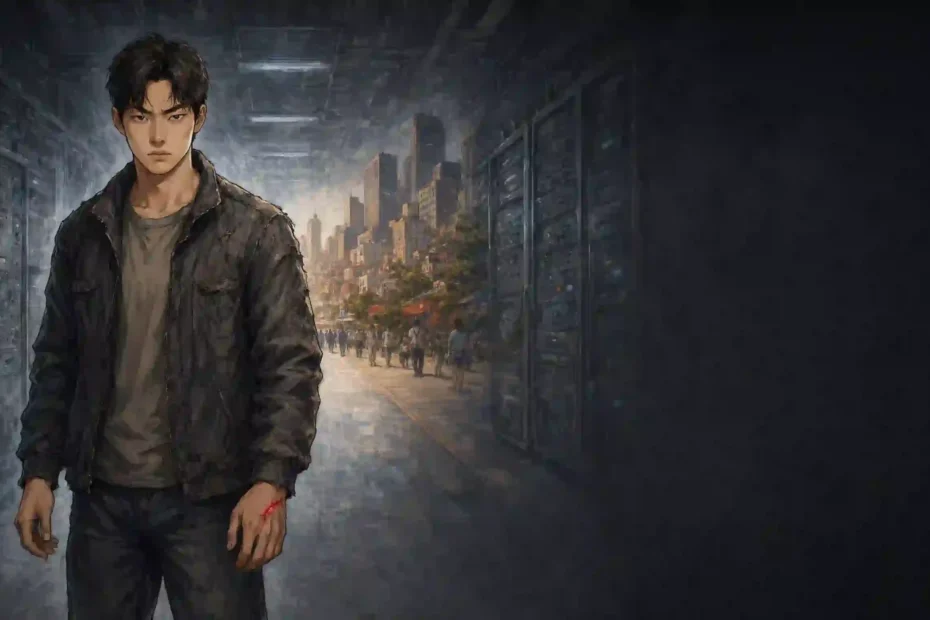
Looking for an action comic with a striking hook, but unsure whether “resurrection” means reincarnation, time travel, or simple healing? That uncertainty can spoil a good pick—or send you into an inaccurate summary. Resurrection Boy follows Ji-o, a young man whose body regenerates after injury and who escaped years of laboratory experimentation. This guide separates confirmed facts from interpretation, maps the main characters and themes, and shows what to expect before you start.
What Is Resurrection Boy About? The Quick Answer
Resurrection Boy is an action WEBTOON series created by RYU. Ji-o, a “Heart Mutant” with the Heart of Resurrection, escapes ten years of brutal experimentation, but the laboratory that harmed him and his friends continues to threaten the fragile normal life he wants. The official premise says he has stopped running and is ready to face the people who made him a test subject.
Short answer: It is a survival-and-action story about a regenerative young man who wants a life beyond captivity. His unusual body makes him difficult to stop, but it also makes him a target.
The hook is easy to understand: Ji-o can recover from injuries that would normally end a fight, yet his power does not erase the damage caused by the people who controlled him. The series pairs physical danger with a simple emotional question: what does freedom mean when the past keeps finding you?
Series Facts at a Glance
| Detail | Verified information |
|---|---|
| Official English title | Resurrection Boy |
| Creator | RYU |
| Platform category | Action on WEBTOON |
| Main character | Ji-o |
| Ability named in the synopsis | The Heart of Resurrection; his body can regenerate from any injury |
| Story setup | Ji-o escapes ten years of experimentation and is hunted again |
| Core threat | The laboratory that experimented on Ji-o and his friends |
| Official content rating | Young Adult (16+) |
| Latest English episode checked | Episode 26, “The Lab Director,” dated October 17, 2026 |
| Status checked | The official listing showed an active series and a Sunday update schedule |
The episode count and schedule reflect the English WEBTOON listing checked on October 23, 2026. A platform can change release timing, regional availability, or episode access, so readers should check the current listing before planning a catch-up session. For anyone who has seen only the title, Resurrection Boy is best understood as an action story about a hunted survivor, not simply as a power showcase.
What the Title Means—and What It Does Not Promise
The title may lead readers to expect a character who dies, returns to life, and repeats that cycle. The official description instead focuses on regeneration: Ji-o’s body repairs itself after injury. It does not identify him as a time traveler, a reincarnated person, or someone who returns in a new life after death.
That difference matters when setting expectations. Regeneration can create a tense action scene because the character may recover, but it does not automatically remove pain, fear, captivity, or the consequences of a fight. The official summary does not spell out every limit of Ji-o’s ability, so the safest description is the one it confirms: he has the Heart of Resurrection and a body that can regenerate from any injury.
The name also points to a contradiction at the center of the premise. Ji-o’s body can recover, while his freedom and childhood cannot simply reset. That contrast gives the story room to examine what survival costs, rather than treating recovery as a complete solution. This is why Resurrection Boy is more accurately introduced as a regeneration story than as a reincarnation story.
Story Premise: A Spoiler-Light Explanation
The official setup begins with a long period of abuse. Ji-o spent ten years inside a research facility where people experimented on him and his friends while suppressing their abilities. He eventually escaped, but life outside the facility does not stay peaceful for long.
His power makes him valuable and dangerous in the eyes of the people who want control over him. When Ji-o finds people and parts of an ordinary life worth protecting, the laboratory threatens those ties. The conflict then shifts from simple escape to a harder choice: keep running, or confront the force that took so much from him.
In Resurrection Boy, the escape is the starting point, not the end of the central problem. That premise gives new readers three clear story anchors:
- A survivor: Ji-o has spent much of his life under someone else’s control.
- A hunted power: His ability draws attention from people who want to use or contain him.
- A reason to resist: The chance to protect others changes what he is willing to do.
This guide stays at the official synopsis level. It does not reveal who survives a particular encounter, how a fight ends, or what later chapters uncover about the facility. If you prefer to enter a story with no plot details at all, start with Episode 1 and return to the character and chapter tables afterward.
How Ji-o’s Heart of Resurrection Works
The official synopsis describes Ji-o as a Heart Mutant with the Heart of Resurrection and says that his body can regenerate from any injury. That is the strongest confirmed explanation available in the listing. It gives the action premise a clear rule without explaining every biological or supernatural detail.
| Question | What the official summary confirms | What it does not settle |
|---|---|---|
| What is Ji-o’s ability called? | The Heart of Resurrection | Whether the name describes an organ, a power system, or both |
| What does the ability do? | His body regenerates from injury | Exact recovery speed, cost, or conditions |
| Does he have a connection to other mutants? | The series calls him a Heart Mutant and mentions friends whose abilities were suppressed | Whether every Heart Mutant shares one rule set |
| Can he be hurt? | The story’s premise includes injury and regeneration | Whether he feels pain or how long recovery takes |
| Can he die permanently? | The promotional wording calls him unkillable | The precise limits of that claim or any exceptions |
Readers should treat unanswered details as mysteries, not as gaps to fill with guesses. The series may explain the rules in its episodes, but a short promotional summary cannot establish the full power system. That distinction helps avoid common search-result errors, such as calling Ji-o literally immortal when the official description only explains regeneration and uses “unkillable” as promotional language.
For Resurrection Boy, regeneration creates a tactical advantage but does not solve the emotional conflict. If an ordinary attack cannot keep Ji-o down, the threat can come from capture, coercion, harm to people he cares about, or the institution that knows his history. Regeneration changes the shape of danger; it does not make danger disappear.
What Does “Heart Mutant” Mean in the Series?
“Heart Mutant” is part of the story’s vocabulary. WEBTOON uses the term in the series description, and the second episode carries the title “The Heart Mutant.” Ji-o’s ability has its own name, the Heart of Resurrection, which suggests that the series groups unusual powers under a shared label.
The official overview does not provide a full guide to the biology, origin, or classification of Heart Mutants. It also does not say that every person in the group has the same kind of power. A careful reader can say that Ji-o belongs to this category; a careful writer should wait for the episodes before publishing a complete rulebook.
This makes the term a useful entry point for several related questions: who else has a heart-based ability, what did the laboratory do to those abilities, and how do different powers affect the characters’ choices? The episodes are the right place to answer those questions. The official vocabulary gives Resurrection Boy a clear entity cluster—Ji-o, the Heart of Resurrection, Heart Mutants, and the laboratory—without settling every rule. A short series profile can introduce the terminology, but it should not invent mechanics the creator has not confirmed.
Main Characters and Story Entities
The official synopsis names Ji-o and describes his friends, the laboratory, and the people he wants to protect. It does not provide a full cast list in the short series description. The table below separates confirmed roles from details that readers should verify in the comic itself.
| Character or entity | Confirmed role | Why it matters to the story |
|---|---|---|
| Ji-o | Protagonist; a Heart Mutant with the Heart of Resurrection | His escape, power, and wish for a more ordinary life drive the premise |
| RYU | Creator credited on the official WEBTOON listing | The series’ official creator attribution; use this spelling when naming the creator |
| The research laboratory | The place where Ji-o and his friends endured years of experimentation | It represents the institution that seeks to control or reclaim him |
| Ji-o’s friends | The official description says the lab experimented on them and suppressed their abilities | Their shared history expands the stakes beyond one person |
| People Ji-o wants to protect | The synopsis says a new life and someone worth protecting are threatened | These relationships give his decision to stop running an emotional reason |
| The Lab Director | Episode 26 title, listed as “The Lab Director” | A signpost in the episode list; the title alone does not establish the character’s identity or motives |
| Hodan Construction | Named in the title of Episode 18, “CEO of Hodan Construction” | A story entity that appears in the official episode index; readers should use the episode for context |
A useful Resurrection Boy character guide should grow as a writer checks the episodes, not from assumptions made from a chapter title. That is especially important for names, family ties, affiliations, and powers. If you publish a spoiler-filled cast page later, label its spoiler range and cite the episodes that support each relationship.
The Central Conflict: Freedom Versus Control
The laboratory is more than a setting in the premise. It represents the system that treated Ji-o and his friends as subjects rather than people. The official summary says the facility suppressed their abilities and that it threatens Ji-o’s chance at a normal life after his escape.
That conflict gives the action a personal purpose. A fight is not only a test of strength if losing can mean another period of confinement or the loss of someone Ji-o values. His regenerative ability may help him survive a physical confrontation, but it cannot decide who deserves control over his future.
That is why Resurrection Boy’s conflict reaches beyond a contest of strength: the question is who gets to decide what Ji-o does with his own life. The premise also changes the usual “power fantasy” question. Instead of asking only how strong the hero can become, readers can ask:
- Who has the right to make decisions about Ji-o’s body?
- Can he build trust after years of being treated as a test subject?
- Does protecting someone require him to risk returning to the place he escaped?
- What kind of justice can answer harm without repeating it?
Those questions are interpretation, not a claim about a final answer. They give the series emotional context while leaving the chapters free to surprise the reader.
Themes to Watch For
Survival is not the same as freedom
Ji-o’s body can regenerate, but the official premise makes clear that he remains hunted after escaping. Physical survival therefore does not guarantee safety, independence, or a settled home. The series can use that gap to show why escape marks a beginning rather than an easy ending.
A body can become a battleground
The laboratory’s experiments and suppression of abilities make the body part of the central conflict. Ji-o’s power may protect him in a fight, yet the history of experimentation turns that same power into a reason others pursue him. This is a strong lens for reading scenes about consent, ownership, and the right to refuse.
Ordinary life can carry real weight
The official synopsis says Ji-o finds a sliver of a normal life worth protecting. That small phrase matters: the story does not frame survival only as a sequence of battles. Episode titles such as “I’m Really at School…!” and “Sweet Tangy Braised Short Ribs” hint at a contrast between everyday settings and the series’ dangerous premise, though titles alone do not reveal the scenes.
Trust takes more than a promise
Ji-o’s past gives him good reason to be cautious. The people around him matter because they can offer something the laboratory did not: relationships that are not built on control. The official summary does not name every bond, so readers should let the episodes show who earns his trust and how.
Resistance has consequences
The series’ premise says Ji-o is done running. That does not automatically make every act of retaliation fair or simple. It creates a question worth following: can he fight back while still choosing what kind of person he wants to become?
These themes are reading lenses grounded in the official setup, not claims that RYU has stated a specific message. They help readers notice what the action may mean without turning interpretation into invented fact.
Genre, Tone, and Reading Experience
WEBTOON categorizes the series as action. Its central hook also uses speculative elements: a person with an extraordinary regenerative ability, other mutants, and a research facility that experiments on them. Calling it an action comic with science-fiction or supernatural flavor describes the premise; those extra labels should not be mistaken for a complete official genre list.
Expect a story built around danger, pursuit, unusual abilities, and the consequences of captivity. The official synopsis also promises a thread of ordinary life and relationships, so the emotional side matters alongside combat. Readers who want a light, consequence-free superhero comedy may find the laboratory history and content rating a poor fit.
As a vertical-scroll digital comic, the format rewards reading each episode in sequence. Long panels can control pace, hold a reveal, or make a change in scale feel dramatic. Read on a phone or tablet at a comfortable size, and pause between episodes if the violence or subject matter feels intense.
Episode Guide: Official Titles as Reading Signposts
Episode titles can help a new reader navigate without spoiling exact outcomes. These groupings are editorial signposts based on the official English episode list, not official arc names or plot summaries.
| Reading stretch | Official episode titles that help you find the section | How to use the signpost |
|---|---|---|
| Opening setup | Ep. 1 “The Heart of Resurrection”; Ep. 2 “The Heart Mutant”; Ep. 3 “Resurrection Boy” | Start here for the core terminology and premise |
| Early connections | Ep. 4 “Tot”; Ep. 7 “Friends”; Ep. 8 “En Route to the Broker”; Ep. 9 “Reunion” | Follow the character and relationship questions as they emerge |
| Rising pressure | Ep. 10 “The Hideout”; Ep. 11 “The Abandoned Factory”; Ep. 12 “Don’t Cross the Line”; Ep. 14 “One-on-One” | Track the movement from concealment to direct conflict |
| Everyday-life contrast | Ep. 15 “Sweet Tangy Braised Short Ribs”; Ep. 16 “I’m Really at School…!” | Notice how ordinary settings sit beside a high-stakes premise |
| Later listed conflict | Ep. 17 “Heart of the Rock”; Ep. 18 “CEO of Hodan Construction”; Ep. 21 “Runaway Train”; Ep. 23 “Trust Me” | Use the titles to locate later developments; read the episodes for context |
| Current listing at review | Ep. 24 “The Lab’s Nightmare”; Ep. 25 “That Hurts, You Sick Bastards”; Ep. 26 “The Lab Director” | The English page showed these among the most recent episodes on October 23, 2026 |
This map avoids summarizing individual fights or reveals. It helps readers answer practical questions such as “Where does the early setup happen?” and “Which titles mark the latest run?” without repeating or replacing the comic.
Is the Series Ongoing? Episode Count and Update Timing
The official English series page showed 26 episodes when checked on October 23, 2026. Its latest listed episode was Episode 26, “The Lab Director,” dated October 17, 2026. The page also displayed a Sunday update schedule, so the series was publishing new episodes at the time of review.
Treat episode counts and release days as a dated snapshot, not permanent facts. A new chapter may appear after this guide goes live, and platform calendars can differ by region or time zone. Before you post an update, verify the current WEBTOON listing and refresh the checked date in the article.
The listing also noted that some recent episodes were available only in the app at the time of checking. Access rules can change, and WEBTOON may use different unlock options across locations. Confirm the status on the official platform rather than trusting an old chapter count on a reposting site.
How to Start Reading Officially
To begin, search for the exact English title on WEBTOON and confirm that the creator credit says RYU. Open Episode 1, “The Heart of Resurrection,” then continue in order. Starting at the first chapter gives the terminology and escape premise room to land before later titles introduce new story questions.
A simple reading plan works well:
- Read Episodes 1–3 to meet the central concept and understand the opening setup.
- Continue in order rather than jumping to a chapter with a dramatic title.
- Check the official page for the newest episode, update day, and current access rules.
- If you publish a review, identify the episode range you have read and mark spoilers clearly.
This approach supports the creator and gives you the complete context. Avoid unofficial copies: they can omit panels, mistranslate names, or show a chapter without the creator’s permission. The official episode page is the reliable place to check title, creator attribution, and release status.
Age Rating and Content Notes
The official WEBTOON listing labels the series Young Adult (16+). Its content note warns readers about mature themes and disturbing imagery involving minors. That warning matters because the premise includes ten years of experimentation and a protagonist who has been pursued by the facility that harmed him.
The rating does not tell every reader exactly how a scene will feel. If stories about confinement, violence, experimentation, or harm to young characters can affect you, review the platform’s current content notice before reading. You can also stop between episodes or choose a different series; protecting your comfort matters more than finishing a chapter quickly.
Parents and educators should not treat “action comic” as an automatic sign that a title suits every teen. Use the official age label, the content warning, and your knowledge of the reader. If you discuss the story with a younger reader, focus on the difference between fictional powers and real-world consent, safety, and medical ethics.
Who Is This Story For?
If you are considering Resurrection Boy, use the official rating and the first episodes to decide whether its tone fits you. The premise may appeal to readers who enjoy:
- Action series where a power changes how fights work.
- Stories about escaping an institution and resisting the people who controlled the protagonist.
- Characters who want connection and ordinary life, not only greater strength.
- Superpowered mysteries that reveal their rules across episodes.
- A serious tone with moments of everyday contrast.
It may not suit readers who want low-stress comedy, dislike body-horror or laboratory themes, or prefer a fully explained power system from chapter one. The 16+ label and official content warning offer a practical starting point for that decision.
A good way to test the fit is to read the first three episodes and ask two questions: Does Ji-o’s central problem interest you, and does the tone feel manageable? If both answers are yes, the series has a clear reason to keep reading. If not, you can leave it without waiting for the story to become something it never promised to be.
Topic Map: Key Subjects Connected to the Series
A strong guide should answer the related questions readers ask after they discover a title. The map below connects the main subject to its important entities and explains where this article covers them.
| Topic or entity | Relationship to the series | Reader question answered here |
|---|---|---|
| Ji-o | Protagonist and Heart Mutant | Who is the main character, and what is his situation? |
| Heart of Resurrection | Ji-o’s named regenerative ability | What power does he have, and what is confirmed about it? |
| Heart Mutant | The series term used for Ji-o | What does the label mean, and what remains unexplained? |
| Research laboratory | The institution tied to the experiments and pursuit | Why is Ji-o still in danger after escaping? |
| RYU | Creator credited by WEBTOON | Who made the series? |
| Episode index | Official chapter titles and dates | Where should I start, and what is the latest listed episode? |
| Content rating | Young Adult (16+) with a content notice | Is the series suitable for me or a younger reader? |
| WEBTOON | Official reading platform | Where can I check the licensed English episodes? |
For a website that wants to build a wider topic cluster, future supporting articles can cover a spoiler-free character guide, a chapter tracker with dated updates, a Heart Mutant terminology explainer, and a content-rating review. Each page should answer a distinct reader question, cite the episodes it discusses, and point back to this guide through the site’s own navigation. Do not publish a character relationship or ability rule until the comic confirms it.
Frequently Asked Questions
1. What is Resurrection Boy about?
Short answer: It follows Ji-o, a regenerative Heart Mutant who escapes years of laboratory experimentation and is hunted again. The story combines action with his attempt to protect a more ordinary life.
2. Is Ji-o immortal?
Short answer: The official description says his body regenerates from any injury and uses “unkillable” as promotional wording, but it does not explain every limit. It is safer to describe him as a regenerative character than to claim that he has no weaknesses or can never die.
3. Is this a reincarnation or time-loop story?
Short answer: The official premise describes bodily regeneration, not reincarnation or time travel. The title alone does not confirm a return across separate lives or a repeated timeline.
4. Who created the series?
Short answer: WEBTOON credits RYU as the creator. Use the official listing if you need to verify the spelling or creator attribution before publishing.
5. Where can I read the official English episodes?
Short answer: Search the title on WEBTOON and begin with Episode 1, “The Heart of Resurrection.” Check the platform for current access, regional availability, and any app-only episodes.
6. Is it suitable for younger readers, and is it still updating?
Short answer: WEBTOON labels it Young Adult (16+) and warns about mature themes and disturbing imagery involving minors. The English listing showed an active Sunday schedule and 26 episodes on October 23, 2026; check the page for changes.
The Takeaway: Start with the Official First Episode
The strongest reason to try this action comic is its clear contrast: Ji-o can recover from injury, but he cannot undo the years of control that shaped his life. The laboratory, his friends, the people he wants to protect, and the possibility of ordinary days give the power premise emotional stakes.
If that mix of action, survival, and character-driven tension sounds right for you, begin with Episode 1 and let the story establish its own rules. Keep the content rating in mind, read through the official platform, and share your thoughts after the opening chapters: which matters more to Ji-o now, staying free or protecting the life he is beginning to build?