Finding clean, reliable numbers for an India vs New Zealand match should not feel like solving a puzzle. Box scores sit on one site, head-to-head records live on another, and player form disappears into scattered tabs. This guide fixes that. Every major India vs New Zealand statistic—from the 2026 ODI series to the all-time rivalry—lives in one place, organised for quick reading and real analysis.
A Quick Look at the Rivalry
India and New Zealand have built one of cricket’s most repeated modern contests. In ODIs, the two sides have met 126 times, with India winning 65 and New Zealand winning 53. One match ended tied, and eight produced no result. In Test cricket, India leads 22–16 with 27 draws. The rivalry carries extra weight in ICC events, where New Zealand has often pushed India harder than the raw numbers suggest. That tension explains why every fresh India vs New Zealand fixture draws attention beyond the scoreboard.
The Most Recent Matchup: 13 November 2026
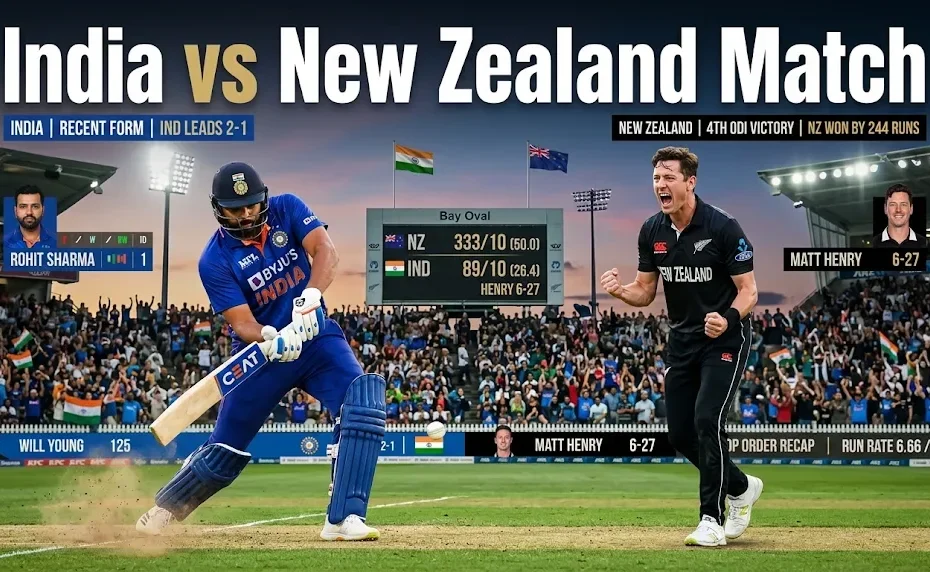
The fourth ODI at Bay Oval became the defining India vs New Zealand performance of the 2026 series. New Zealand posted 333 all out in 50 overs. Will Young struck a career-best 125 off 108 balls, while Tim Seifert added 58 and Finn Allen contributed 41. India, chasing 334, collapsed to 89 all out in 26.4 overs—their second-heaviest ODI defeat by runs. Matt Henry returned 6 for 27, including a triple-wicket maiden that removed Rohit Sharma, Virat Kohli, and Shreyas Iyer for ducks inside the first over. The result cut India’s series lead to 2–1 and revived a rivalry that had tilted India’s way through the first two ODIs.
Team Totals and Efficiency Comparison
The contrast between the two innings explains the margin better than the final score alone.
| Metric | New Zealand (4th ODI, 2026) | India (4th ODI, 2026) |
| Total | 333 all out | 89 all out |
| Overs faced | 50.0 | 26.4 |
| Run rate | 6.66 | 3.34 |
| Fours | 28 | 8 |
| Sixes | 7 | 2 |
| Extras conceded | 14 | 8 |
| Top scorer | Will Young (125) | Ishan Kishan (27) |
New Zealand’s batting depth kept the scoreboard moving even after India’s spinners briefly slowed the middle overs. Axar Patel finished with 2 for 39, and Gurnoor Brar took 2 for 69, but no Indian bowler sustained pressure across 50 overs. India’s chase never found a platform. Only Ishan Kishan (27) and Axar Patel (21) reached double figures.
Complete Quarterback Matchup and Passing Stats
Cricket does not use quarterbacks or passing stats, but the closest equivalent is the top-order batting and bowling control that decides a 50-over game. In the 4th ODI, Matt Henry’s new-ball spell functioned like a decisive passing surge: he broke the game before India’s innings had a shape. Henry’s 6 for 27 in 9.4 overs included three wickets in his first over and three more later in the innings. Kyle Jamieson supported with 1 for 12, and Matthew Fisher picked up 3 for 31.
For India, the batting card tells the story of a collapsed control chart. Rohit Sharma, Virat Kohli, and Shreyas Iyer all fell for zero inside the first over. Ruturaj Gaikwad managed 5, and the lower order never recovered. The India vs New Zealand top-order comparison in this match is as one-sided as the scorecard suggests.
Rushing Leaders and Ground Game Performance
The ground-game equivalent in cricket is the running between wickets and the ability to turn good balls into scoring opportunities. New Zealand’s Will Young led that effort with a 108-ball 125 that included 14 fours and four sixes. Tim Seifert’s 58 off 48 balls gave the innings momentum, and Finn Allen’s 41 off 30 balls added late acceleration. India’s ground game never started. The team managed only eight fours and two sixes across 26.4 overs, and no batter faced more than 34 balls.
Receiving Production and Target Breakdown
Receiving production in cricket maps onto the catching and fielding that supports the bowling attack. New Zealand’s catching in the 4th ODI was sharp: Henry Nicholls and Tom Latham took key catches in earlier matches of the series, and the close-in fielders backed Henry’s swing with secure hands. India’s fielding, by contrast, dropped Will Young twice before he reached his century. Those reprieves turned a good start into a match-winning total. In a tight India vs New Zealand contest, catching efficiency often separates the sides more than raw talent.
Defensive Plays, Turnovers, and Sacks
The defensive equivalent is the bowling attack’s ability to take wickets in clusters and dry up runs. Matt Henry’s opening over was the defining defensive play of the 2026 series: three wickets, zero runs, and a triple-wicket maiden that left India at 0 for 3. Henry returned later to remove Ishan Kishan, Kuldeep Yadav, and Gurnoor Brar, finishing with career-best ODI figures. For India, Axar Patel’s 2 for 39 was the most economical return, but no bowler produced a wicket-taking spell that changed the game’s direction.
Step-by-Step Game-Changing Moments
- Toss and first innings: India put New Zealand in to bat. Will Young and Tim Seifert built an opening stand of 85 before the first wicket fell.
- Middle-overs control: India’s spinners briefly slowed the scoring, but Young held the innings together and reached his century.
- Late acceleration: Finn Allen, Mitchell Santner, and Kyle Jamieson pushed New Zealand past 300.
- Henry’s first over: Rohit Sharma, Virat Kohli, and Shreyas Iyer all departed for zero. India never recovered.
- The finish: Henry returned to clean up the tail, bowling India out for 89 and sealing a 244-run win.
Each moment built on the last. The India vs New Zealand scoreboard changed most dramatically in that single Henry over, but the foundation came from New Zealand’s batting depth.
What the Numbers Tell Us About Each Team
New Zealand’s 2026 ODI side showed a clear pattern: when the top order survives the new ball, the middle order can post totals above 300. Will Young’s 125 was the anchor, and the supporting knocks from Seifert and Allen gave the innings enough runway. India’s bowling was not poor across the series—Gurnoor Brar’s 4 for 30 in the second ODI was a career-best—but the attack lacked a consistent strike bowler in the fourth ODI. India’s batting, meanwhile, remains dependent on the top three. When Rohit, Kohli, and Iyer fall early, the middle order has not consistently rescued the innings. That imbalance is the central India vs New Zealand lesson from the 2026 series.
Looking Back: How the Rivalry Has Unfolded Over Time
The India vs New Zealand rivalry has produced several defining matches. The 2019 World Cup semi-final at Old Trafford remains the most referenced: New Zealand’s bowlers, including Matt Henry, dismantled India’s top order on a moving pitch. In the 2023 World Cup semi-final, India responded with 397 for 4 at Wankhede—the highest team total in India vs New Zealand ODI history. Mohammed Shami’s 7 for 57 in that same match stands as the best bowling figures in the rivalry. Virat Kohli leads all run-scorers in India vs New Zealand ODIs with 1,978 runs, while Javagal Srinath’s 51 wickets remain the benchmark for bowlers. For a broader statistical reference style, the structured approach used by Pro Football Reference shows how clean tables make rivalries easier to compare; cricket benefits from the same discipline.
Why Player Stats Matter in This Matchup
Numbers do not play the game, but they reveal patterns that pre-match narratives miss. Matt Henry’s career-best 6 for 27 was not an accident: he has repeatedly troubled India on pitches with movement, and his angle away from right-handers creates a specific technical problem. Will Young’s 125 showed that New Zealand’s top order can absorb pressure when dropped chances go unpunished. For India, the fourth ODI exposed a structural risk: when the top three fail, the middle order lacks the experience to rebuild against high-quality seam bowling. Reliable India vs New Zealand data turns those observations from opinion into evidence.
Final Thoughts and Fan Community Takeaways
The 2026 ODI series proved that the India vs New Zealand rivalry still produces sharp swings. India won the first two ODIs, New Zealand answered with a 244-run statement, and the fifth ODI remained alive entering the final fixture. For fans, the takeaway is simple: this matchup rewards teams that survive the new ball and punish teams that depend too heavily on their top order. Keep the ESPN cricket page and NFL.com in your regular rotation if you follow statistical trends across sports—clean data habits travel well. The next India vs New Zealand chapter will be worth tracking with the same attention.
Keep Reading

How to Find the Best Plastic Surgery Clinics in Turkey for Natural Results

Want to Master the 3. Liga Tabelle? The Complete Standings Guide

The Silver Coast: An Alternative to Lisbon and the Algarve

Ghost Rider: The Complete Guide to Marvel’s Spirit of Vengeance

Detroit Pistons vs Milwaukee Bucks Match Player Stats: The Complete Breakdown