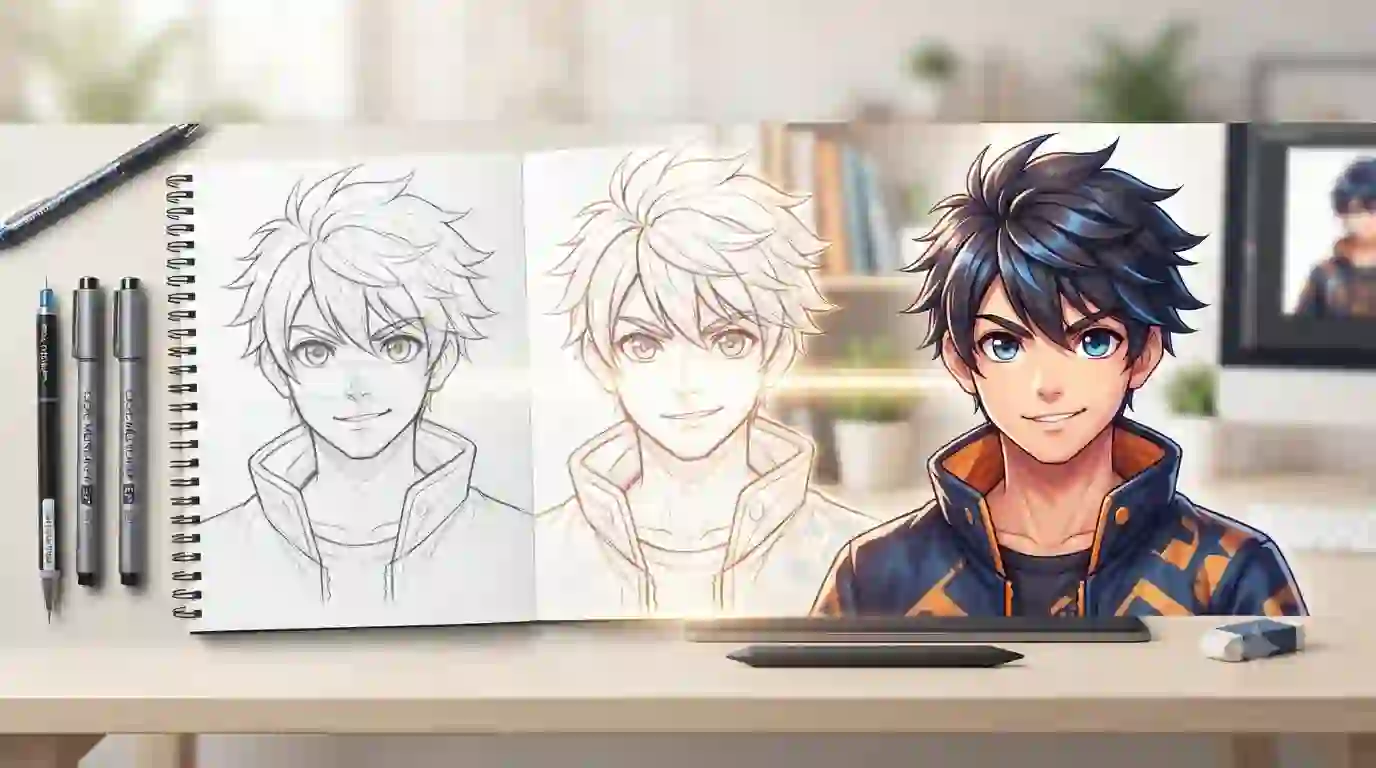
Many aspiring artists stare at a blank page, unsure how to give their anime drawings the right eyes, proportions, and expressions. Hours of tracing references still leave characters looking stiff, flat, or off-model, and confidence fades with every failed attempt. This guide breaks anime drawings into clear, repeatable steps covering anatomy, expressions, tools, and color, so you build characters that look alive instead of traced.
What Are Anime Drawings?
Anime drawings are illustrations built on the visual language of Japanese animation. Large expressive eyes, simplified noses, sharp hair shapes, and exaggerated poses carry emotion instantly, without needing photorealistic detail.
Manga and anime share the same design roots, but manga stays in black-and-white panels while anime art extends into full color, motion, and voice. Both formats depend on the same three skills: proportion, expression, and confident linework.
Here is what separates strong character art from rough sketches:
- Clear silhouettes that read instantly, even in thumbnail size
- Purposeful line weight that thickens on outer edges and thins on inner detail
- Exaggerated but consistent proportions, so the same character looks right from every angle
A Brief History Behind the Anime Art Style
The style did not appear overnight. It grew out of early animation experiments in Japan and matured through decades of manga innovation before becoming the global look artists study today.
Animation pioneers such as Ōten Shimokawa, Jun’ichi Kouchi, and Seitaro Kitayama produced Japan’s first short animated films in the early twentieth century, laying the technical groundwork for everything that followed [1]. After World War II, manga artist Osamu Tezuka reshaped the look of anime characters for good.
Tezuka drew inspiration from Western animation, including Disney’s Bambi and the Betty Boop cartoons, and combined that influence with cinematic camera angles borrowed from French and German films he watched as a schoolboy [1]. That fusion of Western technique and Japanese storytelling became the template for nearly every anime style that followed, from Dragon Ball’s sharp action lines to Studio Ghibli’s soft, painterly worlds.
Essential Tools for Anime Drawings
You do not need expensive gear to start. You need the right tool for your stage of learning.
Traditional tools:
- Mechanical pencil (0.5mm, HB lead) for clean construction lines
- Fine-liner pens (0.1mm–0.3mm) for inking
- Sketchbook with smooth, bleed-resistant paper
Digital tools:
- A drawing tablet or pen display (Wacom and Huion are common starting points)
- Illustration software built for line art and color
Clip Studio Paint has become the software most manga and anime artists reach for once they move to digital work, thanks to dedicated tools for panel layout, perspective rulers, and pen-pressure brushes that mimic real inking pens [2]. Procreate remains a strong choice for artists who draw on a tablet and want a simpler, faster interface for quick sketches and fan art.
Anime Drawing Fundamentals: Proportion and Anatomy
Every strong character starts with structure, not detail. Skipping this step is the single biggest reason character sketches look “off” without the artist knowing why.
Follow this build order:
- Block in the head as a circle with a jawline attached
- Divide the face with a vertical center line and a horizontal eye line
- Place the eyes at the halfway point of the head, not near the top
- Sketch the body using head-height units (5.5–7 heads for adults, 2–4 for chibi)
- Add clothing and hair only after the pose reads correctly in a stick-figure stage
Working in this order keeps your characters consistent across multiple panels or illustrations of the same design.
How to Draw Anime Eyes Step by Step
Anime eyes carry most of a character’s personality, so they deserve careful construction rather than a quick doodle.
- Draw a simple almond or curved shape as the eye socket guide
- Add the upper lid as a bold, slightly curved line with more weight than the lower lid
- Place the iris so its top touches the upper lid, leaving a gap at the bottom for a natural look
- Add one large highlight and one or two small highlights, never centered
- Finish with lashes that taper to a point instead of ending blunt
Shonen-style characters favor sharper, narrower eyes, while shojo styles favor rounder eyes with more highlight detail. Practicing both builds range fast.
Mastering Facial Expressions in Anime Drawings
A technically perfect face still falls flat without expression. Expression is what makes a character feel alive instead of posed.
- Eyebrows do most of the emotional work; raise them for surprise, angle them inward for anger
- Mouth shape should change size and openness for shouting, whispering, or smiling
- Eye shape shifts too: expressions like joy narrow the eyes, while shock widens them
- Blush marks, sweat drops, and speed lines are shorthand symbols readers instantly recognize
Draw the same character expressing five different emotions before moving on. This single exercise improves your sketches faster than copying finished art.
Anime Drawing Styles at a Glance
The style is not one single look; it is a family of related sub-styles, each shaped by genre and audience. This table breaks down the major categories artists study first.
| Style | Key Visual Traits | Common Genres | Example Series |
|---|---|---|---|
| Shonen | Bold outlines, dynamic action lines, angular jaws | Action, adventure | Dragon Ball, Naruto |
| Shojo | Soft linework, oversized sparkling eyes, floral motifs | Romance, drama | Sailor Moon, Fruits Basket |
| Chibi | Oversized heads, tiny bodies, minimal detail | Comedy, mascots | Chibi spin-offs, stickers |
| Seinen | Realistic proportions, muted color, mature shading | Psychological, thriller | Monster, Berserk |
| Mecha | Sharp mechanical lines, metallic shading, geometric forms | Sci-fi, war | Gundam, Evangelion |
Studying these sub-styles side by side helps you spot the specific choices, like eye size or line weight, that define each look.
Common Mistakes That Weaken Your Anime Art
Most beginner problems trace back to a handful of repeated habits.
- Symmetrical, stiff eyes that ignore head turn and perspective
- Hair that ignores the skull shape underneath, creating a floating helmet effect
- Uniform line weight across the whole drawing, which flattens depth
- Copying finished art instead of studying construction, which builds a shallow skill ceiling
- Skipping thumbnails and jumping straight to detail, which wastes hours on a weak pose
Fixing even two of these habits noticeably sharpens your character work within a few weeks of focused practice.
Digital vs Traditional Anime Drawings: Which Fits You?
Neither format is objectively better; each suits a different stage and goal.
Choose traditional tools if you want to:
- Build raw fundamentals without software distractions
- Practice anywhere without charging a device
- Keep costs low while starting out
Choose digital tools if you want to:
- Undo mistakes instantly and experiment freely
- Color and shade your illustrations efficiently with layers
- Share, publish, or sell finished work online
Many working illustrators sketch traditionally first, then scan and refine their characters digitally, combining the strengths of both methods.
How to Practice Anime Drawings and Improve Faster
Consistency beats intensity. Twenty focused minutes daily outperform one exhausting six-hour session on a weekend.
- Set a daily or weekly drawing streak instead of a vague goal
- Study one specific skill per session: eyes this week, hands the next
- Post finished sketches publicly for feedback, even before they feel ready
- Redraw an old piece every 30 days to measure real progress
- Follow structured courses or reference sheets instead of guessing at proportions
Progress in this craft is rarely linear. Expect visible jumps after weeks that felt slow, not steady daily improvement.
Turning Anime Drawings Into a Career
Anime is no longer a niche hobby market; it is a fast-growing global industry, and that growth creates real opportunity for skilled artists. Global anime industry revenue reached a record 3.84 trillion yen (roughly USD 25.1 billion) in 2024, with overseas revenue accounting for 56% of that total, according to the Association of Japanese Animations [3].
That international demand supports paid work far beyond television studios:
- Freelance illustration for book covers, album art, and merchandise
- Character design for indie games and visual novels
- Commission work for fans through platforms built for artists
- Webtoon and comic creation, published digitally to global audiences
- Storyboard and concept art roles within animation and game studios
Building a portfolio of consistent, well-constructed character art matters more than raw talent when clients or studios are hiring.
Frequently Asked Questions
What is the easiest anime style to start drawing?
Chibi is the easiest entry point for beginners because it simplifies proportion, detail, and shading into a small, forgiving format. Beginners can finish a full chibi character in under an hour while still practicing eyes, hair, and expression.
Do anime drawings need to follow real human anatomy?
Yes, at the structural level. This style exaggerates features like eye size and limb length, but it still relies on real skeletal proportions and weight distribution underneath the stylization.
What’s the best app for anime drawings on a tablet?
Procreate suits quick sketches and painted illustrations, while Clip Studio Paint suits artists focused on line art, comics, or full character sheets. Both support pressure-sensitive styluses and layer-based coloring.
How long does it take to get good at anime drawings?
Most artists see a noticeable jump in their work after three to six months of consistent, focused practice. Reaching a professional, publishable level typically takes one to three years, depending on practice frequency.
Can I sell my anime drawings online?
Yes. Artists sell character art as prints, digital commissions, custom designs, and merchandise through marketplaces, social platforms, and personal storefronts. A consistent style and a visible portfolio matter more than follower count.
What is the difference between anime and manga drawings?
Manga drawings are typically black-and-white, panel-based, and built for print or digital comics. Anime drawings extend that same visual style into full color, movement, and voice acting for animated screens.
Your Next Anime Drawing Starts Now
Skill in this craft comes from repetition, not inspiration. Pick one section from this guide, whether it’s eye construction, proportion, or expression, and draw it ten times today. Post your result, compare it against last month’s work, and keep the habit going. That single decision, repeated daily, is what actually separates artists who improve from those who only plan to.