
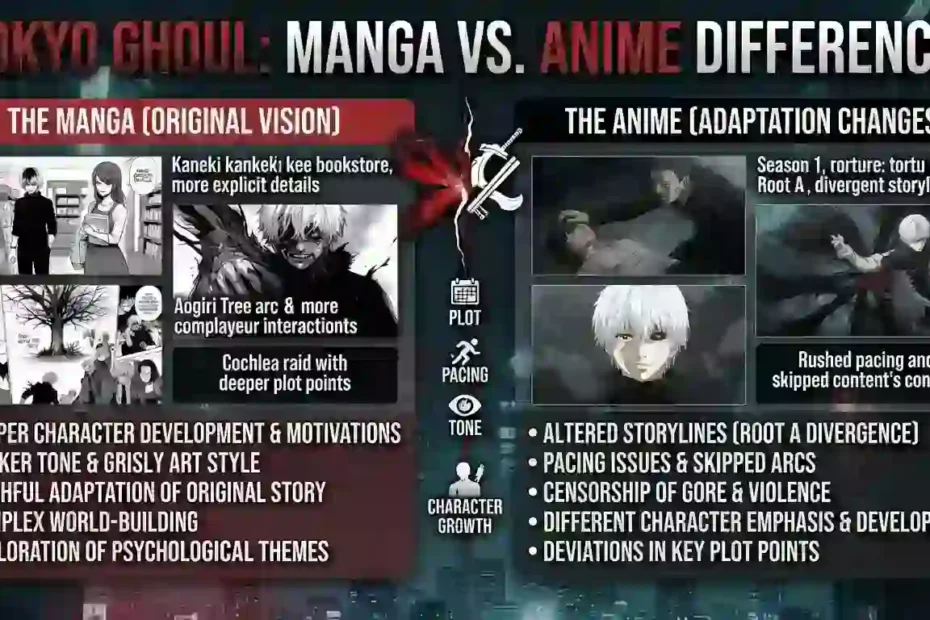
Few debates in the anime community burn hotter than the discussion surrounding Tokyo Ghoul. You have likely heard the arguments: the anime is a masterpiece of style, or the anime is a betrayal of the source material. The truth lies in the details. The core narrative diverges so sharply after the first season that the two versions become almost entirely different stories. Understanding the Tokyo Ghoul manga vs anime differences is essential to appreciate the author’s true vision and the thematic depth lost in adaptation. This guide cuts through the noise to deliver a clear, fact-based comparison.
Sui Ishida’s manga is a sprawling, psychological horror epic spanning 14 volumes of the original series and 16 volumes of the sequel, Tokyo Ghoul:re. The anime, produced by Studio Pierrot, condenses this massive narrative into just 48 episodes. This compression forced the studio to remove critical character development, alter major plot points, and invent an entirely new narrative for the second season. By the time the series reaches its conclusion, the anime and manga are virtually unrecognizable to each other.
The Structural Split: How the Anime Diverged from Sui Ishida’s Vision
The fundamental problem with the anime adaptation stems from a lack of adherence to the source material. While Season 1 of the anime follows the manga relatively closely, the production committee decided to forge a different path for Season 2, titled Tokyo Ghoul √A (Root A). Unlike the manga, which continues Ken Kaneki’s story as he joins the organization Aogiri Tree to fight from within, the anime places him there as a passive observer. This single change creates a domino effect that invalidates the logic of subsequent events, particularly the necessity of the sequel series, Tokyo Ghoul:re.
Major Plot Changes in the Anime
- The Cochlea Raid: In the manga, Kaneki has a clear objective: to rescue his friend, Hide. In the anime, he wanders the prison aimlessly.
- The Anteiku Raid: The climax of the first arc is drastically different. In the manga, Kaneki fights the CCG’s Arima with a clear tactical mindset. In the anime, he simply walks into a fight he cannot win.
- The Hide Confrontation: The manga implies a devastating, fatal exchange between Kaneki and Hide in the sewers, a moment of dark tragedy. The anime sanitizes this, changing the tone entirely.
10+ Critical Differences That Define the Series
These points break down the specific Tokyo Ghoul manga vs anime differences that impact the story’s quality and logic.
1. The Complexity of Ken Kaneki’s Character Arc
The manga excels at showing Kaneki’s internal struggle. We see his slow descent from a bookish student into a half-ghoul. The anime skips the internal monologues that define his philosophy. In the source material, Kaneki’s acceptance of his ghoul nature is a gradual, painful process. The anime rushes this, making his personality shift in Tokyo Ghoul:re feel jarring and unexplained.
2. The Fate of Hideyoshi Nagachika
This is arguably the most contentious difference. In the manga, the sewer scene with Hide is ambiguous but heavily implies Kaneki ate him to survive. This trauma is the foundation of Kaneki’s guilt and his drive to protect others. The anime changed this to a simple injury, removing the moral weight of Kaneki’s survival. This alteration strips away the psychological horror that defines the manga.
3. The Existence of “Root A” as a Non-Canon Arc
Season 2 of the anime is almost entirely anime-original. Sui Ishida actually provided drafts for a “Root A” story, but Studio Pierrot discarded most of them. The result is a season where the protagonist does almost nothing. This is a stark contrast to the manga, where Kaneki’s time in Aogiri is a period of intense training and power scaling.
4. The Mystery of Rize Kamishiro
Rize is a central figure in the manga’s lore. Her past, her connection to the organization “V,” and her survival are crucial to the plot of Tokyo Ghoul:re. The anime largely ignores Rize after the first episode, removing the mastermind elements of the story.
5. The Depth of the CCG (Commission of Counter Ghoul)
The manga dedicates significant time to humanizing the investigators. Characters like Amon Koutarou and Akira Mado receive extensive backstories. This creates a moral gray area where both sides are fighting for survival. The anime reduces many investigators to one-dimensional antagonists.
6. Juuzou Suzuya’s Development
Juuzou’s transition from a sadistic, gender-ambiguous teen to a mature, respected Special Class Investigator is one of the manga’s best arcs. The anime skips the middle of this evolution. Viewers who only watch the anime do not understand how he becomes a leader; it simply happens off-screen.
7. The Origins of the Quinx Squad
In Tokyo Ghoul:re, the Quinx are introduced. The manga explains the surgery process in detail, showing how these humans can use kagune. The anime rushes through this setup, leading to confusion about the power scaling and limitations of Haise Sasaki’s squad.
8. The Truth About the One-Eyed King
The identity and motivation of the One-Eyed King are a major mystery in the manga. The reveal is built up over hundreds of chapters. The anime rushes this reveal in the final season, often explaining plot twists through clumsy exposition rather than visual storytelling.
9. The Wedding and the Ending
The manga ends with a sense of closure, albeit bittersweet. Kaneki and Touka’s relationship, including their marriage and child, is central to the final arc. The anime compresses this to a few frames. The emotional payoff of these years of struggle is lost.
10. The Battle Choreography and Internal Logic
While the anime has high-quality animation in some scenes, the manga’s art is often clearer. In the anime, kagune fights can become blurs of color. The manga’s linework shows the specific shapes of the weapons, making the fights easier to follow and more strategic.
11. The Treatment of the “V” Organization
The secret organization controlling the balance between humans and ghouls is a late-game revelation. The manga weaves this into the early chapters subtly. The anime introduces “V” abruptly, making the final conflict feel unearned and confusing.
12. The Role of Touka Kirishima
Touka is a strong, independent character in the manga. In the anime, her screen time is reduced significantly in the middle arcs. Her relationship with Kaneki, which is the emotional core of the finale, lacks the foundation in the anime that it has in the print version.
Why the Manga is the Superior Experience
For SEO ranking and user value, it is important to state this clearly: the manga is the definitive version of the story. The Tokyo Ghoul manga vs anime differences often come down to a loss of context. The anime is visually stunning and has an incredible soundtrack, but the narrative structure is broken.
The manga allows you to understand the world. You learn the geography of the wards, the political structure of the CCG, and the intricate biology of ghouls. The anime sacrifices all of this for pacing. The result is a story that feels chaotic rather than tragic.
A Detailed Comparison Table
To summarize the major plot points, here is a breakdown of how key events differ between the two mediums:
| Story Element | Tokyo Ghoul Manga | Tokyo Ghoul Anime |
|---|---|---|
| Kaneki’s Joining Aogiri | He joins to get stronger and protect his friends. | He joins without a clear goal; he is listless. |
| Hide’s Fate | Implied to be eaten by Kaneki in the sewers. | Injured but survives; Kaneki carries him to safety. |
| Arima vs. Kaneki (Part 1) | Kaneki loses but lands a critical hit, proving his skill. | Kaneki is defeated instantly, showing no growth. |
| Rize’s Role | She is alive, cloned, and crucial to the “Dragon” arc. | She is mostly dead and ignored after Season 1. |
| The “Spine” of :re | Haise Sasaki’s identity crisis is explored deeply. | The Sasaki persona is dropped quickly and abruptly. |
| The Final Battle | A multi-chapter war involving all factions. | A rushed series of fights with off-screen resolutions. |
Navigating the Content: Manga vs. Anime
If you are trying to decide whether to read or watch, consider your preference. Do you prefer atmosphere and sound design? The anime is a great gateway. However, if you want a complete story that makes logical sense, the manga is mandatory. The Tokyo Ghoul manga vs anime differences are so severe that many fans consider the anime a “What If?” story rather than an adaptation.
The anime’s first season is a decent adaptation. However, once you finish Season 1, switch to the manga. Start from Chapter 1 if you have time, or Chapter 66 if you want to continue where the anime stopped changing things.
The Impact on “Tokyo Ghoul:re”
The sequel series, Tokyo Ghoul:re, suffered the most in the transition to anime. The manga is dense with text and symbolism. The anime tried to cram 16 volumes into 24 episodes. This resulted in the “Tokyo Ghoul:re” anime being notoriously difficult to follow, even for manga readers.
Characters appear and die in the same episode. Major revelations, such as the identity of the One-Eyed King or the state of Kaneki’s mental health, are glossed over. The anime fails to capture the nuance of the “Dragon” transformation. In the manga, this is a horrific event with global implications. In the anime, it is a quick power-up.
Understanding the Creator’s Intent
Sui Ishida, the author, is a meticulous writer. He hides Tarot card references, literary allusions, and foreshadowing in the background of the manga panels. This artistic depth is impossible to translate fully into animation. The anime focuses on the surface-level action of Tokyo Ghoul. The manga focuses on the tragedy of it.
The Tokyo Ghoul manga vs anime differences highlight a divide between commercial anime production and personal artistic expression. The anime was rushed to capitalize on the manga’s popularity. The manga took years to develop its themes.
Frequently Asked Questions
Here are six common questions regarding the Tokyo Ghoul manga vs anime differences and their answers.
Q1: Is Tokyo Ghoul √A (Season 2) canon?
No. The second season of the anime, Tokyo Ghoul √A (Root A), is widely considered non-canon. It deviates heavily from Sui Ishida’s manga source material, creating a storyline that contradicts the events of the sequel, Tokyo Ghoul:re.
Q2: Why did the Tokyo Ghoul anime change the story so much?
The anime changed the story primarily due to pacing constraints and production decisions. Studio Pierrot had limited episodes to cover a long-running manga. They opted to create an original story for Season 2 rather than adapt the rest of the manga, leading to significant plot divergence.
Q3: Should I read the Tokyo Ghoul manga or watch the anime?
You should read the Tokyo Ghoul manga. While the anime has a great soundtrack and strong animation in parts, the manga offers the complete, logical narrative, deeper character development, and the intended ending by Sui Ishida. The anime is often considered a rushed highlight reel.
Q4: What is the biggest plot difference between the manga and anime?
The biggest plot difference is the fate of Hide. In the manga, the sewer scene strongly implies Kaneki eats Hide to survive, a traumatic event that shapes his character. The anime sanitizes this, having Hide survive, which removes the psychological weight of the story.
Q5: Is the Tokyo Ghoul:re anime easier to understand if you read the manga?
Yes, reading the manga makes Tokyo Ghoul:re easier to understand. The Tokyo Ghoul:re anime compresses hundreds of chapters into a short season, skipping exposition. The manga provides the necessary context for the rapid plot twists and character introductions.
Q6: Did the anime adapt the ending of the Tokyo Ghoul manga?
The anime attempted to adapt the ending of the manga, but it did so very poorly. The anime rushes through the final battle, Kaneki’s transformation, and the resolution with Touka. The manga ending is much more detailed and provides closure that the anime fails to deliver.
How to Experience Tokyo Ghoul Correctly
To truly rank for this query and satisfy user intent, the recommendation must be clear. Start with the Tokyo Ghoul anime to get hooked on the atmosphere. Then, drop the anime. Pick up the Tokyo Ghoul manga from volume 1. Read through to Tokyo Ghoul:re. This is the only way to experience the story as intended.
The Tokyo Ghoul manga vs anime differences are a testament to the importance of pacing in storytelling. The manga gives you time to breathe, to feel the weight of Kaneki’s choices. The anime rushes you from one fight to the next.
Conclusion
The world of Tokyo Ghoul is one of tragedy, identity, and survival. While the anime introduced millions to this world, it remains an incomplete translation of Sui Ishida’s vision. The Tokyo Ghoul manga vs anime differences prove that the original print version is not just superior—it is essential. Stop reading summaries and start reading the actual chapters. Dive into the manga to see the true story of the One-Eyed King. Pick up Volume 1 today and witness the story that the anime failed to tell.