
Your dentist just called one of your teeth a baby tooth — and you are in your thirties. Is something wrong? Will it fall out? Did you miss a checkup years ago? Take a breath. Milk teeth in adulthood happen far more often than most people expect, and they are rarely an emergency. This guide explains why baby teeth stick around, which risks actually matter, and the treatment paths dentists recommend.
Quick answer for skimmers: A baby tooth that survives into adulthood almost always means the permanent tooth meant to replace it never formed, grew in the wrong direction, or the baby tooth fused to the jawbone. It is common, usually manageable, and safe to keep under a dentist’s watch — with a replacement plan ready if it ever fails.
Why Are Milk Teeth Important and What Are They?
Milk teeth are the first set of teeth you ever grew. Dentists call them primary teeth or deciduous teeth, and you were born with all 20 of them already waiting inside your gums. The American Dental Association notes that these teeth begin to erupt around six months of age, and most children have the full set by age three.
They do quiet, essential work. They shape the growing jaw, hold space for the adult teeth, and let children chew and speak clearly. Between ages six and twelve, they loosen and drop out one by one as their permanent replacements push through the gums, according to the ADA’s eruption charts.
| Feature | Milk (Primary) Tooth | Permanent Tooth |
|---|---|---|
| How many | 20 in a full set | 32 in a full set |
| Enamel | Thin — wears down faster | Thick — built for decades |
| Color | Bright, milky white | Slightly yellow or gray |
| Pulp (living core) | Large for the tooth’s size | Smaller and better protected |
| Roots | Slender; dissolve as the adult tooth pushes | Long and firmly anchored |
| Working life | Roughly six to ten years | A lifetime |
Notice the design. A milk tooth is a placeholder built to serve for a few years and then hand over its space. When the replacement arrives late — or never arrives at all — the placeholder keeps clocking in, sometimes for decades.
Why Do Baby Teeth Sometimes Stay in an Adult Mouth?
A baby tooth does not fall out because it expires. It falls out because the adult tooth underneath pushes against its root. That pressure slowly dissolves the root (dentists call it root resorption), the tooth loosens, and out it comes.
No push means no exit. That single sentence explains nearly every case of milk teeth in adulthood. The usual culprits:
- A missing adult tooth (hypodontia). The permanent replacement never formed, so nothing ever pushed the baby tooth out. This is the most common cause by far.
- An impacted or off-course adult tooth. The replacement exists but grows in the wrong direction or stays trapped inside the jaw.
- Ankylosis. The baby tooth fuses directly to the jawbone, so it never loosens and stops following jaw growth.
- Crowding. The adult tooth erupts in the wrong spot because the dental arch is too small.
- Early damage. A childhood injury or a deep infection harmed the developing adult tooth bud and left it unable to erupt.
Every cause ends the same way: a small, bright tooth quietly overstaying its welcome.
How Common Are Milk Teeth in Adulthood?
More common than most people guess, and the research backs it up. A widely cited meta-analysis by Polder and colleagues, published in Community Dentistry and Oral Epidemiology, pooled studies covering thousands of people and found that between roughly 3% and 7.6% of adults — depending on country and sex — never developed at least one permanent tooth, wisdom teeth excluded. Women are affected about 1.37 times more often than men.
Two more findings from that same analysis matter here. First, 83% of people with a missing adult tooth are missing only one or two. Second, the lower second premolar is the single most frequently absent tooth.
Put those numbers together and you get a predictable result: millions of adults worldwide carry at least one baby tooth, most often in the lower jaw at the back. If that includes you, you are not a dental oddity. You are a well-documented statistic.
Which Baby Teeth Are Most Often Retained?
The lower second baby molar wins by a clear margin. It sits exactly where the lower second premolar should have formed, and when that premolar goes missing, the baby molar often stays put for life. Dentists see this retained primary molar more than any other over-retained baby tooth.
The upper baby canine comes next, followed by retained upper incisors. Front teeth get noticed faster because the mismatch shows: a small, very white tooth sitting beside larger, yellower adult teeth.
Location shapes the plan. A retained back tooth is mostly a function question — how well it chews and how far it has sunk. A retained front tooth adds an appearance question, which moves treatment up the priority list.
Is It Dangerous to Keep Milk Teeth in Adulthood?
No. Keeping milk teeth in adulthood is not automatically dangerous, and plenty of people keep theirs for decades without a single problem. The honest answer depends on three things: how much root support the tooth has, where it sits in your bite, and how well you clean it.
The risks worth knowing:
- Infraocclusion (the “submerged tooth”). An ankylosed baby tooth stops following jaw growth and gradually sits lower than its neighbors. Food traps form, and cleaning gets awkward.
- Faster wear and cavities. Milk enamel is thin. It wears down and decays faster, especially where teeth touch.
- Progressive root resorption. The remaining root shortens over the years until the tooth suddenly feels loose.
- Neighboring drift. Teeth beside the gap tilt inward, and the tooth above or below grows into the empty space.
- Bone limitations. Where no adult tooth ever formed, the jawbone often stays thinner — a real issue if you later want a dental implant.
None of these risks is an emergency on its own. They are slow-moving problems, which is exactly why a simple monitoring routine catches them early and keeps your options open.
What Are the Warning Signs a Retained Baby Tooth Is Failing?
Your tooth usually sends signals before it fails. Watch for:
- The tooth sits visibly lower than the teeth beside it
- Chipping, flattening, or a worn chewing surface
- New sensitivity to cold, sweet foods, or biting pressure
- A grey, yellow, or dark tint developing
- Food constantly trapping between it and the next tooth
- Puffy or bleeding gums around it
- Any new wobbliness
- Pain when you bite down — the clearest red flag
One symptom alone deserves a dental visit within the week. Two or more together? Book the appointment now.
How Does a Dentist Confirm It Is Really a Baby Tooth?
Dentists often spot a retained baby tooth before you sit down. The size, the bright white color, and the slightly bulbous shape give it away during the exam.
Confirmation takes imaging. A panoramic X-ray shows both jaws in one picture, and on it your dentist checks the telling details: whether an adult replacement exists, how much root remains, how large the pulp is, and how healthy the bone underneath looks. If implant planning enters the picture, a CBCT scan adds a 3D view of your bone volume.
Ankylosis shows up in subtler ways: a solid, hollow note when the dentist taps the tooth and a strange lack of movement when they test it. Ask to see the X-ray yourself. A good dentist walks you through it, and a strange diagnosis turns into a clear picture — literally.
How Long Can a Retained Baby Tooth Last?
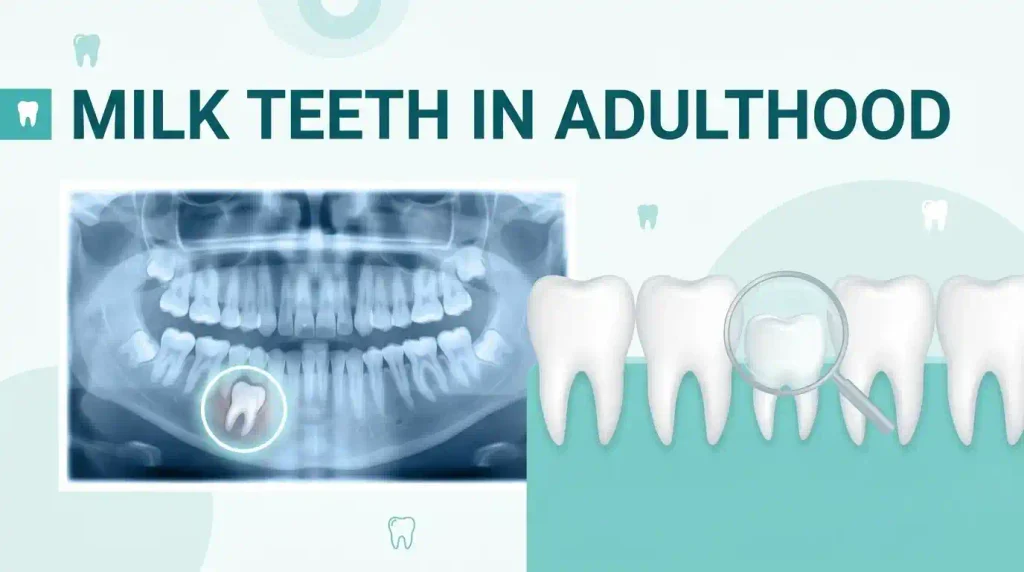
Longer than most people expect. Dentists regularly see baby molars still working in patients in their forties, fifties, and beyond, especially when the root stayed intact and the enamel held up. A small number last an entire lifetime.
A few factors tilt the odds:
- Root length. More root means more support and a longer service life.
- Bite load. Back teeth carry heavy forces, so they wear faster than front teeth.
- Hygiene. Thin enamel forgives nothing. Daily cleaning decides the timeline.
- Ankylosis. A fused tooth resists decay but slowly sinks, and extracting it later gets trickier.
Here is a practical rule: treat a retained baby tooth as a long-term guest, not a permanent resident. Enjoy it while it works, and plan its replacement before it fails — not after.
What Are the Best Treatment Options for Milk Teeth in Adulthood?
Treatment for milk teeth in adulthood comes down to one decision: keep the tooth or replace it. Both routes are legitimate, and the right choice depends on the tooth’s condition, your age, and your budget. Here is how the options genuinely compare.
| Treatment | Best For | Key Benefits | Trade-offs | Typical Working Life |
|---|---|---|---|---|
| Keep and monitor | Healthy tooth, good bite position, no adult successor | No surgery, no cost, natural tooth stays | Needs an X-ray check every 12–24 months; silent failure is possible | Often decades |
| Composite or ceramic buildup | Worn or slightly low tooth with a sound root | Restores height and shape in one visit; preserves bone | Needs redoing eventually | 5–15 years |
| Crown on the baby tooth | Badly worn crown, intact root | Full shape and chewing surface back | Tooth is small, so the fit takes skill | 10–15 years |
| Extraction + dental implant | Failing tooth, jaw growth complete | Feels and works like a real tooth; protects bone | Surgery plus 3–6 months of healing; highest cost | 20–30+ years |
| Extraction + fixed bridge | Implant unsuitable or several gaps nearby | Fixed result, faster than an implant | Requires trimming the neighboring teeth | 10–15 years |
| Extraction + orthodontics | Younger patients with crowding | Closes the gap using your own teeth | 12–24 months of braces or clear aligners | Permanent, if retained |
| Auto-transplantation | Teens with a healthy spare premolar | A living tooth in the gap that grows with the jaw | Technique-sensitive; few specialists offer it | Case-dependent |
A quick word on implants, the option most adults eventually choose. Mayo Clinic describes the process plainly: the failing tooth comes out, the jawbone is prepared (with grafting when needed), a titanium post is placed in the bone, and once the bone heals around it — a process called osseointegration — an abutment and crown complete the new tooth. One timing rule matters more than the rest: implants wait until jaw growth finishes, usually in the late teens to early twenties.
How Much Does Treating a Retained Baby Tooth Cost?
Prices swing widely by country, city, and practice, so treat these figures as planning numbers rather than quotes:
- Monitoring: the cost of routine checkups plus an X-ray every one to two years
- Composite buildup: $150–$450 per tooth
- Crown: $900–$2,500 per tooth
- Simple extraction: $100–$400; surgical extraction $300–$650
- Dental implant (post, abutment, and crown): $3,000–$6,000
- Fixed bridge: $2,500–$5,000
- Orthodontic space closure: $3,000–$7,000
Insurance usually covers exams, X-rays, and extractions at least partly. Implant coverage varies enormously between plans, so request a written pre-treatment estimate before you commit. Outside the United States, local prices often come in far below these figures, which makes a second quote worthwhile.
Many dentists also phase the work: monitor now, build up or replace later. That approach spreads the cost across years and keeps you in control of the calendar.
Retained Baby Teeth, Shark Teeth, or Supernumerary Teeth: Which One Do You Have?
These three conditions get confused constantly, so here is the clean version.
A retained baby tooth is a primary tooth that never left because its adult replacement is missing or off-course. It is usually a single tooth, most often in the lower back jaw. This is the milk teeth in adulthood situation this guide covers.
Shark teeth appear when an adult tooth erupts behind a baby tooth that has not fallen out yet, creating two rows — common in children losing lower incisors. It usually corrects itself once the baby tooth goes.
Supernumerary teeth are extra teeth that form beyond the normal set. They can block eruptions, crowd the arch, and often need removal when they cause trouble.
Related terms worth knowing: hypodontia (one to a few missing adult teeth), oligodontia (six or more missing), and anodontia (all teeth missing). Multiple missing teeth sometimes link to genetic conditions such as ectodermal dysplasia, which deserves a specialist’s attention. A single panoramic X-ray sorts all of these possibilities out in one appointment.
How Do You Care for Milk Teeth in Adulthood at Home?
Home care decides the timeline. A protected baby tooth can serve for decades, so give it deliberate attention:
- Brush it twice a day with a fluoride toothpaste
- Floss or use an interdental brush around it daily — thin enamel fails at the contact points first
- Add a fluoride mouthwash if your dentist recommends it
- Skip ice, hard candy, and pen-chewing; thin enamel chips on hard objects
- Wear a night guard if you grind your teeth
- Keep your six-month cleanings and ask your hygienist to focus on the retained tooth
- Photograph the tooth with your phone every few months — a visual record makes slow changes obvious
None of this takes more than two minutes a day. It is the cheapest dental insurance you will ever buy.
When Should You See a Dentist Immediately?
Book a same-week visit if you notice any of these around a retained baby tooth:
- Throbbing pain, or pain that wakes you at night
- Swelling in the gum, cheek, or jaw
- Pus or a bad taste — classic signs of an abscess
- Sudden looseness
- A crack or a piece breaking off
- A gum lump that lasts longer than two weeks
Never had the tooth assessed at all? Book a baseline X-ray anyway. It takes ten minutes, and it converts a lifetime of wondering “what is this tooth?” into a written plan that has dates on it.
Frequently Asked Questions About Milk Teeth in Adulthood
Is it normal to still have milk teeth in adulthood?
Yes. Milk teeth in adulthood usually mean the replacement tooth never formed, and roughly 3–8% of people are missing at least one adult tooth. Every dental practice sees retained baby teeth, so yours will surprise no one.
Can a retained baby tooth last a lifetime?
Some do, especially front teeth under light biting forces. Most baby molars eventually wear down or lose root support. An X-ray lets your dentist estimate the remaining service life in minutes.
Do baby teeth in adults still have roots?
Most do, but the roots are usually shorter than a child’s because years of slow resorption shave them down. The X-ray shows exactly how much support remains.
Will an over-retained baby tooth fall out on its own?
Rarely after the teenage years. If the adult replacement never formed, no force exists to push the tooth out, and an ankylosed tooth never loosens at all. Assume it stays.
Can you replace milk teeth in adulthood with a dental implant?
Yes. Dentists replace milk teeth in adulthood with implants every day, and the implant is the standard choice once jaw growth is complete. Treatment runs several months from extraction to final crown, and the result looks, feels, and chews like a natural tooth.
Does insurance cover treatment for retained baby teeth?
Usually the diagnostics and extraction, at least in part. Implant and bridge coverage depends on your plan and country. Always request a written pre-treatment estimate so nothing surprises you later.
Your Next Step: Book the X-Ray and Ask Three Smart Questions
You now know more about milk teeth in adulthood than most people pick up in a lifetime of dental visits. You know why the tooth stayed, which risks are real, and the seven treatment paths that exist. The gap between you and a clear plan is one appointment.
When you get there, ask these three questions:
- Is the adult replacement tooth present on my X-ray?
- How much root support does my baby tooth have left?
- Should we monitor this tooth, and when do we revisit the plan?
Write the answers down. A retained baby tooth rewards owners who pay attention: catch changes early and every option stays open, from a quick composite buildup today to a flawless implant later.
Your baby tooth stayed behind when everything around it moved on. Give it the one thing it needs now — a professional set of eyes and a dated X-ray. Book the visit this week, and take this guide with you.