
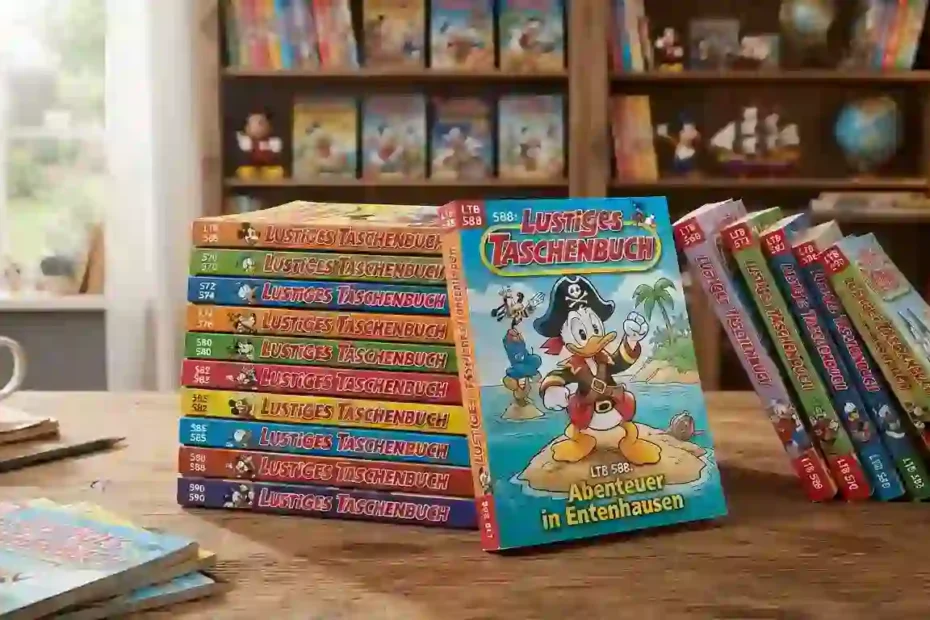
You loved Disney comics as a kid, but one legendary series always slipped past you: the Lustiges Taschenbuch. Missing issues scatter across flea markets, prices for early volumes climb every year, and solid facts hide deep inside fan wikis. This guide ends that frustration. You get the full story of Germany’s favorite comic digest — its 1967 origin, its heroes, its rarest issues, and a clear plan to start collecting today.
What Is the Lustiges Taschenbuch?
The Lustiges Taschenbuch is a German-language Disney comic digest that packs around 250 pages of adventures into one small paperback. Fans simply call it LTB. Every volume collects complete stories starring the duck and mouse families of Entenhausen, the German name for Duckburg.
The name translates to “funny pocket book,” and the format does exactly what it promises. One book, several long stories, hours of reading. No cliffhangers, no ads breaking the flow. You can finish a whole treasure hunt on a single train ride.
Since October 1967, the series has never stopped publishing. New volumes arrive every four weeks, and the count passed 615 in September 2026. That makes it one of the longest-running comic series in Europe.
How Did the Lustiges Taschenbuch Begin in 1967?
The story starts with a smart look across the Alps. Italian readers already adored Disney comics in cheap paperback form, especially the digest series I Classici di Walt Disney. The Ehapa Verlag in Germany wanted that same success.
On October 1, 1967, the first volume hit the newsstands: Der Kolumbusfalter und andere Abenteuer (The Columbus Butterfly and Other Adventures). It cost 2.50 Deutsche Mark, ran 254 pages, and featured a cover by Italian artist Marco Rota. Dr. Erika Fuchs, the legendary translator who shaped how Germans hear Donald Duck talk, edited the book and polished its texts.
Volume one drew almost entirely from Italian story material, and that recipe stuck. Volumes 1 through 116 consisted mostly of reprints from the Italian classics line. Early books even alternated two full-color pages with two black-and-white pages to keep costs down. Full color only became standard later, but readers never cared — the stories carried the books.
Which Characters Headline the Lustiges Taschenbuch?
Entenhausen runs on big personalities. The cast mixes greedy millionaires, unlucky ducks, clever nephews, and masked heroes. Here are the stars you will meet on almost every cover:
- Onkel Dagobert (Scrooge McDuck) — the richest duck alive, guardian of the famous money bin, eternal treasure hunter
- Donald Duck — the short-tempered, big-hearted hero of a thousand disasters
- Tick, Trick und Track (Huey, Dewey and Louie) — the sharp junior scouts who solve what adults break
- Daisy Duck — Donald’s confident and unimpressed girlfriend
- Gitta Gans (Brigitta) — Dagobert’s most persistent admirer
- Daniel Düsentrieb (Gyro Gearloose) — the inventor whose gadgets backfire gloriously
- Die Panzerknacker (the Beagle Boys) — the clumsy crooks after the money bin
- Micky Maus and Goofy — the mouse detectives of Entenhausen’s second story universe
- Phantomias — Donald’s secret masked identity, a fan-favorite superhero
Duck stories dominate the series. Between volumes 200 and 250, Mickey tales shrank to one story per book or fewer. The ducks simply sold better, and the editors followed their readers.
Why Do Readers Keep Coming Back?
Great characters alone do not explain a 59-year run. The LTB formula blends several ingredients that reward loyal readers:
- Complete stories in one sitting. Long Italian adventures give each volume real narrative depth.
- A pocket format that travels. The book fits in a jacket pocket and survives school bags, beach trips, and hospital waiting rooms.
- A collectible spine. Since 1987, the spines of consecutive volumes form one continuous panorama image. A full shelf row looks like one giant painting — a magnet for collectors.
- Language with personality. The German texts carry the wit Erika Fuchs made famous: playful words, quoted classics, and jokes that adults catch years later.
- A low price for thick reading. At €8.99 for about 250 pages, each hour of entertainment costs cents.
Verified sales figures back up the love. Around 245,000 copies sold per issue in the 2009/2010 audit period. In 2019, the publisher reported €12.8 million in retail revenue, making the series the top-selling children’s and comic title in German press retail, with ten percent growth — rare for any print magazine.
Lustiges Taschenbuch at a Glance: Key Facts
| Fact | Detail |
|---|---|
| First published | October 1, 1967 |
| First volume | Der Kolumbusfalter und andere Abenteuer (254 pages, DM 2.50) |
| Original series title | Walt Disneys Lustige Taschenbücher (renamed in 1987) |
| Publisher | Egmont Ehapa Media GmbH, Berlin |
| Frequency | Every four weeks on a Tuesday, 13 issues per year |
| Pages per volume | Around 250 |
| Current cover price | €8.99 print, €6.99 e-paper (2026) |
| Volumes published | 615+ as of September 2026 |
| Story source | Mainly Italian Disney studio productions, first published in German |
| Verified circulation | About 245,000 copies per issue (2009/2010) |
| Retail revenue | €12.8 million in 2019, no. 1 among German children’s and comic titles |
| Spine panorama art | Running continuously since 1987 |
How Has the Series Evolved Over Six Decades?
Each era left a visible mark on the books. This timeline shows the milestones that shaped the Lustiges Taschenbuch readers hold today:
- 1967 — The debut. Volume 1 launches with Italian stories and a mix of color and black-and-white pages.
- 1970s–1980s — Full color arrives. The alternating monochrome pages disappear after roughly volume 118, and print quality improves.
- 1987 — A name and a panorama. The series drops “Walt Disneys Lustige Taschenbücher” for the shorter current title, and the famous spine artwork begins.
- 2007 — Variant covers debut. For the 40th anniversary, volume 369 appears in gold and silver cover versions — the first variant covers in the series.
- 2010 — Volume 400. The milestone issue ships with an online anniversary edition as a bonus.
- 2017 — The 50th anniversary year. Fans vote for their favorite stories in the five-volume Fan Edition. A Nostalgie Edition reprints volumes 1–10 with the original covers (limited to 5,000 boxed sets). Volume 500 becomes the first flip book you can read from both ends.
- 2023 — Disney turns 100. The publisher reissues the very first volume in a limited edition with a special cover.
- 2024 — Donald turns 90. A four-volume special edition celebrates the anniversary across the whole year.
- 2026 — Still monthly, still growing. Volume 614 lands in August, volume 615 follows on September 22, and fresh spin-offs keep arriving.
Which Special Editions and Spin-Offs Exist?
The Lustiges Taschenbuch spawned a whole family of themed books. Egmont Ehapa uses them to serve every corner of the fandom:
- LTB Spezial — themed anthologies, now past volume 130
- LTB Enten-Edition — character-focused volumes, one star per book
- LTB Crime — spy and detective stories from Entenhausen
- LTB Mystery and LTB Halloween — spooky season reading
- LTB Abenteuer and LTB Europareise — adventure trips across the globe, country by country
- LTB Entenhausen Stars — premium hardcover-style spotlights on single characters like Dagobert Duck, Goofy, or Oma Duck
- LTB Mundart — stories translated into German dialects: Bavarian, Berlinerisch, and even Viennese, with real celebrity guest translators
- LTB Phantomias Collection — dedicated volumes for Donald’s masked alter ego
- Seasonal releases — Weihnachten, Nikolaus, and Sommer editions every year
- Curveballs like the Heavy Metal edition — yes, an LTB presented by the Wacken Open Air festival
Newcomers often overlook these side series, but they hold some of the best-curated stories the archives offer.
How Can Beginners Start Collecting the Lustiges Taschenbuch?
Starting a collection feels easier when you follow a simple order. Here is the path that works for most new collectors:
- Buy the current issue first. Grab the newest volume at any German newsstand, or order it from the publisher’s shop. It costs €8.99 and shows you exactly what the series looks like today.
- Pick an era you love. Miss the 1980s art? Chase those volumes. Prefer modern Phantomias stories? Focus on the 2010s. A themed collection stays fun and affordable.
- Use reprints to fill gaps. The 2017 Nostalgie Edition and the Disney 100 reissue of volume 1 let you read the classics without paying collector prices.
- Set a condition standard. Decide early: only near-mint copies, or reading copies at fair prices. Mixing both strategies keeps costs down.
- Track the spine panorama. If you collect from volume 1 onward in order, the spine artwork rewards you with one continuous image — the most satisfying display in any comic collection.
- Subscribe if you never want to miss an issue. Annual subscriptions run around €127.90 for 13 issues, and e-paper editions cost €6.99 per volume.
Which Issues Are Rare and Valuable?
Condition decides value more than age does. A beat-up early volume may sell for pocket change while a pristine copy triples its estimate. Keep the table below as a rough market compass, based on catalog estimates and recent sales:
| Issue / Edition | Why It Matters | Typical Value (very good condition) |
|---|---|---|
| LTB 1, 1967 first edition | Series debut, Der Kolumbusfalter | Up to ~€1,500 (catalog estimate for top grade) |
| LTB 2–10, first editions | First decade of Italian classics | Low to mid three-figure sums |
| LTB 100 | First major milestone, Ein Fest für Donald | Modest premium over later volumes |
| LTB 150 | First gold anniversary cover | Steady collector demand |
| LTB 369 (2007) | First variant covers, gold and silver | Buy both versions as a pair |
| LTB 500 (2017) | Flip-book anniversary, fan-voted stories | Affordable modern keepsake |
| Nostalgie Edition box (2017) | Volumes 1–10, limited to 5,000 sets | Rising, still below originals |
| 50 Jahre LTB – Eine Retrospektive (2017) | 600 pages, limited to 1,500 copies, €199 launch price | The top shelf piece of the era |
Two buying rules protect you: inspect the spine and corners before paying, and compare at least three listings before you bid. Original first editions of the first ten volumes stay the blue chips of the market.
Where Can You Buy New and Back Issues Today?
You can find the Lustiges Taschenbuch in five places, each with its own strength:
- Newsstands and train station kiosks — every new volume, every four weeks, no shipping fees
- The Egmont shop — current issues, subscriptions, special editions, and even personalized gift volumes
- Digital kiosks — e-paper editions for readers who travel light
- Online marketplaces — the main hunting ground for back issues, from €2 reading copies to graded first editions
- Flea markets and comic conventions — the best place to find bargain boxes and talk to collectors who know their stock
German-speaking readers have the deepest supply, but international fans can order through the publisher’s shop or marketplace sellers who ship across the EU.
How Did the Lustiges Taschenbuch Shape German Pop Culture?
Few comic series left a deeper mark on the German language. Translator Erika Fuchs gave the ducks a voice full of wordplay, hidden quotes from Goethe and Schiller, and invented slang that entered everyday speech. Generations of readers grew up quoting panels they memorized at age nine.
The publisher leaned into that bond with playful projects. Dialect editions translated entire volumes into Bavarian, Berlin slang, and Viennese — with schlager star Andy Borg guest-translating the Vienna edition and appearing in the story as a duckified ballroom dancer. A heavy metal edition partnered with the Wacken festival. Personalized volumes let fans put their own name on the cover.
The numbers describe the footprint. Roughly a quarter million copies sold per issue at the series’ recent audited peak, close to half a million readers per volume, and a retail revenue crown among all German children’s and comic titles. For nearly six decades, the little paperback has been a first reading experience — and a shared memory across generations.
How Do You Keep Your Collection in Great Shape?
Paper from the early Lustiges Taschenbuch years yellows fast if you store it wrong. Protect your investment with these habits:
- Store volumes upright, snug but not squeezed, on a shelf away from direct sunlight
- Keep the room dry — humidity warps covers and breeds foxing spots
- Use comic bags or archival boxes for early and valuable issues
- Wash your hands before handling first editions; skin oils stain covers permanently
- Never bend the spine to “read it flat” — the panorama artwork depends on intact spines
- Log your collection in a simple spreadsheet: volume number, edition, condition, purchase price
Small care today preserves real money tomorrow. A near-mint LTB 1 outsells a worn one by hundreds of euros.
Lustiges Taschenbuch FAQs: Quick Answers
What does “Lustiges Taschenbuch” mean in English?
It translates to “funny pocket book.” The name describes the format: a small, affordable paperback packed with humorous Disney stories.
How often does the Lustiges Taschenbuch come out?
A new volume appears every four weeks on a Tuesday, 13 times per year. Volume 615 is scheduled for September 22, 2026.
How many pages are in one issue?
Each volume contains around 250 pages of comics. The very first issue set the standard with 254 pages back in 1967.
Where do the stories come from?
Most stories originate from Italian Disney studio productions, the same tradition behind Topolino and I Classici di Walt Disney. The German volumes usually mark the first publication of these stories in German.
How much is a first edition of LTB 1 worth?
Catalog estimates put a top-condition original of Der Kolumbusfalter at up to about €1,500. Worn copies sell for far less, and affordable reprints from 2017 and 2023 let any fan own the story.
Can you read the Lustiges Taschenbuch digitally?
Yes. E-paper editions of current issues cost €6.99 each, and subscription bundles cover the full year. Print remains the collector’s choice because of the spine panorama art.
Your Next Step Starts With One Volume
Sixty years of treasure hunts, money bins, and masked ducks are waiting on a shelf near you. Grab the newest issue for less than the price of a coffee and a sandwich, or start hunting for the era that shaped your childhood. Open one book, and Entenhausen pulls you back in. Which volume will you hunt first — the latest issue or the legendary Kolumbusfalter? Tell us your favorite story in the comments, and share this guide with a fellow collector who still has gaps on their shelf.