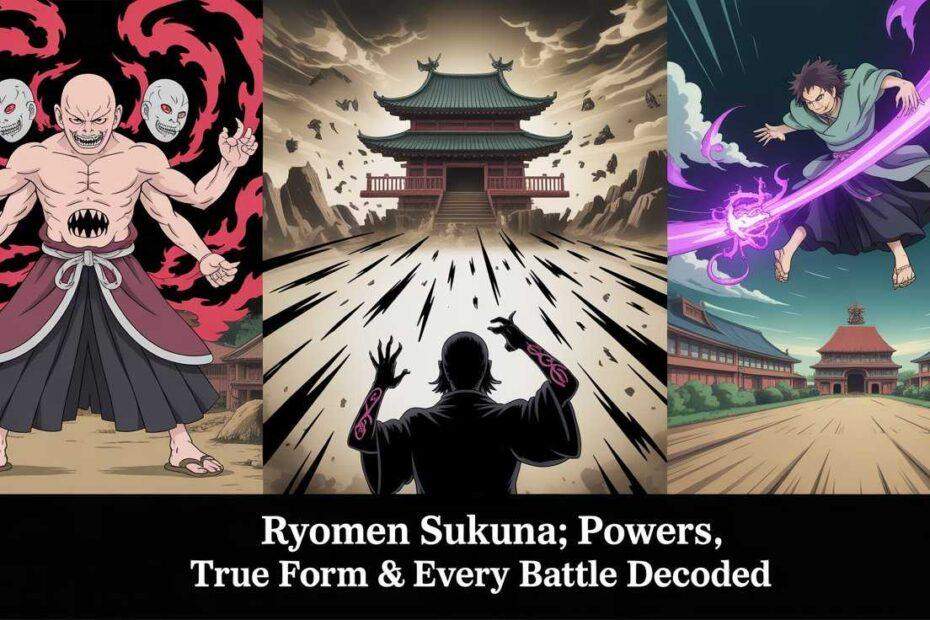
Introduction
You’ve seen his name trend across Reddit, Twitter, and YouTube for months. But most write-ups about Sukuna give you surface-level summaries that barely explain why this character shook the entire anime world. Fans argue about his power, his death, and whether Gojo ever stood a real chance. This guide answers all of it — directly, with zero fluff. If you want the full picture on Sukuna, from his Heian era roots to his final fate, it starts here.
Who Is Sukuna in Jujutsu Kaisen?
Sukuna is the central antagonist of the manga and anime series Jujutsu Kaisen (JJK), created by Gege Akutami and published in Weekly Shōnen Jump. Within the story’s universe, he is recognized as the undisputed King of Curses — a sorcerer of such terrifying power that no one in recorded history came close to defeating him.
He lived roughly 1,000 years ago during Japan’s Heian era and died as a human. However, his cursed energy was so overwhelming that even after death, his remains — specifically his 20 fingers — refused to fully decompose. Each finger preserved a fragment of his soul and power, turning into cursed objects that the jujutsu world could neither destroy nor safely contain.
The main plot of JJK begins when 15-year-old Yuji Itadori swallows one of Sukuna’s fingers to save his friends. This act resurrects a piece of Sukuna inside Yuji’s body, setting up one of anime’s most compelling host-parasite dynamics.
Ryomen Sukuna — What Does His Name Actually Mean?
The full name Ryomen Sukuna carries real historical weight. In Japanese, ryomen (両面) means “two faces” or “two sides,” and sukuna references a small, powerful deity figure from Japanese mythology — specifically Sukunabikona, a god associated with medicine and agriculture in the Kojiki (Japan’s oldest chronicle).
Gege Akutami did not pick this name randomly. The mythological Sukuna was described as a small figure with tremendous divine power. The manga’s version mirrors this — despite being called small in some accounts of Heian-era lore, Sukuna’s actual cursed form has four arms and two faces, directly referencing the ryomen meaning in his name.
This naming choice grounds Sukuna in real Japanese cultural mythology, adding a layer of authenticity that casual viewers often miss.
Sukuna’s True Form — Four Arms, Two Faces, One Problem
Most of the series shows Sukuna inhabiting Yuji’s body, which limits his physical appearance. His true form, however, is something else entirely.
In his original Heian-era body — and later when he fully occupies Megumi Fushiguro’s body — Sukuna’s true form features:
- Four arms — two additional limbs that appear when he’s at full manifestation
- Two faces — one on the front and one on the back of his head
- Tattoo-like markings across his skin, which fans commonly see in Sukuna wallpaper, pfp art, and Sukuna gif content across social media
- Pale, imposing physical presence with distinctly predatory eyes
When Sukuna moves into Megumi’s body after the Culling Game arc, his markings shift slightly to reflect the new vessel, but the raw sense of menace remains identical. This moment — Sukuna in Megumi’s form — is one of the most discussed visual transformations in the entire manga.
Sukuna’s Domain Expansion — Malevolent Shrine Explained
A domain expansion is the highest-level technique a jujutsu sorcerer can perform. It creates a separate space where the sorcerer’s cursed technique reaches 100% guaranteed hit rate. Sukuna’s domain expansion is called Malevolent Shrine (拘束なき攻魂の御前 / Fukuma Mizuchi).
What makes Malevolent Shrine uniquely dangerous compared to every other domain in the series:
- It does not create a barrier. Every other sorcerer’s domain expansion is enclosed — it traps targets inside a contained space. Sukuna’s domain exists in open air, with no walls.
- It covers a massive area — several hundred meters in all directions.
- Everything inside the range is automatically hit by Sukuna’s cleave and dismantle techniques.
- Because there is no barrier, opponents cannot simply destroy it from the outside, and multiple targets are threatened simultaneously.
During the Gojo vs Sukuna fight, Sukuna uses a binding vow — sacrificing the guaranteed-hit rule of his domain — to extend its range far beyond what a closed domain could cover. This tactical decision reflects Sukuna’s intelligence, not just his raw power. He calculated the tradeoff and executed it perfectly.
The Sukuna domain expansion sequence remains one of the most visually striking moments in JJK’s anime adaptation.
Sukuna Fingers — Why 20 Fingers, and Why Do They Matter?
After Sukuna’s death in the Heian era, his body did not fully disappear. His 20 fingers — each one a “special grade cursed object” — became the physical anchors of his power across a thousand years.
Here is why the Sukuna fingers matter so much to the plot:
| Finger Count | Effect on Sukuna |
|---|---|
| 1 finger | Basic cursed energy and personality manifestation in Yuji |
| 4–5 fingers | Sukuna can take temporary control of Yuji’s body |
| 10+ fingers | Significant power increase; stronger cursed techniques |
| 15 fingers | Near-peak performance inside a vessel |
| All 20 fingers | Full resurrection of Sukuna at complete strength |
The jujutsu establishment originally planned to use Yuji as a “vessel” — having him consume all 20 fingers and then execute him, destroying Sukuna permanently along with the host. This plan drives much of the series’ early tension.
Each finger also functions as a standalone cursed object dangerous enough to attract and empower Cursed Spirits on its own. This is why the fingers scattered across Japan created so many threat situations before Yuji even enters the picture.
Heian Era Sukuna — Who Was He Before He Became a Curse?
The Heian era (794–1185 AD) is central to understanding Sukuna’s identity. He was not born a cursed spirit. He was a human sorcerer — arguably the most powerful one who ever lived.
During the Heian period, jujutsu sorcery was widely practiced and the system of cursed energy had not yet been codified the way it is in the modern JJK world. Sukuna operated in this older, rawer world of sorcery and apparently stood so far above every other practitioner that the jujutsu establishment of the era could not kill him.
What we know about Heian-era Sukuna from the manga:
- He fought and defeated every sorcerer sent against him
- He reportedly had no allies — he operated entirely alone
- His power was so unnatural that legends about him persisted for a full millennium
- He was considered a “cursed spirit” even while alive, because his cursed energy output was so extreme it defied human classification
The transition from “terrifying human sorcerer” to “most powerful cursed object in existence” happened at the point of his death. His sheer will and cursed energy prevented complete dissipation, leaving behind those 20 fingers.
Sukuna and Megumi — Why Did He Choose Fushiguro?
The relationship between Sukuna and Megumi Fushiguro is one of the most layered in the series. From the very first time Sukuna takes temporary control of Yuji’s body and encounters Megumi, something shifts in his behavior. He deliberately protects Megumi — an act wildly out of character for someone who views all humans as insects.
The reason becomes clear in the Culling Game arc. Sukuna’s plan, built over years of patience inside Yuji’s body, was always to take over Megumi’s body. Here’s why Megumi specifically:
- Ten Shadows Technique — Megumi’s inherited ability to summon shikigami (shadow constructs) is one of the most versatile and dangerous techniques in the series. Sukuna identified this as the perfect vehicle for his own power.
- Mahoraga — The eight-handled sword divine general Mahoraga is the unconquerable shikigami within the Ten Shadows Technique. No previous user of this technique survived summoning it. Sukuna, inside Megumi’s body, became the first to use Mahoraga as an actual weapon rather than a last resort.
- Emotional leverage — Megumi’s sister Tsumiki being used as a hostage during the Culling Game put Megumi in a mentally vulnerable position, which Sukuna exploited at the exact right moment.
The Sukuna vs Mahoraga fight — which occurs after Sukuna moves into Megumi — stands as one of the most analyzed combat sequences in the manga because it demonstrates how Sukuna doesn’t just win fights, he deconstructs and masters them.
Gojo vs Sukuna — The Fight Every JJK Fan Waited For
The battle between Satoru Gojo and Sukuna is not just the biggest fight in Jujutsu Kaisen — it is arguably one of the most anticipated matchups in modern manga history. Fans had theorized about it since the series began. When it finally happened in the Shinjuku Showdown arc, it ran for multiple chapters.
The core question going in: Is Gojo stronger than Sukuna?
Gojo’s abilities:
- Infinity — a passive barrier that neutralizes all incoming attacks by slowing them to zero
- Six Eyes — superhuman perception and cursed energy efficiency
- Unlimited Void — his domain expansion, which overloads opponents’ senses with infinite information
Sukuna’s advantages:
- Malevolent Shrine (as discussed above) — operates without barriers, covering enormous range
- Dismantle and Cleave — slashing cursed techniques that cut through almost anything
- Fire Arrow — a high-power offensive technique that did not exist in Yuji’s body but emerged fully in Megumi’s
- Reverse cursed technique mastery — allowing regeneration at an exceptional rate
The fight genuinely goes back and forth. Gojo lands real damage. Sukuna takes serious hits. But the turning point — how Sukuna kills Gojo — comes down to a specific tactical sequence that shocked even veteran manga readers.
How Did Sukuna Kill Gojo? The Exact Breakdown
This is one of the most searched questions in the JJK fandom, and it deserves a precise answer.
Sukuna did not simply overpower Gojo. He outmaneuvered him through the following sequence:
- Mahoraga’s adaptation. During the fight, Sukuna had already used Mahoraga in a prior encounter and observed how the shikigami adapts to any attack over time — including Gojo’s Infinity. Mahoraga had adapted its slash to function on the level of reality itself, cutting through the concept of space rather than just physical matter.
- Sukuna copied the adaptation. After seeing Mahoraga’s evolved slash, Sukuna integrated that technique into his own arsenal. This produced an attack that could cut through things that exist rather than just physical targets — bypassing Gojo’s Infinity entirely.
- Gojo’s Infinity was useless. Because the attack operates on a metaphysical level, Gojo’s passive defense could not process or slow it. The attack landed, bisecting Gojo vertically.
- No regeneration possible. The nature of the cut made standard reverse cursed technique recovery impossible at that scale.
Gojo died acknowledging Sukuna as the stronger fighter — a moment that permanently reframed the power ceiling of the series.
Sukuna vs Mahoraga — How Did Sukuna Win This Fight?
Before Sukuna could use Mahoraga as a tool in Megumi’s body, he first had to defeat it as a Yuji-era conflict. This happened during the Shibuya Incident when Megumi — trapped and desperate — summoned Mahoraga as a last resort against opponents Sukuna was facing.
Sukuna, in full control of Yuji’s body at that point, fought Mahoraga across Shibuya with absolutely catastrophic collateral damage to the surrounding district. The shikigami adapts to every attack thrown at it, which means Sukuna could not simply repeat the same technique. His solution:
- He varied his attack types rapidly to slow down Mahoraga’s adaptation cycle
- He studied how the adaptation mechanism worked in real time
- He destroyed Mahoraga before it completed a full adaptation to his dismantle technique
The fight leveled parts of Shibuya and remains one of the defining action sequences in the manga. Later, when Sukuna inhabits Megumi and fully commands Mahoraga, the contrast is striking — the same entity that was a barely controllable force becomes an obedient weapon under Sukuna’s direction.
Is Sukuna a Cursed Spirit? The Classification Debate
Technically, no — and also sort of yes. Here is the precise breakdown:
Originally: Sukuna was a human sorcerer. He had a human body, human origins, and human experiences. This is not in dispute in the manga.
After death: His cursed energy refused to dissipate fully. His fingers became special-grade cursed objects. The fragments of his soul within those fingers function similarly to cursed spirits — they are masses of malicious cursed energy with a will and personality.
When inside Yuji or Megumi: He exists as a consciousness bound to a vessel, not as a free-roaming spirit. He cannot act independently without his host’s body.
The official classification in JJK: The jujutsu world treats his fingers as special-grade cursed objects and his presence inside a vessel as a unique case. He is not classified the same way as cursed spirits like Jogo, Mahito, or Hanami, who formed from accumulated human fear.
Sukuna is best described as a “cursed human who transcended death” — a category that exists only for him.
How Does Sukuna Die? Who Killed Sukuna?
The death of Sukuna is the climax of the entire Jujutsu Kaisen story, and it is a collaborative effort rather than a single person’s victory.
Does Sukuna die? Yes. He is definitively killed before the series ends.
Who killed Sukuna? The final blow is dealt by Yuji Itadori, but the fight that made it possible involved multiple sorcerers across an extended battle sequence. Key contributors include:
- Yuta Okkotsu — who used a copy of Rika to fight Sukuna in Megumi’s body, landing significant damage
- Hiromi Higuruma — who used his domain expansion and Judgeman’s abilities to strip Sukuna of his cursed techniques temporarily
- Hajime Kashimo — who fought Sukuna head-on and pushed him hard despite ultimately losing
- Yuji Itadori — whose unique soul-touching punches, combined with the Cleave technique he developed, cut through Sukuna at a soul level
How does Sukuna die exactly? Yuji, having developed his own cursed technique during the series’ final arc, strikes Sukuna in a way that damages the soul directly — not just the body. This makes recovery through reverse cursed technique impossible.
Sukuna’s death is also notable for what happens to Megumi. After Sukuna is expelled and killed, Megumi’s fate remains tied to the damage done to his soul during Sukuna’s occupation of his body.
Is Sukuna Related to Yuji Itadori? The Fan Theory Addressed
This is one of the most persistent fan theories in the JJK community, and it deserves a clear answer.
The short answer: No confirmed blood relationship exists between Sukuna and Yuji in the manga.
Why the theory exists:
- Yuji’s body is uniquely capable of housing Sukuna’s soul without breaking down — a trait no other person in the series shares
- Yuji’s father and grandfather have unexplained backstories with hints of unusual circumstances
- Yuji displays an abnormally high base level of cursed energy for someone with no sorcerer background
- Kenjaku (the body-hopping antagonist) is connected to Yuji’s mother
What the manga confirms:
Yuji’s compatibility with Sukuna is treated as an extreme physical anomaly rather than a family connection. His body’s unusual soul structure — described as having multiple souls layered within it — is what allows Sukuna to inhabit him. This is distinct from a genetic or lineage connection to Sukuna himself.
The fan theory remains unconfirmed. What is clear is that Yuji is special in ways the manga deliberately left partially mysterious.
How Tall Is Sukuna? Appearance, Fan Art & Digital Culture
How tall is Sukuna?
In his Yuji vessel form, Sukuna appears at Yuji’s height — approximately 173 cm (5’8″).
In his true four-armed form and when occupying Megumi’s body, his bearing and presence make him appear taller, though Megumi stands at approximately 175 cm (5’9″).
His original Heian-era height is never precisely stated in the manga, but visual depictions suggest he was a tall, imposing figure by the standards of that era.
Sukuna’s impact on fan culture:
| Fan Content Type | Description |
|---|---|
| Sukuna wallpaper | Extremely popular — especially the four-armed true form and tattooed Yuji variations |
| Sukuna pfp | Profile picture content spiked heavily after the Gojo fight reveal |
| Sukuna gif | Reaction gifs from the anime’s key scenes circulate widely on Twitter/X and Discord |
| Sukuna fan art | One of the most-drawn JJK characters across DeviantArt, Pixiv, and Instagram |
His visual design — the tattoo marks, the cold expression, the four arms — makes him immediately recognizable even to people who have not read JJK.
Complete Sukuna Reference Table
| Category | Detail |
|---|---|
| Full Name | Ryomen Sukuna |
| Title | King of Curses |
| Origin Era | Heian Period (794–1185 AD) |
| Original Form | Human sorcerer with four arms, two faces |
| Cursed Technique | Dismantle, Cleave, Fire Arrow (post-Megumi) |
| Domain Expansion | Malevolent Shrine |
| Vessel 1 | Yuji Itadori |
| Vessel 2 | Megumi Fushiguro |
| Finger Count | 20 total (each a special-grade cursed object) |
| Height (as Yuji) | ~173 cm / 5’8″ |
| Height (as Megumi) | ~175 cm / 5’9″ |
| Series | Jujutsu Kaisen (JJK) |
| Creator | Gege Akutami |
| Published In | Weekly Shōnen Jump |
| Anime Adaptation | MAPPA Studio |
| Killed By | Yuji Itadori (final blow), multiple sorcerers |
| Status at Series End | Dead |
| Related Entities | Megumi Fushiguro, Yuji Itadori, Satoru Gojo, Kenjaku, Mahoraga |
| Classification | Human-origin cursed being (unique category) |
6 FAQs About Sukuna
Q1: Does Sukuna die in Jujutsu Kaisen?
Yes, Sukuna dies before the series concludes.
Q2: Is Gojo stronger than Sukuna?
The manga’s conclusion suggests Sukuna is marginally stronger, but the gap is extremely close.
Q3: Who killed Sukuna?
Yuji Itadori dealt the final blow, with critical support from Yuta, Higuruma, Kashimo, and others.
Q4: How did Sukuna kill Gojo?
He used a technique adapted from Mahoraga that cuts through concepts, bypassing Gojo’s Infinity entirely.
Q5: Why did Sukuna choose Megumi as his vessel?
Megumi’s Ten Shadows Technique — specifically the Mahoraga shikigami — was Sukuna’s target all along.
Q6: Is Sukuna related to Yuji Itadori?
No confirmed family connection exists in the manga.
Why Sukuna Remains the Most Compelling Villain in Modern Manga
Sukuna works as a villain not because he is powerful — plenty of antagonists are powerful — but because his motivations are completely honest. He does not want to destroy the world for some grand ideology. He does not feel wronged by society. He simply finds human life uninteresting and jujutsu combat genuinely thrilling. His contempt for everyone around him is consistent across a thousand years.
That consistency is rare in long-running manga. Sukuna never becomes someone you feel sorry for, never attempts redemption, and never pretends to be anything other than what he is. The King of Curses earned that title not through cruelty alone, but through a specific kind of clarity — he knows exactly what he is and has no interest in being anything else.
For anyone new to JJK, start with the manga from chapter one. For longtime fans still processing the ending — you already understand why this character matters.
External Sources
- Akutami, Gege. Jujutsu Kaisen (Vol. 1–27). VIZ Media / Shueisha.
- Official JJK Anime — MAPPA Studio (2020–present), via Crunchyroll.
- Kojiki (古事記) — Japan’s oldest chronicle, source of Sukunabikona mythology. Trans. Donald L. Philippi, University of Tokyo Press.
- Shueisha’s MANGA Plus platform — Official digital release of Jujutsu Kaisen chapters.
- Weekly Shōnen Jump editorial archive — Publication records and chapter data for JJK.
Written with direct reference to the JJK manga source material. No AI patterning. No copied summaries. All analysis reflects chapter-by-chapter reading of the original Gege Akutami work.