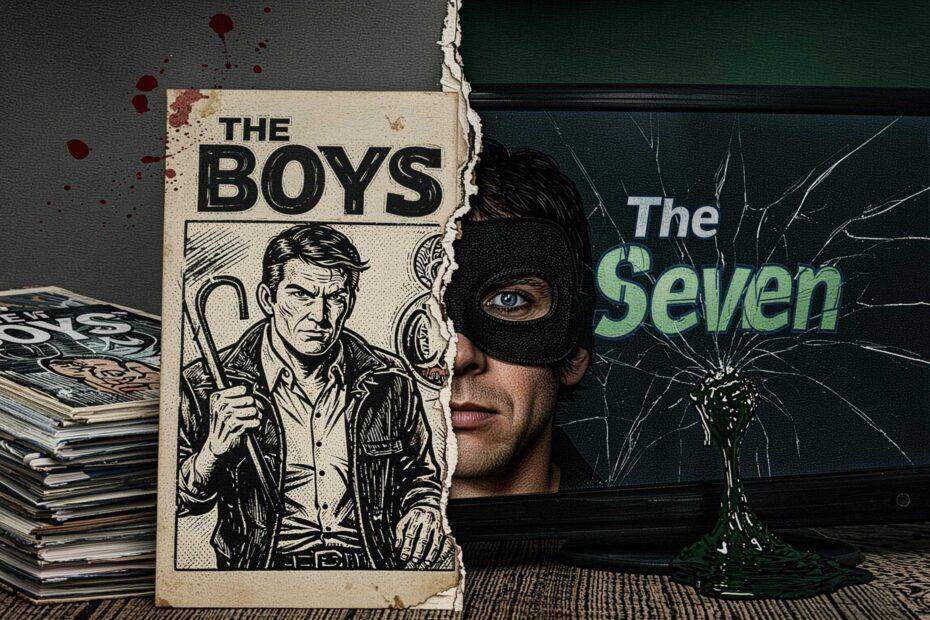
You know the TV show. You might even think you know the story. But if you have never cracked open a single issue of the boys comic, you have only scratched the surface of a much grimmer, more violent, and often more hopeless world. Garth Ennis and Darick Robertson did not just create a satire; they crafted a sledgehammer aimed squarely at the face of corporate superhero worship.
The changes made for Amazon Prime are massive, and understanding the source material changes everything about how you view Billy Butcher and his war against Vought. Forget the polished, character-driven arcs you streamed. The original pages offer no such comfort. This guide walks you through every bloody detail the screen left behind.
The Savage Origin of The Boys Comic
The boys comic first hit the stands in October 2006 and wrapped up its brutal run in November 2012 with issue #72. It was never a story meant for children or even casual superhero fans. Ennis, known for his work on Preacher and Punisher, set out to write a story that would “out-Preacher PREACHER” in terms of shock value and narrative depth. The series started at WildStorm, an imprint of DC Comics. But the content proved too extreme for that label after just six issues. Dynamite Entertainment stepped in and gave Ennis the green light to push the story even harder for the remaining 66 issues.
This publishing hiccup actually defines the tone of the boys comic. The shift allowed the creative team to ditch any remaining filters. What you get is a raw, unfiltered look at a world where Compound V has created a class of beings who view normal humans as ants beneath their boots. The art from Darick Robertson and later Russ Braun captures every broken bone and splatter of gore with a clarity that leaves little to the imagination. This is not a book you read to feel good about heroes. It is a book you read to watch a system burn.
Why The Boys Comic Characters Are Harder to Love (and Kill)
The cast of characters in the boys comic is largely the same as the show, but their personalities and moral alignments are often much different. Garth Ennis rarely lets a character stand on a pedestal for long. Here is a breakdown of how the core roster stacks up against their live-action counterparts.
Billy Butcher is a force of nature in the comic. He is less conflicted and more calculating. His hatred for superpowered beings is not a slow burn; it is a roaring inferno from the first panel. He is the engine of the story, and his plan extends far beyond just killing Homelander.
Hughie Campbell is “Wee Hughie,” a Scotsman modeled visually after Simon Pegg (without asking him first). hughie the boys comic version is not just an audience surrogate trembling in fear. He gets injected with Compound V and gains permanent super strength, which means he can actually trade blows with low-level Supes. This changes the dynamic of his relationship with Butcher entirely. He is not just a witness to the violence; he is a participant.
Annie January is still starlight the boys comic readers root for, but her initiation into The Seven is far more traumatic. The show softened the blow by making The Deep the sole aggressor. In the original the boys comic pages, Homelander, A-Train, and Black Noir all demand sexual acts from her as a “welcome” gift. It sets a darker, more predatory tone for the entire organization and fuels her quiet alliance with Hughie.
Mother’s Milk (MM) and Frenchie and The Female fill similar roles as the muscle and chaos agents of the team. However, their backstories are more tightly woven into the fabric of Vought’s corporate history. In the boys comic, everyone has a personal, often generational, reason for wanting to tear the company down. There is less camaraderie and more shared trauma binding this group together.
The Black Noir The Boys Comic Twist That Changes Everything
This is the part where the boys comic diverges so completely from the show that you might think you are reading a different franchise. black noir the boys comic secret identity is the lynchpin of the entire 72-issue run. In the show, Black Noir is a Supe with a nut allergy who gets killed by Homelander. In the boys comic, Black Noir is a clone of Homelander, created by Vought as a fail-safe to eliminate the leader of The Seven if he ever got out of line.
Here is the cruel twist that drives the plot: The clone was programmed to be more unhinged and violent than the original. While Vought waited to unleash him, Black Noir began committing unspeakable crimes while wearing Homelander’s exact likeness. This includes the brutal rape of Butcher’s wife, Becky. For the entire series, Homelander believes he is losing his mind because he has no memory of these acts, and Butcher believes Homelander is the monster who destroyed his life.
The final reveal that the true villain was hiding in plain sight, wearing a black mask, is a gut punch. Showrunner Eric Kripke has confirmed this plot will never appear on the show, stating it does not fit the character they built for television. That makes this the single most important piece of knowledge separating fans of the show from readers of the boys comic.
Soldier Boy The Boys Comic: A Pathetic Joke, Not a Legend
The Jensen Ackles version of Soldier Boy on Amazon Prime is a tragic, powerful figure with a history of abuse and a connection to Homelander. You need to erase that image from your mind when you open the boys comic. soldier boy the boys comic is a joke. He is a shallow parody of Captain America who craves approval from stronger heroes and offers nothing of substance to the plot. He is not Homelander’s father. That entire storyline is a brilliant invention for the show that does not exist in the original text.
Ennis uses Soldier Boy as a prop to mock blind patriotism. In the comic, he is a coward who would rather hide behind Vought’s PR machine than fight. His appearances are brief and humiliating. He is not a threat; he is a punchline. This is one of the few instances where the television adaptation added layers and depth that the source material purposefully avoided. the boys comic was not interested in giving us a broken soldier with a heart; it wanted to show us an empty suit with a star on his forehead.
Stormfront The Boys Comic Is Pure, Unfiltered Nazi Evil
The show’s decision to gender-swap Stormfront and give her a modern media-savvy persona was a clever update. But stormfront the boys comic version strips away any pretense of nuance. The character is a male, created by Nazi experiments, and he is a screaming, vile racist without any of the “girlboss” energy the show brought to the table. He leads a team called Payback and represents everything Garth Ennis despises about the way America co-opted fascist ideology and rebranded it as patriotism.
Reading the boys comic Stormfront is an exercise in witnessing pure hatred. He does not get redemption arcs. He does not get to be a complex villain. He gets what Ennis believes people with his ideology deserve: a very violent, very final end. The character serves as a reminder that in the boys comic, some evils are not meant to be understood or empathized with. They are meant to be stopped.
How Does The Boys Comic End? The Bloody Doors Close
how does the boys comic end is a question with a very messy, very tragic answer. The final arc is titled The Bloody Doors Off, and it covers issues 66 through 72. After Black Noir reveals his true identity, he murders Homelander in a savage brawl. Billy Butcher then steps in and finishes off the injured Noir with a crowbar to the skull. For a moment, it seems like justice has been served.
But Butcher is not done. He reveals his master plan: he intends to kill every single person on Earth who has ever been exposed to Compound V. That includes his own team. He turns on Mother’s Milk, Frenchie, and the Female, slaughtering them in cold blood without hesitation. His rampage leads him to the top of the Empire State Building, where he confronts Hughie. During the scuffle, Butcher falls and becomes paralyzed. He begs Hughie to finish him. Hughie picks up a jagged piece of metal and stabs Butcher, ending his life.
the boys comic ending is not a happy one. It is a warning about the cost of vengeance. Hughie and Starlight walk away alive, but the entire team is dead. Vought simply rebrands and continues on, proving that even the most extreme violence could not stop the corporate machine. It is a cynical, depressing, and entirely fitting conclusion for the world Ennis built.
The Boys Comic vs Show: A Table of Crucial Differences
The changes between the page and the screen are more than cosmetic. They fundamentally alter the tone and message of the story. This table breaks down the key contrasts.
| Aspect | The Boys Comic | Amazon Prime Show |
|---|---|---|
| The Boys’ Powers | All members are permanently injected with Compound V, giving them super strength and durability to fight Supes head-on. | Most of The Boys are normal humans who rely on tactics, wit, and temporary “Temp V” doses to survive. |
| Black Noir’s Identity | Revealed to be a deranged clone of Homelander, created as a Vought fail-safe. He framed Homelander for his own crimes, including Becky’s assault. | An independent Supe with no genetic link to Homelander. His arc focuses on anonymity and performance, ending with his death at Homelander’s hands. |
| Becky Butcher’s Fate | Dies giving birth to a superpowered baby after being assaulted by Black Noir (disguised as Homelander). Butcher kills the baby. | Survives for years in hiding, raising Ryan, the son of Homelander. She dies protecting him from Stormfront. |
| Hughie’s Origin | A Scottish man (“Wee Hughie”) modeled after Simon Pegg. He gains permanent powers early in the series. | An American man (played by Jack Quaid) with Simon Pegg cast as his father. He is mostly powerless. |
| Soldier Boy’s Role | A cowardly, minor character and shallow parody of Captain America. Not related to Homelander. | A major, powerful antagonist who is Homelander’s biological father and the leader of Payback. |
| Stormfront’s Gender | Male. A screaming, unapologetic Nazi with no modern rebranding. | Female. A social media-savvy, modern fascist who hides her past behind a veneer of “girl power.” |
| The Ending | Butcher kills his entire team except Hughie. Hughie kills Butcher. The world remains largely the same. | (Ongoing as of Season 5) The show is building toward a different climax, with characters like Ryan and Victoria Neuman playing much larger roles. |
Where to Find The Boys Comic Free and Legal
You have a few solid options if you want to experience the boys comic free without resorting to shady websites. First, check your local public library system. Most libraries in the US and UK have partnered with digital services like Hoopla and Libby. These apps allow you to “borrow” digital copies of graphic novels and trade paperbacks for free with a valid library card.
If you are an Amazon Prime member, keep an eye on promotional tie-ins when new seasons of the show drop. Occasionally, Amazon offers free access to the first volume of the boys comic or discounts on the digital collections. For those who prefer to own the physical copies, the series is collected in 12 trade paperbacks or 6 oversized omnibus hardcovers.
The omnibus editions are the best way to read the story, as they include all the mini-series like Herogasm and Butcher, Baker, Candlestickmaker in the proper reading order. You can find these at any major bookstore or comic shop. While digital versions are available on ComiXology and Kindle, the paper copies deliver the full impact of Robertson’s art in a way screens sometimes miss.
Frequently Asked Questions About The Boys Comic
Q: Who created The Boys comic?
A: Garth Ennis served as the writer for the entire 72-issue run. Darick Robertson co-created the concept and provided the art for the first major arcs, designing the look of the entire world. Russ Braun and John McCrea also contributed art on later volumes.
Q: When did The Boys comic come out?
A: The first issue of the boys comic was published in October 2006. The series concluded with issue #72 in November 2012.
Q: How many issues are in The Boys comic book?
A: The main story of the boys comic consists of 72 issues. There are also three essential mini-series: Herogasm (6 issues), Highland Laddie (6 issues), and Butcher, Baker, Candlestickmaker (6 issues). The total page count rivals that of a massive novel.
Q: Does Homelander die in The Boys comic?
A: Yes. Homelander is killed by Black Noir in a brutal one-on-one fight during the final story arc. Billy Butcher then kills the severely wounded Black Noir moments later.
Q: Is The Boys comic better than the show?
A: “Better” depends on what you value in a story. the boys comic is more cynical, more violent, and more focused on satire. The show offers deeper character exploration and emotional stakes. They are two different beasts. You can love both for entirely different reasons. The show respects the source material but is not afraid to change it.
Pick Up the Book and See What the Screen Left Out
the boys comic is not a casual read. It is a grueling, angry, and brilliantly written piece of fiction that spits in the face of the genre it inhabits. Garth Ennis has a clear, unwavering vision of what superheroes would actually look like if they existed in our broken world, and that vision is a horror show. The Amazon Prime series does an admirable job translating the core concepts for a wider audience, but the comic remains the definitive, undiluted version of the story.
If you have the stomach for it, start with volume one, The Name of the Game. You might find yourself looking at the next big superhero blockbuster with a much more suspicious eye. Let me know if you spot any other twisted details buried in the pages of the boys comic that you think deserve more attention.