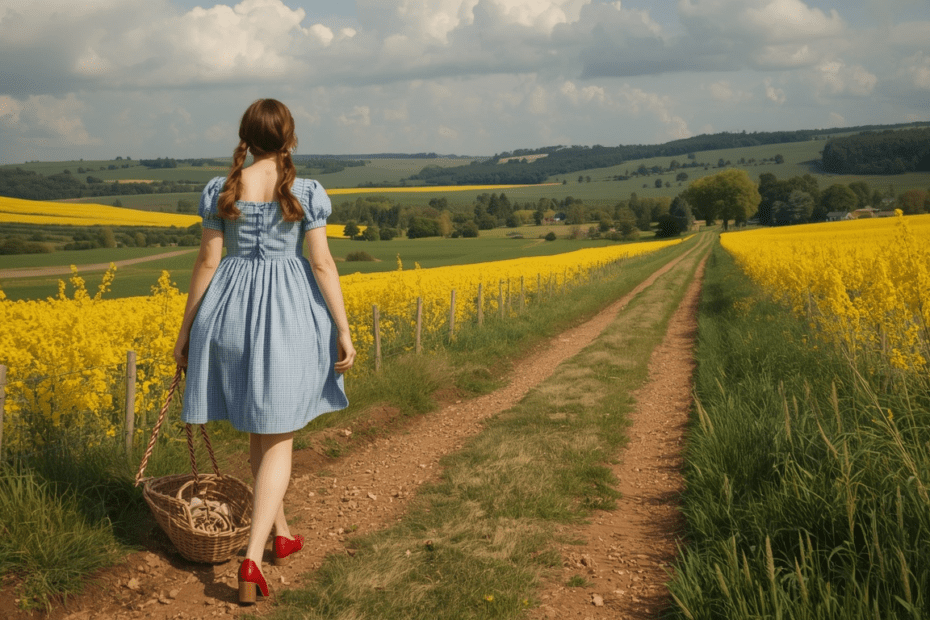
You remember the ruby slippers and the yellow brick road. You can hum “Over the Rainbow.” But if someone asks for the deeper Dorothy Gale meaning, you might pause. Most people never look past the surface of this Kansas farm girl. Yet her very name holds a secret, and every step she takes carries weight. This piece peels back every layer—from the Greek roots of “Dorothy” to the storm hidden in “Gale.” No academic fog. Just the truth about a character who changed storytelling forever.
Who Is Dorothy Gale?
L. Frank Baum dropped Dorothy into American fiction in 1900. She is an orphan living with Aunt Em and Uncle Henry on a gray Kansas farm. A cyclone snatches her house and hurls it into Oz. There, she accidentally crushes a wicked witch and begins a quest to get home. That is the plot. The Dorothy Gale meaning runs deeper. She stands as the ordinary human who walks straight into the unknown without superpowers. Her weapons are honesty, loyalty, and a refusal to bow to fake authority.
The Name Dorothy Gale: Gift and Gale
Dorothy comes from the Greek Dorothea. Doron means “gift.” Theos means “God.” The name literally translates to “gift of God.” Baum chose it with care. His wife Maud’s infant niece, Dorothy Gage, died in 1898. Naming his heroine after the lost child made the character a living memorial. So the first layer of Dorothy Gale meaning is a gift born from grief.
Gale is a strong wind. A gale uproots, disorients, and pushes you somewhere new. In a 1902 stage script, Baum wrote a pun where Dorothy says she is “one of the Kansas Gales,” and the Scarecrow answers, “That accounts for your breezy manner.” The joke points to truth: Dorothy herself is a gale. She enters Oz like a storm, sweeps away two tyrants, and exposes a fraud. Her name means a divine gift that rearranges the world.
Dorothy Gale and the Hero’s Journey
Joseph Campbell’s hero cycle fits Dorothy perfectly. She crosses a threshold (the cyclone) into a strange world. She finds allies: the Scarecrow who thinks he lacks brains, the Tin Man who longs for a heart, the Lion who craves courage. She faces trials—poppy fields, flying monkeys, a witch who wants her dead. She confronts the Wizard, the false father figure, and strips away his illusion. She returns home changed, carrying the knowledge that what she sought was already inside her.
That is the heart of the Dorothy Gale meaning: the hero does not need to become someone else. She needs to remember who she has always been.
The Shoes: Silver or Ruby
In Baum’s book, the shoes are silver. In the 1939 film, they are ruby. Both versions pulse with symbolism. The silver shoes connect to the 1890s battle over whether silver should back U.S. currency alongside gold—a fight for the common farmer and worker. Dorothy walks on the power of ordinary people. The ruby slippers, chosen to pop in Technicolor, carry a different truth: Glinda tells Dorothy she always had the power to go home. The Dorothy Gale meaning here is blunt. The magic you chase outside yourself already sits on your own feet.
The Yellow Brick Road: A Promise That Deceives
The golden road looks certain. Follow it, and you will reach the great Wizard who solves everything. But the Wizard is a humbug. The road leads to a city of illusions. This thread of the Dorothy Gale meaning warns against external saviors. Political readings link the road to the gold standard—a shimmering path that leaves farmers in poverty. Spiritually, the road stands for any external quest that postpones the real work of looking inward.
Home: The Knot at the Center
Dorothy chants her desire to return to Kansas through the entire story. Yet at the start, Kansas is the place she tried to run away from. The film paints it in sepia, flat and hungry. So what is home? Not geography. Home, in the deepest Dorothy Gale meaning, is a state of belonging and self-acceptance. The journey teaches her that nowhere else needs to be perfect if she carries love inside her. “There’s no place like home” is not a trite proverb; it is a hard-won recognition.
The Political Dorothy: A Populist Parable
In 1964, historian Henry Littlefield published an essay interpreting The Wonderful Wizard of Oz as a populist allegory. Dorothy represents the everyday American citizen. The Yellow Brick Road is the gold standard. The silver shoes are the Free Silver movement. The Scarecrow is the farmer, the Tin Man the industrial worker, the Lion the populist politician William Jennings Bryan. The Wicked Witch of the East stands for Wall Street banks. The Wicked Witch of the West for railroad monopolies. The Wizard is any politician who rules by fraud.
Baum never confirmed the allegory. But the reading sticks because the pieces fit. Under this lens, the Dorothy Gale meaning becomes political: ordinary people have the power to expose corrupt systems once they stop believing the lies.
The Spiritual Layer: A Soul’s Map
Baum joined the Theosophical Society, which taught that souls journey through astral planes after death. In a spiritual reading, the cyclone is physical death. Oz is the afterlife realm. The Yellow Brick Road represents the false lure of material salvation. Each companion embodies a soul fragment that needs healing. The Wicked Witch is the shadow self, dissolved by water—a symbol of spiritual cleansing. Dorothy clicking her heels three times and speaking her mantra is a meditative act that returns her to full consciousness. The Dorothy Gale meaning here is the soul’s voyage toward wholeness.
Book Dorothy vs. Film Dorothy
Baum’s Dorothy is a small child, direct and practical. The 1939 film Dorothy, played by 16-year-old Judy Garland, longs for a place “where troubles melt like lemon drops.” The film frames Oz as a dream, while Baum’s Oz is a real kingdom Dorothy eventually moves to. The film adds the farmhands who mirror the Scarecrow, Tin Man, and Lion—making the Dorothy Gale meaning more psychological. Oz becomes the inner landscape of a girl processing her fears and hopes. This shift planted Dorothy firmly in the terrain of human psychology.
Dorothy Gale as a Feminist Figure
Literary scholars point to Dorothy as America’s first feminist children’s hero. She leads a group of males. She makes the decisions. She speaks truth to the Wizard when no one else dares. She kills two witches and liberates whole populations—all without a male rescuer. Baum’s mother-in-law, Matilda Joslyn Gage, was a fierce suffragist. Her influence threads through the character. Some critics note that Dorothy returns to domestic Kansas rather than ruling Oz, a tension that reflects the era’s limits. Even so, the Dorothy Gale meaning includes a strong current of female agency.
The Modern Reach
Gregory Maguire’s Wicked (1995) re-framed Dorothy through the witches’ eyes. The Wiz reimagined her as a Black woman finding home. Every generation reworks her story because her core quest—to belong, to matter, to strip away illusion—never expires. The 2026 documentary It’s Dorothy! examined her cultural gravity, finding enough depth for an entire series. The Dorothy Gale meaning now lives in everything from political commentary to self-help.
Frequently Asked Questions
What does Dorothy Gale symbolize?
She symbolizes the ordinary person who discovers inner strength. Her journey reveals that courage, intelligence, and love are not gifts from authority—they already exist within you.
Is Dorothy Gale based on a real person?
Not a single person. The name honors Baum’s infant niece Dorothy Gage, who died in 1898. The character’s spirit draws from suffragist Matilda Joslyn Gage, Baum’s mother-in-law.
Why is her name Dorothy Gale important?
Dorothy means “gift of God.” Gale means a wind that changes everything. Together, the Dorothy Gale meaning points to a divine gift that uproots corruption and restores truth.
What do the ruby slippers represent?
In the film, they represent the power Dorothy always possessed. Glinda confirms she could go home at any moment. In the book, silver shoes point to the monetary power of ordinary people.
What is the political meaning of Dorothy Gale?
Many read her as the American common citizen. She exposes a fraudulent leader and discovers that real power rests with the people, not with those who claim authority.
Does Dorothy’s story have a spiritual meaning?
Yes. A Theosophical reading interprets her journey as a soul’s passage after death, with the cyclone as death, Oz as the astral plane, and her return as conscious awakening.
The Dorothy Gale meaning holds because it refuses to be just one thing. She is a grieving author’s love letter to a dead child, a political cartoon in shoe form, a soul on the long road home, and a girl who learns that she already carries the lightning. That is the gift. That is the gale. That is Dorothy.