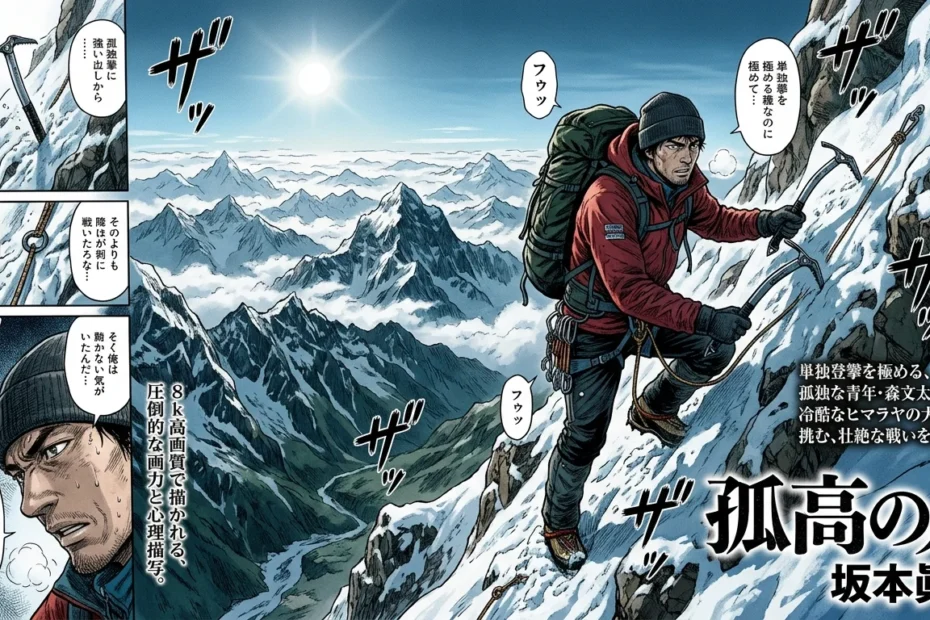
The climber manga is not a story about finding friends. It is a raw journey into obsession, isolation, and the heavy price of ambition. This article explores why this masterpiece changes how you see passion and purpose.
Table: Everything You Need to Know About The Climber Manga
| Aspect | Details |
|---|---|
| Japanese Title | Kokou no Hito (孤高の人) |
| English Title | The Climber |
| Genre | Seinen, Psychological Drama, Sports |
| Original Run | November 2007 – October 2011 |
| Volumes | 17 |
| Author (Story) | Shin-ichi Sakamoto, Yoshio Nabeta (vol. 1-2), Hiroshi Takano (vol. 2-4) |
| Illustrator | Shin-ichi Sakamoto |
| Publisher (JP) | Shueisha |
| English Publisher | VIZ Media |
| Magazine | Weekly Young Jump |
| Real-Life Basis | Partially inspired by climber Buntarō Katō |
| Awards | Excellence Prize, 14th Japan Media Arts Festival (2010) |
A Teenager’s First Taste of the Vertical World
The climber manga begins with a transfer student named Mori Buntarou. He is quiet, gloomy, and completely disconnected from his peers. When a classmate dares him to climb the school building, Mori accepts the challenge. He reaches the roof and feels something new. The cold wind and the height give him a sense of freedom he has never known. This single act of defiance changes everything for him. Climbing becomes the only thing that makes sense in a world that has always felt wrong.
Who Is the Real Person Behind the Story?
Mori Buntarou’s character draws from a real figure. He is partially based on the life of Japanese climber Buntarō Katō. Katō was known for his intense solo ascents and his tragic death on the South Face of Gasherbrum I in 1969. The manga takes this real-life skeleton and builds a fictional body around it. The climber manga uses reality as a foundation but adds layers of psychological depth. This blend of truth and imagination makes every page feel more authentic and grounded.
The Changing Voices of the Series
The climber manga has a unique writing history. Yoshio Nabeta handled the story for the first two volumes. Hiroshi Takano then took over for the next two volumes. For the final stretch, Shin-ichi Sakamoto controlled both the story and the art by himself. This shift in authors explains the tonal changes you see in the series. The early volumes feel more like a traditional sports manga. The later chapters turn into a dark, psychological spiral. Sakamoto’s solo run is where the story truly finds its voice.
The Art That Speaks Louder Than Words
Shin-ichi Sakamoto’s artwork is the heart of the climber manga. The man did not just draw a manga, he built an experience. One page will show Mori’s hand gripping a tiny crack in a rock face. The next page will stretch across two panels to show the terrifying depth of a mountain valley. Sakamoto uses faces with extreme detail to show fear, exhaustion, and pure ecstasy. This is not flashy art. It is intimate and raw. The lack of text in many scenes forces you to feel the story through shadows, sweat, and silent screams.
Why Mori Buntarou Breaks the Hero Mold
Mori is not a hero you cheer for. He is a broken person you cannot stop watching. He does not speak much. He does not make friends easily. Other characters try to get close, but Mori pushes them away or sees them leave. His only true relationship is with the mountain. The climber manga does not give you a redemption arc. It gives you a man who chooses pain over peace. You might not like him, but you will definitely understand him.
The Cost of Going All In
This manga shows the dark side of obsession very clearly. Mori gives up everything for his climbs. He loses friends, ignores his health, and says goodbye to a normal life. The story does not glorify this sacrifice. It shows him alone, cold, and sometimes broken. The climber manga asks a hard question. Is a life without balance a life worth living? Mori’s answer is yes, but the reader has to decide for themselves.
Loneliness as a Superpower and a Curse
Being alone is a double-edged sword in this story. On the mountain, Mori’s solitude gives him an advantage. He has no distractions. He trusts only himself. But off the mountain, that same loneliness hurts him. He cannot connect to people. He feels invisible in a crowd. The climber manga explores this contradiction perfectly. Mori is powerful on the rock but powerless in the classroom.
How the Climber Compares to Vagabond and Punpun
Fans often compare the climber manga to other psychological masterpieces. Vagabond shares the same focus on a lone warrior finding his path. Oyasumi Punpun has the same heavy feeling of depression and isolation. Both of these titles push the boundaries of the manga medium. The Climber sits right beside them. If you enjoyed the quiet intensity of Vagabond or the crushing reality of Punpun, you will love this climb.
The Non-Linear Storytelling Trick
The author plays with time in a clever way. He often shows you a scene from the future. Then he goes back to explain how Mori arrived at that point. This non-linear style keeps you engaged. You want to know what event broke Mori so badly. However, some readers find it a little tedious. You might guess what happens next before the manga reveals it. Still, the technique adds a unique flavor to the narrative.
A Glimpse Into 1970s Japan
The climber manga is set in post-boom Japan. The country was rich, but the people were struggling with social pressure and isolation. Mori’s silent suffering reflects a generation of people who felt trapped by society’s rules. The manga does not preach about politics. It just shows a world where a boy would rather risk death on a mountain than face the emptiness of a crowded school hallway. This hidden commentary adds a layer of depth for history fans.
Sports Manga Without the Cheering Crowds
Most sports manga are loud. They have cheering crowds, training montages, and final showdowns. The climber manga has none of that. There are no tournaments here. When Mori climbs, it is usually just him against the rock. This is a sports story about silence. The only opponent is gravity. The only scorecard is survival. This fresh take is why many readers call it the best sports manga they have ever read.
The Uncomfortable Truth About Failure
In other stories, failure is a lesson. The hero falls down, learns something, and wins the next fight. Not here. In the climber manga, failure is a scar. Mori fails often. He falls, he gets hurt, and sometimes he just lies there in the snow. The manga does not rush past the pain. It makes you sit with it. This is realistic. In real life, failure does not always make you stronger. Sometimes it just makes you tired.
The Legacy and the 2025 English Release
For years, English readers had to read fan translations. An official English version did not exist. That changed recently. VIZ Media finally licensed the series for an English release. The first volume hit shelves on April 15, 2025. This is huge news for the manga community. New readers can finally buy the physical books. The legacy of the climber manga is now secure in the West. If you have been waiting for this day, your wait is over.
Why This Manga Won an Excellence Award
In 2010, the climber manga won an Excellence Prize at the Japan Media Arts Festival. It shared that spotlight with other major titles. This award is not given lightly. It recognizes art that pushes the boundaries of expression. Sakamoto’s work won because it treats manga as a serious art form. The jagged lines, the silent panels, and the heavy themes all contribute to a work that feels important.
Should You Read the Climber Manga?
You should read this if you are tired of happy endings. Read it if you want to see what true dedication looks like. The climber manga is not for someone looking for light entertainment. It is for the reader who wants to stare into the void and see a person staring back. If you like deep character studies and breathtaking art, you will find a new favorite here. Be warned, it will make you think hard about your own obsessions.
Frequently Asked Questions
Q1: Is The Climber based on a true story?
The story is partially inspired by real-life climber Buntarō Katō. Katō was a famous Japanese solo climber who died in the mountains. The manga uses his life as a framework but adds fictional characters and events. You will see the real struggle of mountaineering mixed with creative storytelling.
Q2: Does the main character die at the end?
The climber manga does not give you a clear yes or no. The ending is open to interpretation. It focuses more on the journey than the final destination. Readers have different opinions, but the manga avoids a standard Hollywood resolution.
Q3: Why did the art style change?
Shin-ichi Sakamoto grew as an artist during the run of the manga. The early volumes look more like a standard manga. The later volumes show his unique style, with more realistic faces and detailed backgrounds. This change reflects his confidence and his decision to take full control of the story.
Q4: Is there any nudity in the manga?
Yes, there are a few scenes with nudity. Some readers feel these scenes are artistic and meaningful. Others think the nudity feels forced and out of place. It is not a major part of the story, but it is present in a few panels.
Q5: How many volumes are there?
There are 17 volumes in total. They originally ran from 2007 to 2011. VIZ Media is currently releasing the official English versions. It will take some time for all 17 books to be available in English.
Q6: Where can I buy the official English version?
You can buy the official English translation from major bookstores or online retailers. VIZ Media publishes the series. Look for the VIZ Signature edition. The first volume was released in April 2025.
Your Next Step into the Silence
The climber manga is a rare gem. It does not scream for your attention. It waits for you in the quiet. Mori Buntarou’s journey is cold, hard, and beautiful. If you are ready to leave behind the noise of normal manga, pick up this series. Feel the wind on your face. Grip the rock with your fingers. See how high one man can climb when he has nothing left to lose. Order your copy today and start the ascent.